Department of Child Health, University of Ghana Medical School, P O Box 4236, Accra, Ghana.
BMC Infect Dis. 2014 Aug 6;14:431. doi: 10.1186/1471-2334-14-431.
Almost all diarrhea deaths in young children occur in developing countries. Immunization against rotavirus, the leading cause of childhood severe dehydrating acute diarrhea may reduce the burden of severe diarrhea in developing countries. Ghana introduced rotavirus and pneumococcal vaccination in the national expanded program on immunization in May 2012.
Review of all-cause diarrheal hospitalization data for children aged 59 months and younger at 2 pediatric referral hospitals in southern Ghana from 2008 to 2014. The proportion of acute diarrhea (defined as 3 or more watery, non-bloody stools within 24 hours that has lasted for less than 7 days) cases caused by rotavirus was determined. Temporal trend and age group distribution of all-cause diarrhea and rotavirus gastroenteritis before and after introduction of the new vaccines were compared.
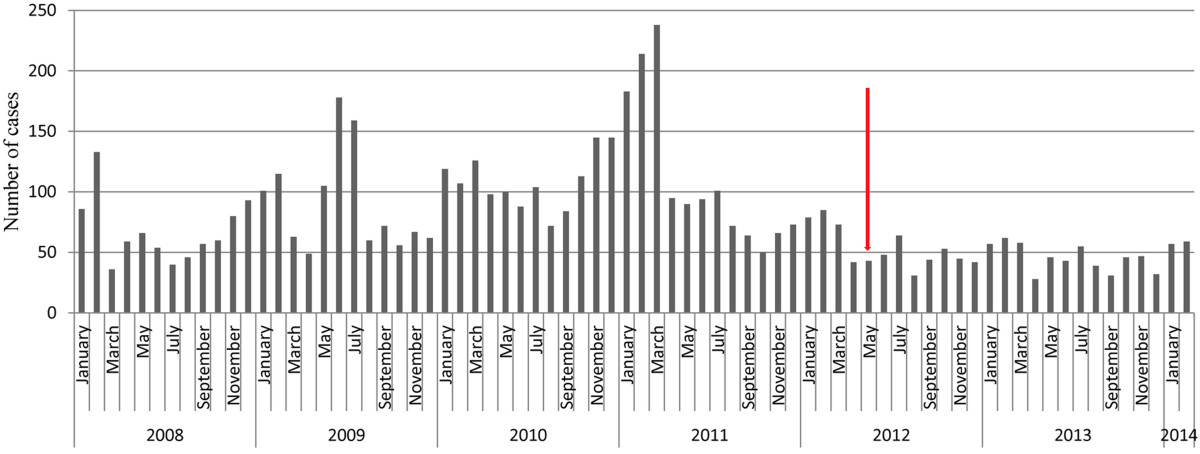
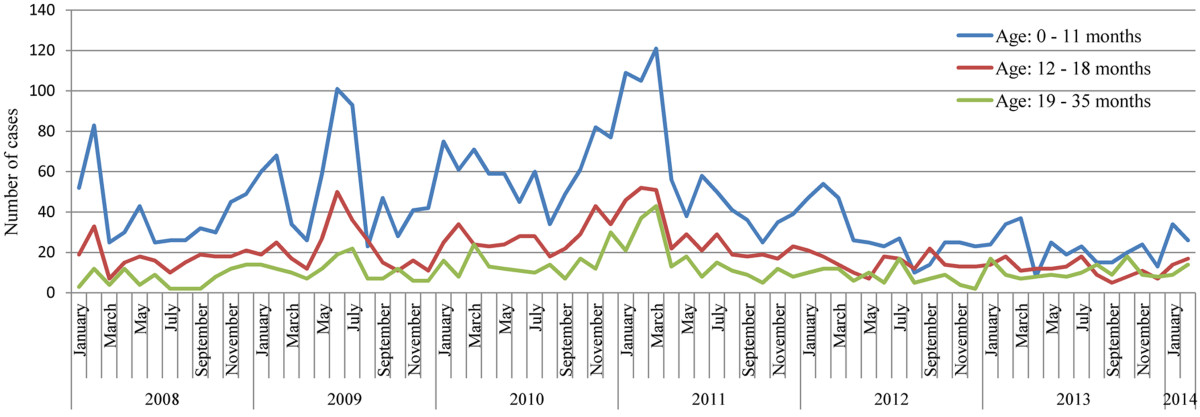
Of the 5847 children hospitalized with all-cause diarrhea during the 74 months (January 2008 - February 2014), 3963 (67.8%) children were recruited for rotavirus surveillance and stool specimens were tested for rotavirus in 3160/3963 (79.7%). Median monthly hospitalization for all-cause diarrhea reduced from 84 [interquartile range (IQR) 62 - 105] during the 52 months pre-vaccination introduction to 46 (IQR 42 - 57) in the 22 months after implementation of vaccination. Significant decline in all-cause diarrhea hospitalization occurred in children aged 0 - 11 months: 56.3% (2711/4817) vs. 47.2% 486/1030 [p = 0.0001, 95% confidence interval (CI) 0.77 - 0.88] and there was significant reduction of rotavirus gastroenteritis hospitalization: 49.7% (1246/2505) vs. 27.8% (182/655) [p = 0.0001, 95% CI 0.32 - 0.47] before and after vaccine introduction respectively.
Implementation of rotavirus vaccination program may have resulted in significant reduction of severe diarrhea hospitalization even though this observational study could not exclude the effect of other confounding factors. Continued surveillance is recommended to monitor the progress of this program.
发展中国家几乎所有儿童腹泻死亡都发生在幼儿期。针对轮状病毒的免疫接种是导致儿童严重腹泻的主要原因,接种疫苗可能会降低发展中国家严重腹泻的负担。加纳于 2012 年 5 月在国家扩大免疫规划中引入轮状病毒和肺炎球菌疫苗。
对加纳南部 2 家儿科转诊医院 59 个月以下儿童的所有病因腹泻住院数据进行回顾性分析,时间为 2008 年至 2014 年。确定急性腹泻(定义为 24 小时内出现 3 次或 3 次以上水样、非血性腹泻,持续时间不到 7 天)病例中轮状病毒的比例。比较新疫苗引入前后所有病因腹泻和轮状病毒胃肠炎的时间趋势和年龄组分布。
在 74 个月(2008 年 1 月至 2014 年 2 月)期间,共有 5847 名儿童因所有病因腹泻住院,其中 3963 名(67.8%)儿童接受了轮状病毒监测,3160/3963 名(79.7%)儿童的粪便标本进行了轮状病毒检测。在疫苗接种前的 52 个月中,每月因所有病因腹泻住院的中位数为 84[四分位距(IQR)62-105],而在疫苗接种后的 22 个月中为 46(IQR 42-57)。0-11 个月儿童所有病因腹泻住院显著下降:56.3%(2711/4817)vs.47.2%(486/1030)[p=0.0001,95%置信区间(CI)0.77-0.88],轮状病毒胃肠炎住院显著下降:49.7%(1246/2505)vs.27.8%(182/655)[p=0.0001,95%CI 0.32-0.47]。
尽管这项观察性研究不能排除其他混杂因素的影响,但实施轮状病毒疫苗接种计划可能导致严重腹泻住院的显著减少。建议继续监测该计划的进展情况。