Price Alison J, Travis Ruth C, Appleby Paul N, Albanes Demetrius, Barricarte Gurrea Aurelio, Bjørge Tone, Bueno-de-Mesquita H Bas, Chen Chu, Donovan Jenny, Gislefoss Randi, Goodman Gary, Gunter Marc, Hamdy Freddie C, Johansson Mattias, King Irena B, Kühn Tilman, Männistö Satu, Martin Richard M, Meyer Klaus, Neal David E, Neuhouser Marian L, Nygård Ottar, Stattin Par, Tell Grethe S, Trichopoulou Antonia, Tumino Rosario, Ueland Per Magne, Ulvik Arve, de Vogel Stefan, Vollset Stein Emil, Weinstein Stephanie J, Key Timothy J, Allen Naomi E
Cancer Epidemiology Unit, Nuffield Department of Population Health, University of Oxford, Oxford, OX3 7LF, UK; London School of Hygiene and Tropical Medicine, London, UK.
Cancer Epidemiology Unit, Nuffield Department of Population Health, University of Oxford, Oxford, OX3 7LF, UK.
Eur Urol. 2016 Dec;70(6):941-951. doi: 10.1016/j.eururo.2016.03.029. Epub 2016 Apr 6.
Folate and vitamin B are essential for maintaining DNA integrity and may influence prostate cancer (PCa) risk, but the association with clinically relevant, advanced stage, and high-grade disease is unclear.
To investigate the associations between circulating folate and vitamin B concentrations and risk of PCa overall and by disease stage and grade.
DESIGN, SETTING, AND PARTICIPANTS: A study was performed with a nested case-control design based on individual participant data from six cohort studies including 6875 cases and 8104 controls; blood collection from 1981 to 2008, and an average follow-up of 8.9 yr (standard deviation 7.3). Odds ratios (ORs) of incident PCa by study-specific fifths of circulating folate and vitamin B were calculated using multivariable adjusted conditional logistic regression.
Incident PCa and subtype by stage and grade.
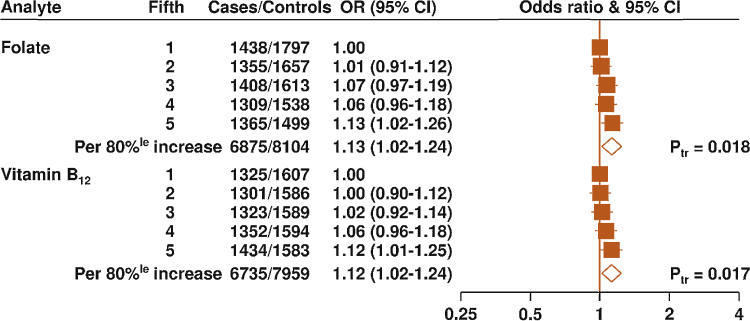
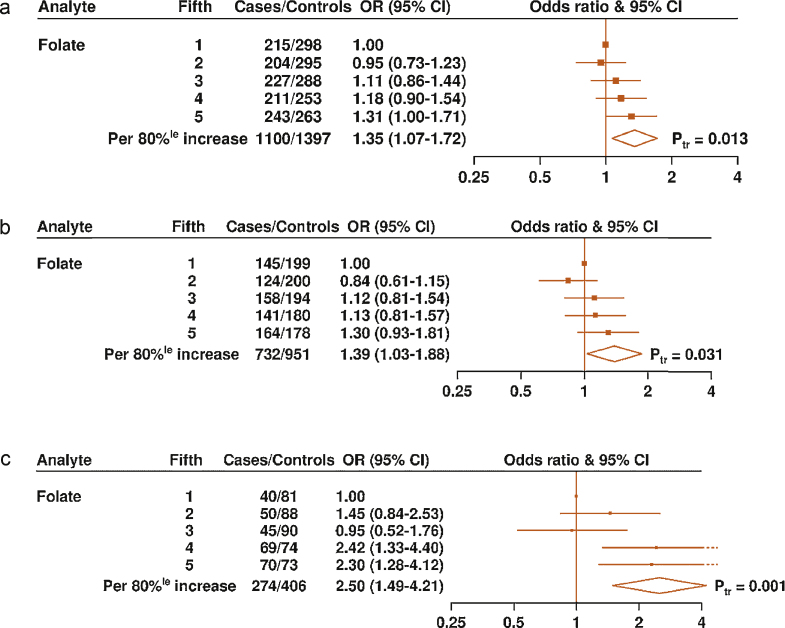
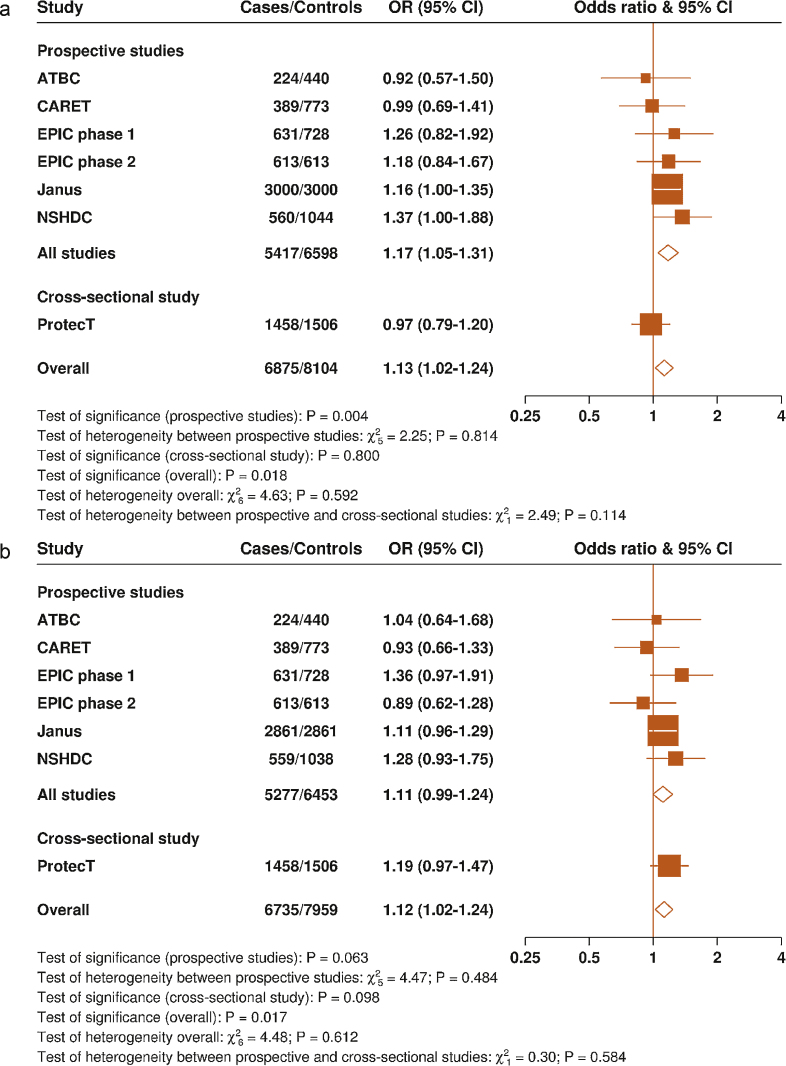
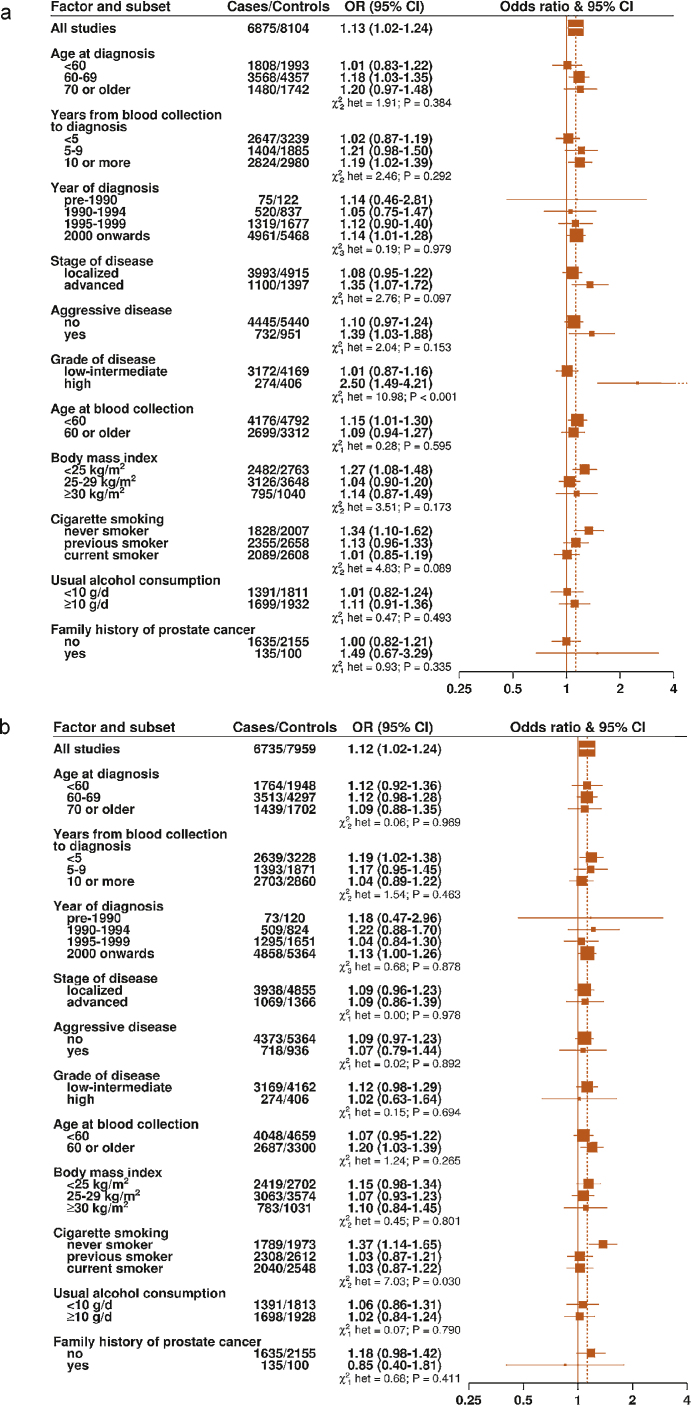
Higher folate and vitamin B concentrations were associated with a small increase in risk of PCa (ORs for the top vs bottom fifths were 1.13 [95% confidence interval (CI), 1.02-1.26], p=0.018, for folate and 1.12 [95% CI, 1.01-1.25], p=0.017, for vitamin B), with no evidence of heterogeneity between studies. The association with folate varied by tumour grade (p<0.001); higher folate concentration was associated with an elevated risk of high-grade disease (OR for the top vs bottom fifth: 2.30 [95% CI, 1.28-4.12]; p=0.001), with no association for low-grade disease. There was no evidence of heterogeneity in the association of folate with risk by stage or of vitamin B with risk by stage or grade of disease (p>0.05). Use of single blood-sample measurements of folate and B concentrations is a limitation.
The association between higher folate concentration and risk of high-grade disease, not evident for low-grade disease, suggests a possible role for folate in the progression of clinically relevant PCa and warrants further investigation.
Folate, a vitamin obtained from foods and supplements, is important for maintaining cell health. In this study, however, men with higher blood folate levels were at greater risk of high-grade (more aggressive) prostate cancer compared with men with lower folate levels. Further research is needed to investigate the possible role of folate in the progression of this disease.
叶酸和维生素B对于维持DNA完整性至关重要,可能会影响前列腺癌(PCa)风险,但与临床相关、晚期和高级别疾病的关联尚不清楚。
研究循环中叶酸和维生素B浓度与总体PCa风险以及疾病分期和分级之间的关联。
设计、设置和参与者:基于六项队列研究的个体参与者数据进行了一项巢式病例对照研究,包括6875例病例和8104例对照;1981年至2008年采集血液,平均随访8.9年(标准差7.3)。使用多变量调整的条件逻辑回归计算按循环叶酸和维生素B的特定研究五分位数划分的PCa发病比值比(OR)。
按分期和分级划分的PCa发病情况及亚型。
较高的叶酸和维生素B浓度与PCa风险的小幅增加相关(叶酸最高五分位数与最低五分位数的OR为1.13 [95%置信区间(CI),1.02 - 1.26],p = 0.018;维生素B为1.12 [95% CI,1.01 - 1.25],p = 0.017),各研究间无异质性证据。叶酸与风险的关联因肿瘤分级而异(p < 0.001);较高的叶酸浓度与高级别疾病风险升高相关(最高五分位数与最低五分位数的OR:2.30 [95% CI,1.28 - 4.12];p = 0.001),与低级别疾病无关联。叶酸与分期风险的关联以及维生素B与疾病分期或分级风险的关联均无异质性证据(p > 0.05)。使用单一血样测量叶酸和B浓度是一个局限性。
较高的叶酸浓度与高级别疾病风险之间的关联在低级别疾病中不明显,这表明叶酸在临床相关PCa进展中可能起作用,值得进一步研究。
叶酸是一种从食物和补充剂中获取的维生素,对维持细胞健康很重要。然而,在本研究中,与叶酸水平较低的男性相比,血液叶酸水平较高的男性患高级别(侵袭性更强)前列腺癌的风险更大。需要进一步研究来调查叶酸在这种疾病进展中的可能作用。