Koren Michael A, Arnold John C, Fairchok Mary P, Lalani Tahaniyat, Danaher Patrick J, Schofield Christina M, Rajnik Michael, Hansen Erin A, Mor Deepika, Chen Wei-Ju, Ridoré Michelande, Burgess Timothy H, Millar Eugene V
Walter Reed National Military Medical Center, Washington, DC, USA.
Naval Medical Center, San Diego, CA, USA.
Influenza Other Respir Viruses. 2016 Sep;10(5):414-20. doi: 10.1111/irv.12392. Epub 2016 May 13.
Adenovirus is a recognized cause of influenza-like illness (ILI). The proportion of ILI attributable to adenovirus is not known. Moreover, knowledge gaps remain with respect to the epidemiologic, virologic, and clinical characteristics of adenovirus-associated ILI among otherwise healthy individuals.
An observational, longitudinal study of <65-year-old patients with febrile ILI at five medical centers was conducted from 2009 to 2014. Nasopharyngeal specimens obtained at enrollment were first tested by single-reaction PCR for adenovirus, then further evaluated by a multiplex PCR assay for other respiratory viral pathogens. Symptoms over a 28-day period were collected.
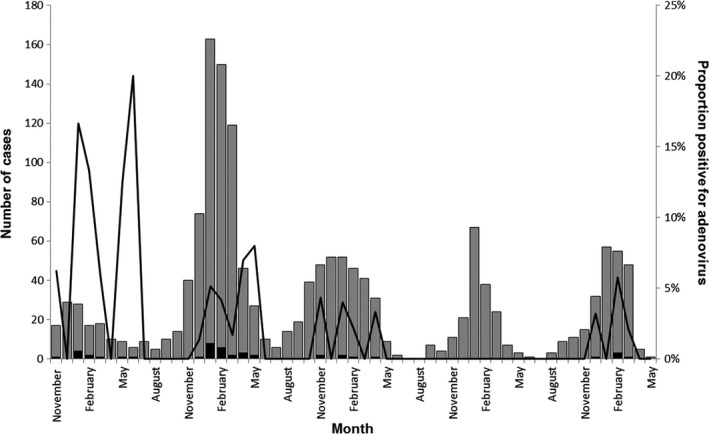
We enrolled 1536 individuals, among whom 43 (2·8%) were positive for adenovirus. The median age of cases was 3·4 years (range: 4 months to 41 years). Three were hospitalized. Species and serotype information was available for 33 (76·7%) cases. Species C (n = 21) was the most common, followed by B3 (n = 9) and one each of E4a, D46, and A. Species C infections were more frequent in children (P < 0·01). Half of the cases were positive for at least one other respiratory viral pathogen. Symptoms were generally mild and most commonly included cough (90%), fatigue (79%), rhinorrhea (74%), loss of appetite (71%), and sore throat (64%). Children with non-C adenovirus infection were more likely to report sore throat (P = 0·05) and hoarseness (P = 0·06) than those with species C infection.
Adenovirus is frequently detected with other respiratory viruses. Persons with non-C adenovirus infections reported more severe symptoms, suggesting there may be species-specific differences in virulence and/or host response to infection.
腺病毒是公认的引起流感样疾病(ILI)的病因。由腺病毒引起的ILI所占比例尚不清楚。此外,在健康个体中,关于腺病毒相关ILI的流行病学、病毒学和临床特征方面仍存在知识空白。
2009年至2014年在五个医疗中心对年龄<65岁的发热ILI患者进行了一项观察性纵向研究。入组时采集的鼻咽标本首先通过单反应PCR检测腺病毒,然后通过多重PCR检测其他呼吸道病毒病原体进行进一步评估。收集28天内的症状。
我们纳入了1536人,其中43人(2.8%)腺病毒检测呈阳性。病例的中位年龄为3.4岁(范围:4个月至41岁)。3人住院。33例(76.7%)可获得种属和血清型信息。C种(n = 21)最常见,其次是B3种(n = 9),E4a、D46和A种各1例。C种感染在儿童中更常见(P < 0.01)。一半的病例至少对一种其他呼吸道病毒病原体检测呈阳性。症状一般较轻,最常见的包括咳嗽(90%)、疲劳(79%)、流涕(74%)、食欲不振(71%)和咽痛(64%)。非C种腺病毒感染的儿童比C种感染的儿童更有可能报告咽痛(P = 0.05)和声音嘶哑(P = 0.06)。
腺病毒常与其他呼吸道病毒一起被检测到。非C种腺病毒感染的人报告的症状更严重,这表明在毒力和/或宿主对感染的反应方面可能存在种属特异性差异。