Butler Andrew C, Rice Heather J, Wooldridge Cynthia L, Rubin David C
University of Texas at Austin, United States.
Washington University in St. Louis, United States.
Conscious Cogn. 2016 May;42:237-253. doi: 10.1016/j.concog.2016.03.018. Epub 2016 Apr 8.
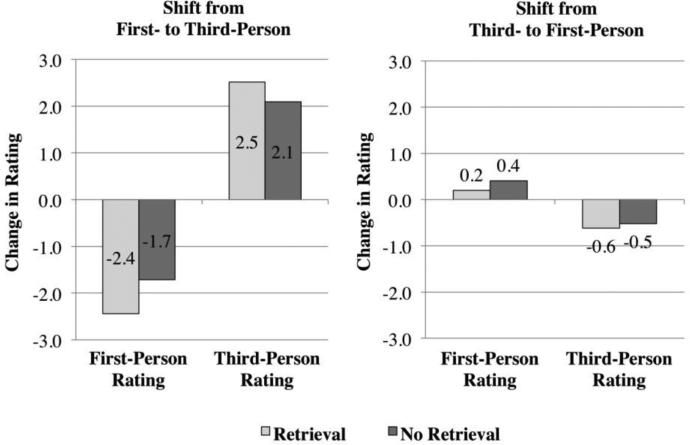
Recent memories are generally recalled from a first-person perspective whereas older memories are often recalled from a third-person perspective. We investigated how repeated retrieval affects the availability of visual information, and whether it could explain the observed shift in perspective with time. In Experiment 1, participants performed mini-events and nominated memories of recent autobiographical events in response to cue words. Next, they described their memory for each event and rated its phenomenological characteristics. Over the following three weeks, they repeatedly retrieved half of the mini-event and cue-word memories. No instructions were given about how to retrieve the memories. In Experiment 2, participants were asked to adopt either a first- or third-person perspective during retrieval. One month later, participants retrieved all of the memories and again provided phenomenology ratings. When first-person visual details from the event were repeatedly retrieved, this information was retained better and the shift in perspective was slowed.
近期记忆通常从第一人称视角被回忆起来,而较早的记忆则常常从第三人称视角被回忆起来。我们研究了重复提取如何影响视觉信息的可用性,以及它是否能解释随着时间推移所观察到的视角转变。在实验1中,参与者执行微型事件,并根据提示词提名近期自传体事件的记忆。接下来,他们描述对每个事件的记忆,并对其现象学特征进行评分。在接下来的三周里,他们反复提取一半的微型事件和提示词记忆。对于如何提取记忆未给出任何指示。在实验2中,要求参与者在提取过程中采用第一人称或第三人称视角。一个月后,参与者提取所有记忆,并再次提供现象学评分。当来自事件的第一人称视觉细节被反复提取时,这些信息被更好地保留下来,视角转变也减缓了。