Davidson Jennifer, Smetham Gabriel, Russ Michelle H, McMurray Larn, Rodda Matthew, Krysinska-Kaczmarek Marzena, Ford Rebecca
Pulse and Oilseed Pathology, Plant Health and Biosecurity, Sustainable Systems, South Australian Research and Development Institute Adelaide, SA, Australia.
Faculty of Veterinary and Agricultural Sciences, University of Melbourne Parkville, VIC, Australia.
Front Plant Sci. 2016 Mar 31;7:393. doi: 10.3389/fpls.2016.00393. eCollection 2016.
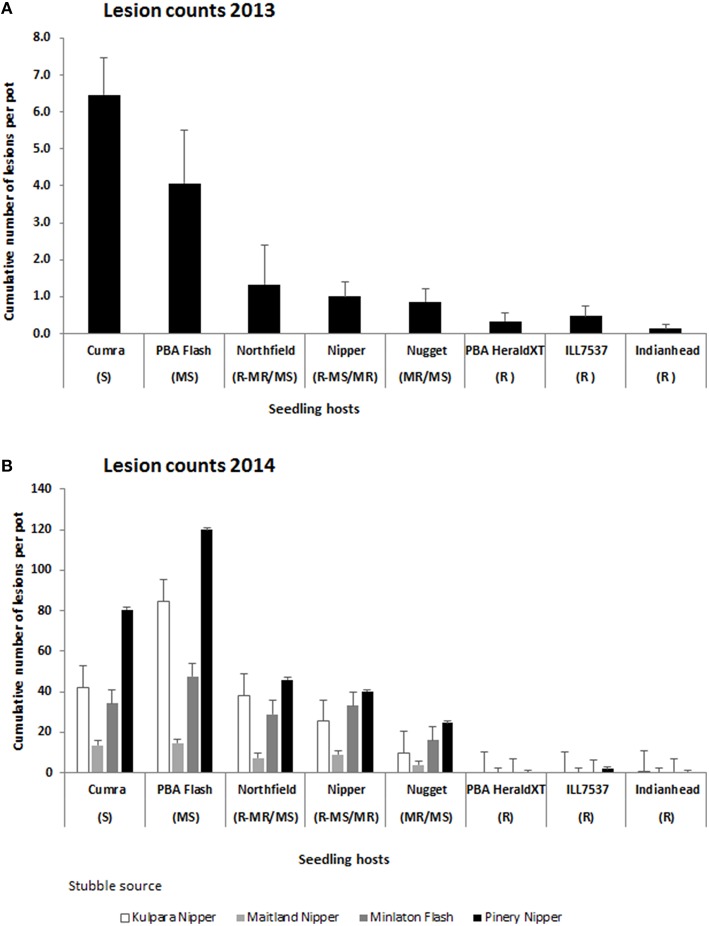
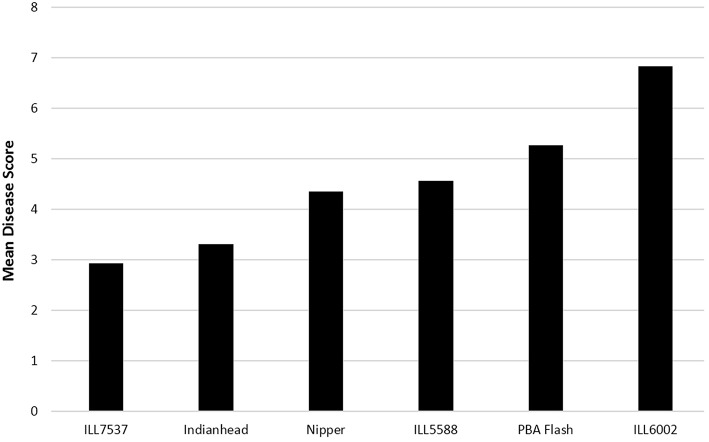
Anecdotal evidence identified a change in the reaction of the resistant lentil cv Nipper to ascochyta blight in South Australia in 2010 and subsequent seasons, leading to infection. This study investigated field reactions of lentil cultivars against Ascochyta lentis and the pathogenic variability of the A. lentis population in southern Australia on commonly grown cultivars and on parental germplasm used in the Australian lentil breeding program. Disease data recorded in agronomic and plant breeder field trials from 2005 to 2014 in southern Australia confirmed the change in reaction on the foliage of the previously resistant cvs Nipper and Northfield. Cultivar responses to seed staining from A. lentis did not change. The change in foliar response was confirmed in a series of controlled environment experiments using single, conidium-derived, isolates of A. lentis collected over different years and inoculated onto differential host sets. Specific isolate/cultivar interactions produced a significant range of disease reactions from high to low aggressiveness with a greater percentage of isolates more aggressive on cvs Nipper, Northfield and PBA Flash than previously detected. Specific isolates were tested against Australian lentil cultivars and breeding lines in controlled conditions, again verifying the aggressiveness on cv Nipper. A small percentage of isolates collected prior to the commercial release of cv Nipper were also able to infect this cultivar indicating a natural variability of the A. lentis population which subsequently may have been selected in response to high cropping intensity of cv Nipper. Spore release studies from naturally infested lentil stubbles collected from commercial crops also resulted in a high percentage of infection on the previously resistant cvs Nipper and Northfield. Less than 10% of the lesions developed on the resistant differentials ILL7537 and cv Indianhead. Pathogenic variation within the seasonal populations was not affected by the cultivar from which the stubble was sourced, further indicating a natural variability in aggressiveness. The impact of dominant cultivars in cropping systems and loss of effective disease resistance is discussed. Future studies are needed to determine if levels of aggressiveness among A. lentis isolates are increasing against a range of elite cultivars.
轶事证据表明,2010年及随后几个季节,南澳大利亚抗性扁豆品种Nipper对炭疽病的反应发生了变化,导致感染。本研究调查了扁豆品种对扁豆炭疽菌的田间反应,以及澳大利亚南部扁豆炭疽菌种群在常见种植品种和澳大利亚扁豆育种计划中使用的亲本种质上的致病变异性。2005年至2014年在澳大利亚南部的农艺和植物育种田间试验中记录的病害数据证实,之前抗性品种Nipper和Northfield的叶片反应发生了变化。品种对扁豆炭疽菌种子染色的反应没有改变。在一系列受控环境实验中证实了叶片反应的变化,这些实验使用了在不同年份收集的单株、分生孢子衍生的扁豆炭疽菌分离株,并接种到鉴别寄主组上。特定分离株/品种相互作用产生了从高到低侵袭性的显著病害反应范围,与之前检测到的相比,更多比例的分离株对品种Nipper、Northfield和PBA Flash更具侵袭性。在受控条件下,对特定分离株进行了针对澳大利亚扁豆品种和育种系的测试,再次验证了对品种Nipper的侵袭性。在品种Nipper商业发布之前收集的一小部分分离株也能够感染该品种,这表明扁豆炭疽菌种群存在自然变异性,随后可能因品种Nipper的高种植强度而被选择。从商业作物中收集的自然感染扁豆茬的孢子释放研究也导致之前抗性品种Nipper和Northfield的高感染率。在抗性鉴别品种ILL7537和品种Indianhead上形成的病斑不到10%。季节种群内的致病变异不受茬口来源品种的影响,进一步表明侵袭性存在自然变异性。讨论了种植系统中优势品种的影响和有效抗病性的丧失。需要进一步研究以确定扁豆炭疽菌分离株对一系列优良品种的侵袭性水平是否在增加。