Rapo-Pylkkö Susanna, Haanpää Maija, Liira Helena
a Kirkkonummi Health Center , Kirkkonummi , Finland ;
b Department of General Practice , Unit of Primary Health Care, Helsinki University Central Hospital, University of Helsinki , Helsinki , Finland ;
Scand J Prim Health Care. 2016 Jun;34(2):159-64. doi: 10.3109/02813432.2016.1160628. Epub 2016 Apr 11.
To present the occurrence, characteristics, etiology, interference, and medication of chronic pain among the elderly living independently at home.
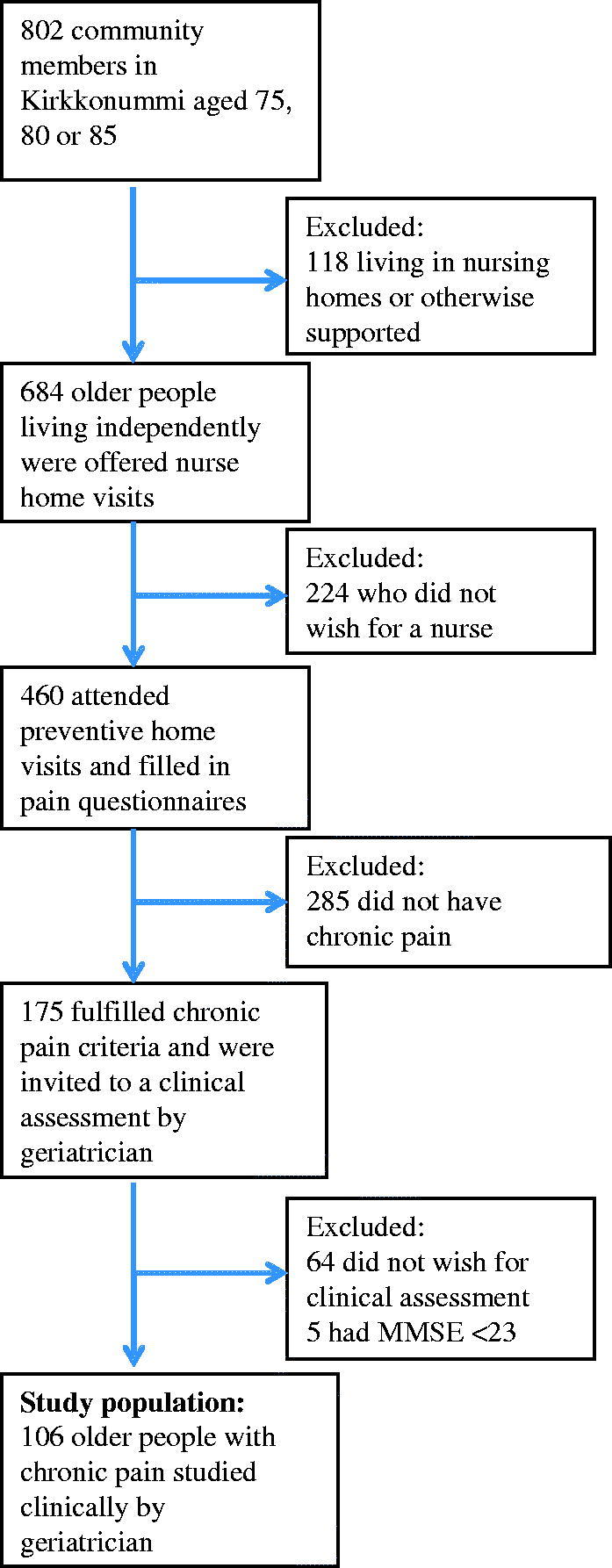
DESIGN/SETTING: A total of 460 subjects in three cohorts aged 75, 80 and 85 years respectively received visits by communal home-care department nurses for a cross-sectional survey. Of them, 175 had chronic (duration ≥ 3 months) pain with an average intensity of ≥ 4/10 and/or ≥ moderate interference in daily life.
Clinical assessment was performed for consenting subjects to define the location, intensity, etiology, type, interference and medications of chronic pain.
According to home visits, elderly people with chronic pain rated their health and mobility worse and felt sadder, lonelier and more tired than those without chronic pain. A geriatrician made clinical assessments for 106 patients with chronic pain in 2009-2013. Of them, 66 had three, 35 had two and 5 had one pain condition. The worst pain was musculoskeletal in 88 (83%) of patients. Pain was pure nociceptive in 61 (58%), pure neuropathic in 9 (8%), combined nociceptive and neuropathic pain in 34 (32%), and idiopathic in 2 (2%) patients. On a numerical rating scale from 0 to 10, the mean and maximal intensity of the worst pain was 5.7 and 7.7, respectively, while the mean pain interference was 5.9. Mean pain intensity and maximal pain intensity decreased by age. Duration of pain was longer than 5 years in 51 (48%) patients. Regular pain medication was used by 82 (77%) patients, most commonly paracetamol or NSAIDs. Although pain limited the lives of the elderly with chronic pain, they were as satisfied with their lives as those without chronic pain.
Elderly people in our study often suffered from chronic pain, mostly musculoskeletal pain, and the origin of pain was neuropathic in up to 40% of these cases. However, elderly people with chronic pain rarely used the medications specifically for neuropathic pain. Based on increased loneliness, sadness and tiredness, as well as decreased subjective health and mobility, the quality of life was decreased among those with chronic pain compared with those without pain. KEY POINTS It is known that chronic pain is one of the most common reasons for general practice consultations and is more common in women than men. In our study using detailed clinical examinations, up to 40% of patients with chronic pain in cohorts aged 75, 80 and 85 years suffered from neuropathic pain. However, only a few elderly people with chronic pain used medications specifically for chronic pain, which may be due to side effects or non-willingness to experiment with these drugs. Elderly people with chronic pain rated their health and mobility to be worse and felt sadder, lonelier and more tired but were not less satisfied with their lives than those without chronic pain.
阐述居家独立生活老年人慢性疼痛的发生情况、特点、病因、干扰因素及用药情况。
设计/背景:三个队列中分别为75岁、80岁和85岁的共460名受试者接受了社区家庭护理部门护士的上门访视,以进行横断面调查。其中,175人患有慢性(持续时间≥3个月)疼痛,平均强度≥4/10且/或对日常生活有≥中度干扰。
对同意参与的受试者进行临床评估,以确定慢性疼痛的部位、强度、病因、类型、干扰因素及用药情况。
根据上门访视,患有慢性疼痛的老年人对自身健康和活动能力的评分低于无慢性疼痛者,且感觉更悲伤、更孤独、更疲惫。2009年至2013年,一名老年病医生对106例慢性疼痛患者进行了临床评估。其中,66人有一种以上疼痛状况,35人有两种,5人有一种。88例(83%)患者最严重的疼痛为肌肉骨骼疼痛。61例(58%)疼痛为单纯伤害性疼痛,9例(8%)为单纯神经病理性疼痛,34例(32%)为伤害性和神经病理性混合性疼痛,2例(2%)为特发性疼痛。在0至10的数字评分量表上,最严重疼痛的平均强度和最大强度分别为5.7和7.7,而平均疼痛干扰为5.9。平均疼痛强度和最大疼痛强度随年龄增长而降低。51例(48%)患者疼痛持续时间超过5年。82例(77%)患者使用常规止痛药物,最常用的是对乙酰氨基酚或非甾体抗炎药。尽管疼痛限制了慢性疼痛老年人的生活,但他们对生活的满意度与无慢性疼痛者相同。
我们研究中的老年人常患有慢性疼痛,主要为肌肉骨骼疼痛,其中高达40%的病例疼痛起源于神经病理性疼痛。然而,患有慢性疼痛的老年人很少使用专门用于神经病理性疼痛的药物。基于孤独感、悲伤感和疲惫感增加,以及主观健康和活动能力下降,与无疼痛者相比,慢性疼痛患者的生活质量降低。要点 已知慢性疼痛是全科诊疗中最常见的原因之一,且在女性中比男性更常见。在我们使用详细临床检查的研究中,75岁、80岁和85岁队列中高达40%的慢性疼痛患者患有神经病理性疼痛。然而,只有少数慢性疼痛老年人使用专门用于慢性疼痛的药物,这可能是由于副作用或不愿试用这些药物。患有慢性疼痛的老年人对自身健康和活动能力的评分较低,感觉更悲伤、更孤独、更疲惫,但他们对生活的满意度并不低于无慢性疼痛者。
