Zhang Wen-Hui, Lin Xiang-Yan, Xu Liang, Gu Xi-Xi, Yang Ling, Li Wan, Ren Si-Qi, Liu Ya-Hong, Zeng Zhen-Ling, Jiang Hong-Xia
National Risk Assessment Laboratory for Antimicrobial Resistance of Animal Original Bacteria, College of Veterinary Medicine, South China Agricultural University Guangzhou, China.
Front Microbiol. 2016 Mar 31;7:436. doi: 10.3389/fmicb.2016.00436. eCollection 2016.
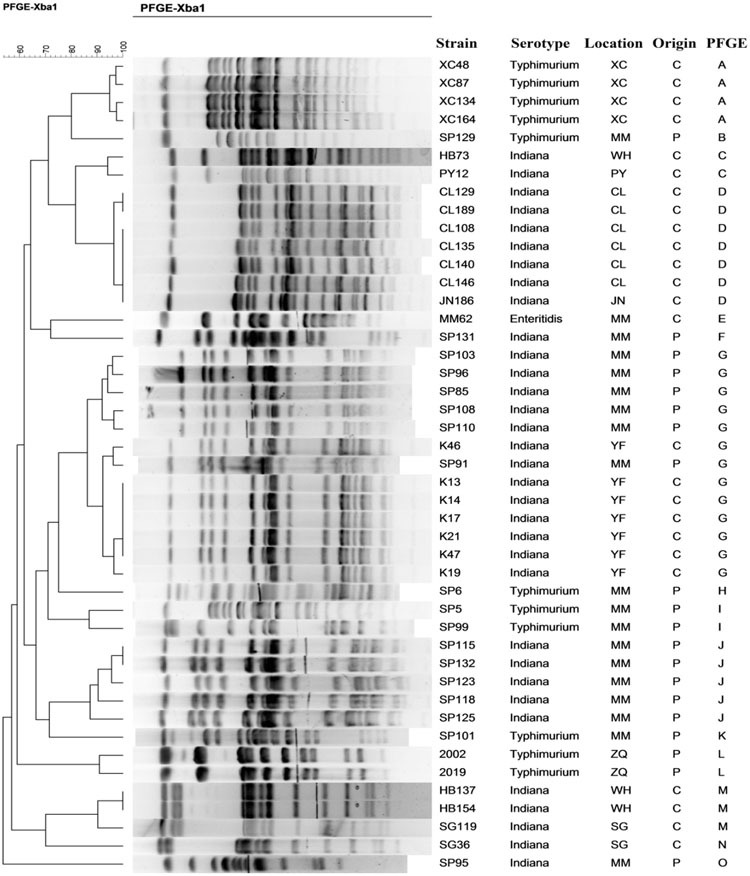
Salmonella spp. is one of the most important food-borne pathogens causing digestive tract and invasive infections in both humans and animals. Extended-spectrum β-lactamases (ESBLs) especially the CTX-M-type ESBLs are increasingly being reported worldwide and in China. These studies seldom focused on Salmonella isolates from food-producing animals. The aim of this study was to characterize the antimicrobial resistance profiles, serotypes and ESBLs and in particular, CTX-M producing Salmonella isolates from chickens and pigs in China. Salmonella isolates were identified by API20E system and polymerase chain reaction (PCR) assay; serotypes were determined using slide agglutination with hyperimmune sera; antimicrobial susceptibility was tested using the ager dilution method; the prevalence of ESBLs and PMQR genes were screened by PCR; CTX-M-producing isolates were further characterized by conjugation along with genetic relatedness and plasmid replicon type. In total, 159 Salmonella strains were identified, among which 95 strains were Salmonella enterica serovar Typhimurium, 63 strains were S. enterica serovar Indiana, and 1 strain was S. enterica serovar Enteritidis. All of these isolates presented multi-drug resistant phenotypes. Forty-five isolates carried bla CTX-M genes, the most common subtype was CTX-M-27(34), followed by CTX-M-65(7) and CTX-M-14(4). Most bla CTX-M genes were transmitted by non-typeable or IncN/IncFIB/IncP/IncA/C/IncHI2 plasmids with sizes ranging from 80 to 280 kb. In particular, all the 14 non-typeable plasmids were carrying bla CTX-M-27 gene and had a similar size. PFGE profiles indicated that CTX-M-positive isolates were clonally related among the same serotype, whilst the isolates of different serotypes were genetically divergent. This suggested that both clonal spread of resistant strains and horizontal transmission of the resistance plasmids contributed to the dissemination of bla CTX-M-9G-positive Salmonella isolates. The presence and spread of CTX-M, especially the CTX-M-27 in S. enterica serovars Typhimurium and Indiana from food-producing animals poses a potential threat for public health. Control strategies to limit the dissemination of these strains through the food chain are necessary.
沙门氏菌属是最重要的食源性病原体之一,可引起人和动物的消化道感染及侵袭性感染。超广谱β-内酰胺酶(ESBLs)尤其是CTX-M型ESBLs在全球及中国的报道日益增多。这些研究很少关注来自食品生产动物的沙门氏菌分离株。本研究的目的是对中国鸡和猪源沙门氏菌分离株的抗菌药物耐药谱、血清型及ESBLs,特别是产CTX-M的沙门氏菌分离株进行特征分析。沙门氏菌分离株通过API20E系统和聚合酶链反应(PCR)检测进行鉴定;血清型通过与免疫血清的玻片凝集试验确定;抗菌药物敏感性采用琼脂稀释法检测;ESBLs和质粒介导的喹诺酮类耐药(PMQR)基因的流行情况通过PCR筛选;产CTX-M的分离株通过接合试验以及遗传相关性和质粒复制子类型进行进一步特征分析。总共鉴定出159株沙门氏菌菌株,其中95株为肠炎沙门氏菌鼠伤寒血清型,63株为肠炎沙门氏菌印第安纳血清型,1株为肠炎沙门氏菌肠炎血清型。所有这些分离株均呈现多重耐药表型。45株分离株携带bla CTX-M基因,最常见的亚型是CTX-M-27(34株),其次是CTX-M-65(7株)和CTX-M-14(4株)。大多数bla CTX-M基因由不可分型或IncN/IncFIB/IncP/IncA/C/IncHI2质粒传播,大小范围为80至280 kb。特别是,所有14个不可分型质粒均携带bla CTX-M-27基因且大小相似。脉冲场凝胶电泳(PFGE)图谱表明,CTX-M阳性分离株在同一血清型中具有克隆相关性,而不同血清型的分离株在基因上存在差异。这表明耐药菌株的克隆传播和耐药质粒的水平转移均促成了bla CTX-M-9G阳性沙门氏菌分离株的传播。食品生产动物源肠炎沙门氏菌鼠伤寒血清型和印第安纳血清型中CTX-M尤其是CTX-M-27的存在和传播对公共卫生构成了潜在威胁。有必要采取控制策略以限制这些菌株通过食物链传播。