Zhao Xueqin, Wang Jun, Tao SiJie, Ye Ting, Kong Xiangdong, Ren Lei
College of Life Sciences, Zhejiang Sci-Tech University, Hangzhou, 310018, People's Republic of China.
Department of Biomaterials, College of Materials, Xiamen University, Xiamen, 361005, People's Republic of China.
Nanoscale Res Lett. 2016 Dec;11(1):195. doi: 10.1186/s11671-016-1409-6. Epub 2016 Apr 12.
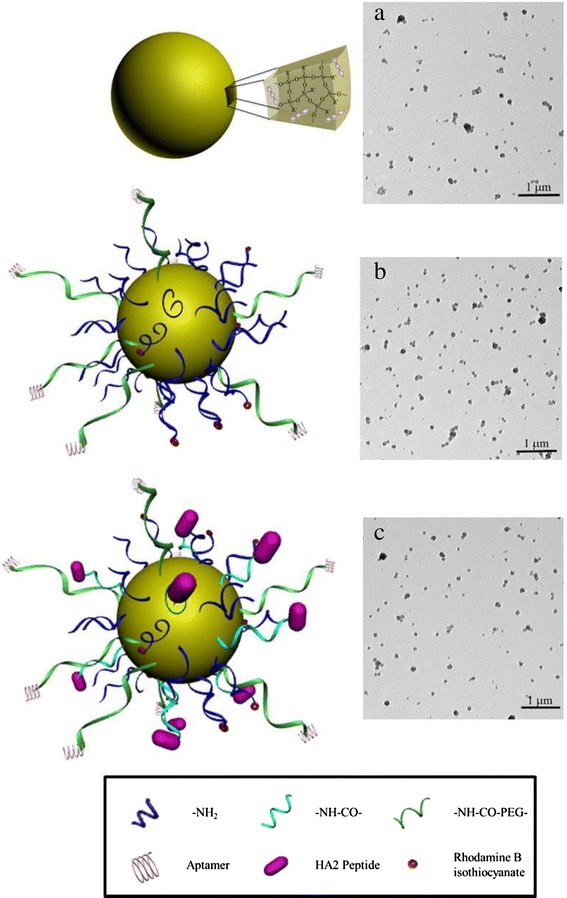
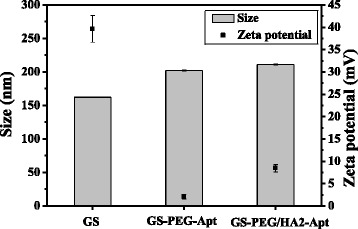
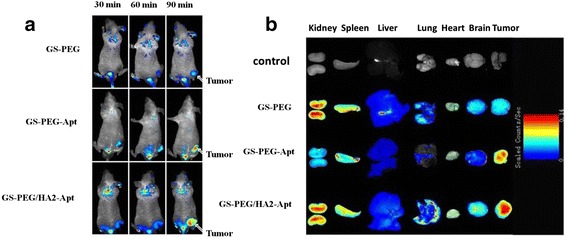
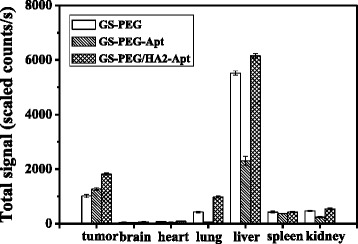
The non-viral gene delivery system is an attractive alternative to cancer therapy. The clinical success of non-viral gene delivery is hampered by transfection efficiency and tumor targeting, which can be individually overcome by addition of functional modules such as cell penetration or targeting. Here, we first engineered the multifunctional gelatin/silica (GS) nanovectors with separately controllable modules, including tumor-targeting aptamer AGRO100, membrane-destabilizing peptide HA2, and polyethylene glycol (PEG), and then studied their bio-distribution and in vivo transfection efficiencies by contrast resonance imaging (CRI). The results suggest that the sizes and zeta potentials of multifunctional gelatin/silica nanovectors were 203-217 nm and 2-8 mV, respectively. Functional GS-PEG nanoparticles mainly accumulated in the liver and tumor, with the lowest uptake by the heart and brain. Moreover, the synergistic effects of tumor-targeting aptamer AGRO100 and fusogenic peptide HA2 promoted the efficient cellular internalization in the tumor site. More importantly, the combined use of AGRO100 and PEG enhanced tumor gene expression specificity and effectively reduced toxicity in reticuloendothelial system (RES) organs after intravenous injection. Additionally, low accumulation of GS-PEG was observed in the heart tissues with high gene expression levels, which could provide opportunities for non-invasive gene therapy.
非病毒基因递送系统是癌症治疗中一种有吸引力的替代方法。非病毒基因递送的临床成功受到转染效率和肿瘤靶向性的阻碍,通过添加诸如细胞穿透或靶向等功能模块可分别克服这些问题。在此,我们首先构建了具有可单独控制模块的多功能明胶/二氧化硅(GS)纳米载体,包括肿瘤靶向适体AGRO100、膜破坏肽HA2和聚乙二醇(PEG),然后通过对比共振成像(CRI)研究了它们的生物分布和体内转染效率。结果表明,多功能明胶/二氧化硅纳米载体的尺寸和zeta电位分别为203 - 217 nm和2 - 8 mV。功能性GS - PEG纳米颗粒主要积聚在肝脏和肿瘤中,心脏和大脑的摄取量最低。此外,肿瘤靶向适体AGRO100和融合肽HA2的协同作用促进了肿瘤部位细胞的有效内化。更重要的是,AGRO100和PEG的联合使用增强了肿瘤基因表达的特异性,并有效降低了静脉注射后网状内皮系统(RES)器官中的毒性。此外,在基因表达水平高的心脏组织中观察到GS - PEG的低积聚,这可为非侵入性基因治疗提供机会。