Walker Ayron E, Wattick Rachel A, Olfert Melissa D
Division of Animal and Nutritional Sciences, Davis College of Agriculture, Natural Resources and Design, West Virginia University, Morgantown, WV, USA.
Curr Dev Nutr. 2021 Aug 10;5(9):nzab105. doi: 10.1093/cdn/nzab105. eCollection 2021 Sep.
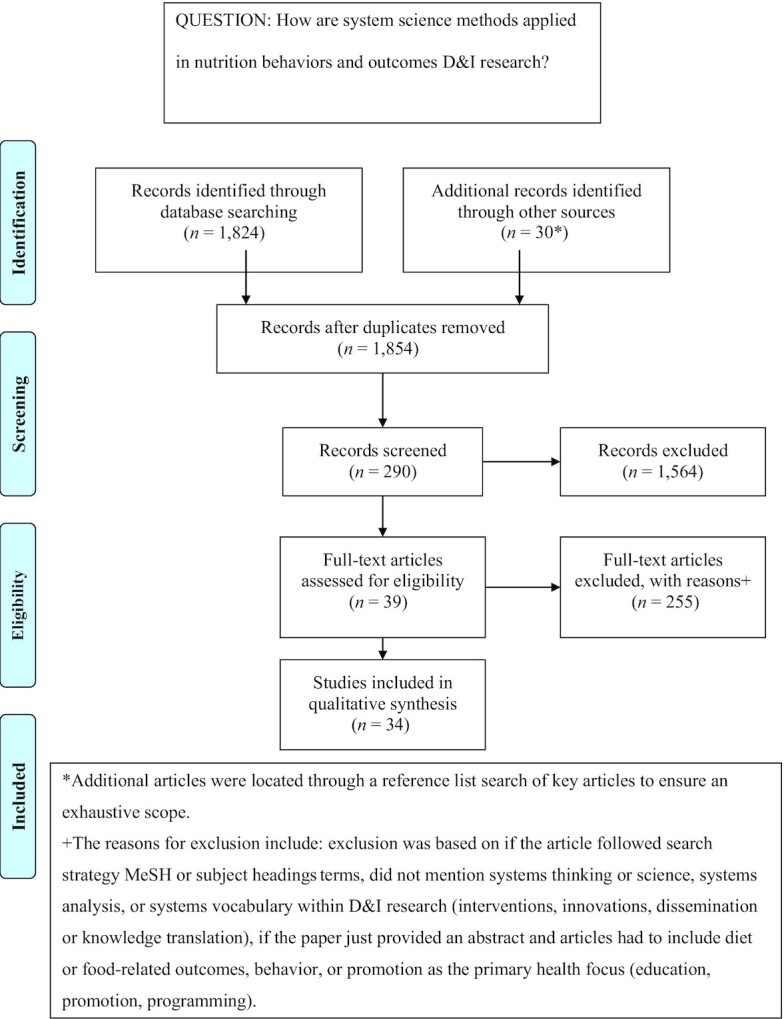
Use of systems science can improve the dissemination and implementation (D&I) process. However, little is known about use of systems science in nutrition D&I research. The purpose of this article is to synthesize the ways in which systems science methodology is applied in nutrition D&I research. Scoping review methodology involved searching 6 academic databases for full-text, peer-reviewed, English articles published between 1970 and 2020 that employed systems science within nutrition D&I research. Data extraction included intervention type, population, study aim, methods, theoretical approach, outcomes, and results. Descriptive statistics and qualitative thematic analysis followed. Thirty-four retained articles qualitatively identified benefits (successful planning and organization of complex interventions) and challenges (limited resources, trainings, and lack of knowledge) to utilizing systems science in nutrition D&I research. Future research should work toward building knowledge capacity among nutrition practitioners by increasing available trainings and resources to enhance the utilization of systems science in nutrition D&I research.
运用系统科学可以改善传播与实施(D&I)过程。然而,关于系统科学在营养传播与实施研究中的应用却知之甚少。本文旨在综合阐述系统科学方法在营养传播与实施研究中的应用方式。范围综述方法包括在6个学术数据库中搜索1970年至2020年间发表的、在营养传播与实施研究中采用系统科学的全文、同行评审英文文章。数据提取包括干预类型、人群、研究目的、方法、理论方法、结果和成果。随后进行描述性统计和定性主题分析。34篇留存文章定性地确定了在营养传播与实施研究中运用系统科学的益处(成功规划和组织复杂干预措施)和挑战(资源有限、培训不足以及知识匮乏)。未来的研究应致力于通过增加可用培训和资源来提高营养从业者的知识能力,以加强系统科学在营养传播与实施研究中的应用。