Van der Spoel van Dijk Anneke, Makhoahle Pakiso M, Rigouts Leen, Baba Kamaldeen
Department of Medical Microbiology, Faculty of Health Sciences, University of the Free State, Bloemfontein, South Africa; National Health Laboratory Service, Universitas Academic Laboratory, Bloemfontein 9301, South Africa.
Unit for Drug Discovery Research, Department of Health Sciences, Biomedical Technology, Faculty of Health and Environmental Sciences, Central University of Technology, Bloemfontein 9300, South Africa.
Int J Microbiol. 2016;2016:6572165. doi: 10.1155/2016/6572165. Epub 2016 Mar 17.
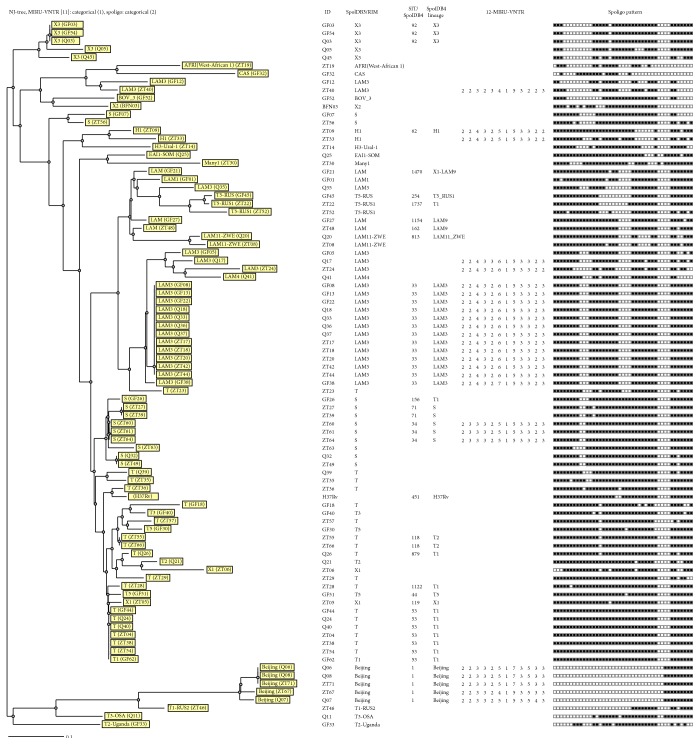
Tuberculosis is a serious public health concern especially in Africa and Asia. Studies describing strain diversity are lacking in the Free State region of South Africa. The aim of the study was to describe the diversity of Mycobacterium tuberculosis (M. tuberculosis) strain families in the Free State province of South Africa. A total of 86 M. tuberculosis isolates were genotyped using spoligotyping. A 12-locus mycobacterial interspersed repetitive units-variable-number tandem repeats (MIRU-VNTRs) typing was used to further characterize the resulting spoligotyping clusters. SITVITWEB identified 49 different patterns with allocation to six lineages including Latin-American-Mediterranean (LAM) (18 isolates), T (14 isolates), Beijing (five isolates), S (six isolates), Haarlem (one isolate), and X (five isolates), while 37 (43.0%) orphans were identified. Eight clusters included 37 isolates with identical spoligotypes (2 to 13/cluster). MIRU-VNTR typing further differentiated three spoligotyping clusters: SIT1/Beijing/MIT17, SIT33/LAM3/MIT213, and confirmed one SIT34/S/MIT311. In addition, SpolDB3/RIM assignment of the orphan strains resulted in a further 10 LAM and 13 T families. In total, LAM (28 isolates) and T (27 isolates) cause 63% of the individual cases of MTB in our study. The Free State has a highly diverse TB population with LAM being predominant. Further studies with inclusion of multidrug-resistant strains with larger sample size are warranted.
结核病是一个严重的公共卫生问题,在非洲和亚洲尤为如此。南非自由邦地区缺乏描述菌株多样性的研究。本研究的目的是描述南非自由邦省结核分枝杆菌(M. tuberculosis)菌株家族的多样性。使用间隔寡核苷酸分型(spoligotyping)对总共86株结核分枝杆菌分离株进行基因分型。采用12个位点的分枝杆菌插入重复单位可变数目串联重复序列(MIRU-VNTRs)分型进一步对所得的间隔寡核苷酸分型簇进行特征分析。SITVITWEB识别出49种不同模式,归为六个谱系,包括拉丁美洲-地中海(LAM)谱系(18株分离株)、T谱系(14株分离株)、北京谱系(5株分离株)、S谱系(6株分离株)、哈勒姆谱系(1株分离株)和X谱系(5株分离株),同时识别出37株(43.0%)孤儿菌株。8个簇包含37株具有相同间隔寡核苷酸分型的分离株(每个簇2至13株)。MIRU-VNTR分型进一步区分了3个间隔寡核苷酸分型簇:SIT1/北京/MIT17、SIT33/LAM3/MIT213,并确认了1个SIT34/S/MIT311。此外,对孤儿菌株进行SpolDB3/RIM分类又得到了10个LAM家族和13个T家族。在我们的研究中,LAM谱系(28株分离株)和T谱系(27株分离株)导致了63%的结核分枝杆菌个体病例。自由邦的结核病患者群体具有高度多样性,LAM谱系占主导地位。有必要开展进一步研究,纳入更大样本量的耐多药菌株。