Witt Norina, Coynor Seth, Edwards Christopher, Bradshaw Hans
Department of Pediatrics, The University of Arizona, PO Box 245073, Tuscon, 85724 AZ USA.
Departments of Pediatrics and Emergency Medicine, The University of Arizona, PO Box 245057, Tucson, 85724-5057 AZ USA ; College of Pharmacy, The University of Arizona, Department of Pharmacy Services, Banner-University Medical Center, PO Box 210202, Tucson, AZ USA.
Curr Emerg Hosp Med Rep. 2016;4:1-10. doi: 10.1007/s40138-016-0089-y. Epub 2016 Mar 12.
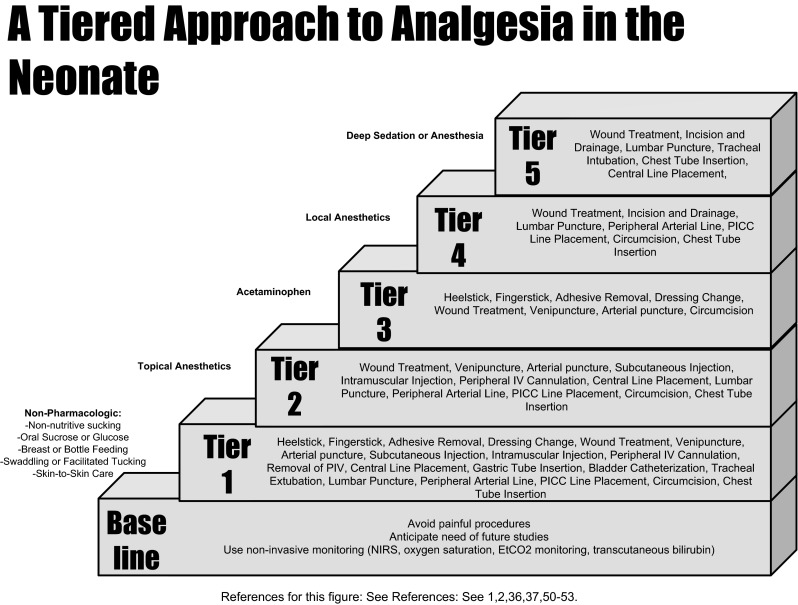
Newborn infants experience acute pain with various medical procedures. Evidence demonstrates that controlling pain in the newborn period is beneficial, improving physiologic, behavioral, and hormonal outcomes. Multiple validated scoring systems exist to assess pain in a neonate; however, there is no standardized or universal approach for pain management. Healthcare facilities should establish a neonatal pain control program. The first step is to minimize the total number of painful iatrogenic events when possible. If a procedure cannot be avoided, a tiered approach to manage pain using environmental, non-pharmacologic, and pharmacologic modalities is recommended. This systematic approach should decrease acute neonatal pain, poor outcomes, and provider and parent dissatisfaction.
新生儿在接受各种医疗程序时会经历急性疼痛。有证据表明,在新生儿期控制疼痛是有益的,可改善生理、行为和激素方面的结果。存在多种经过验证的评分系统来评估新生儿的疼痛;然而,对于疼痛管理并没有标准化或通用的方法。医疗机构应建立新生儿疼痛控制项目。第一步是尽可能减少医源性疼痛事件的总数。如果某项程序无法避免,建议采用一种分层方法,使用环境、非药物和药物手段来管理疼痛。这种系统方法应能减少新生儿急性疼痛、不良后果以及医护人员和家长的不满。