Mugo Peter M, Wahome Elizabeth W, Gichuru Evanson N, Mwashigadi Grace M, Thiong'o Alexander N, Prins Henrieke A B, Rinke de Wit Tobias F, Graham Susan M, Sanders Eduard J
Centre for Geographic Medicine Research - Coast (CGMR-C), Kenya Medical Research Institute, Kilifi, Kenya.
Department of Global Health, Academic Medical Center, University of Amsterdam, Amsterdam, the Netherlands.
PLoS One. 2016 Apr 14;11(4):e0153612. doi: 10.1371/journal.pone.0153612. eCollection 2016.
Following HIV-1 acquisition, many individuals develop an acute retroviral syndrome and a majority seek care. Available antibody testing cannot detect an acute HIV infection, but repeat testing after 2-4 weeks may detect seroconversion. We assessed the effect of appointment reminders on attendance for repeat HIV testing.
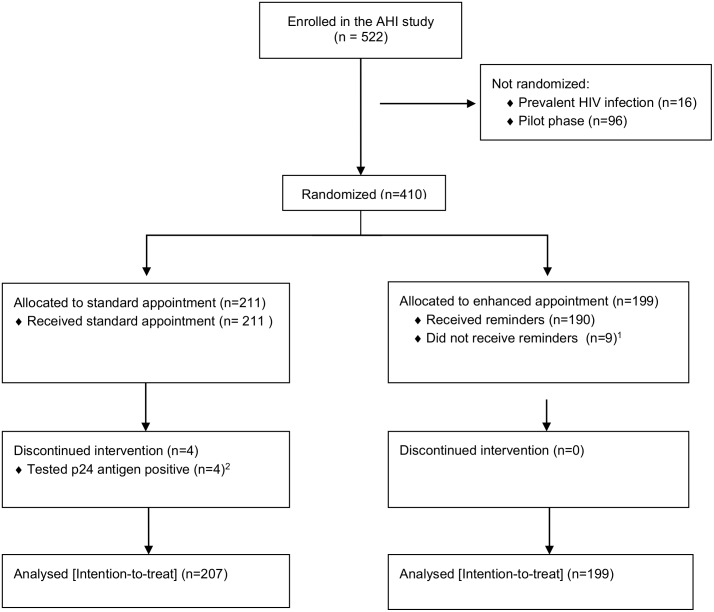
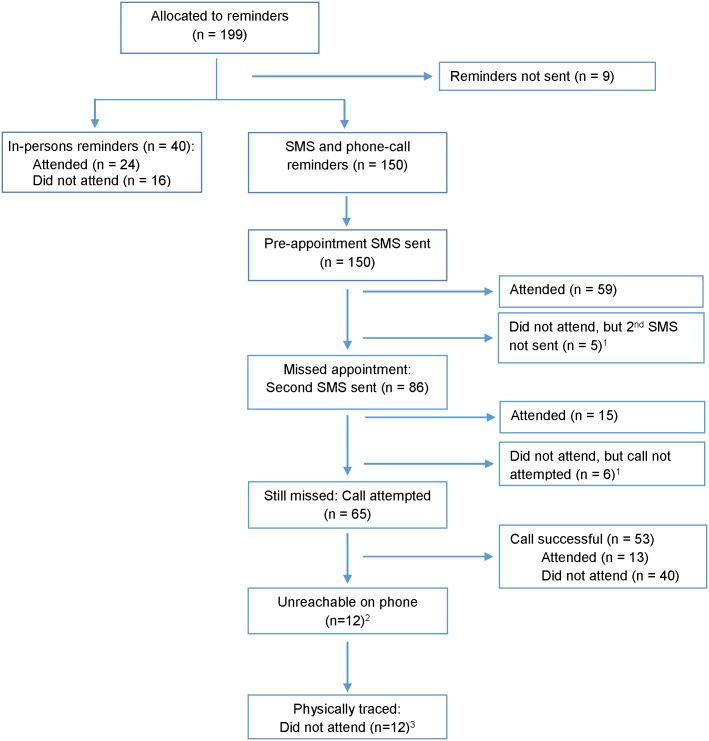
We enrolled, in a randomized controlled trial, 18-29 year old patients evaluated for acute HIV infection at five sites in Coastal Kenya (ClinicalTrials.gov NCT01876199). Participants were allocated 1:1 to either standard appointment (a dated appointment card) or enhanced appointment (a dated appointment card plus SMS and phone call reminders, or in-person reminders for participants without a phone). The primary outcome was visit attendance, i.e., the proportion of participants attending the repeat test visit. Factors associated with attendance were examined by bivariable and multivariable logistic regression.
Between April and July 2013, 410 participants were randomized. Attendance was 41% (85/207) for the standard group and 59% (117/199) for the enhanced group, for a relative risk of 1.4 [95% Confidence Interval, CI, 1.2-1.7].Higher attendance was independently associated with older age, study site, and report of transactional sex in past month. Lower attendance was associated with reporting multiple partners in the past two months.
Appointment reminders through SMS, phone calls and in-person reminders increased the uptake of repeat HIV test by forty percent. This low-cost intervention could facilitate detection of acute HIV infections and uptake of recommended repeat testing.
Clinicaltrials.gov NCT01876199.
感染HIV-1后,许多人会出现急性逆转录病毒综合征,大多数人会寻求治疗。现有的抗体检测无法检测出急性HIV感染,但在2 - 4周后重复检测可能会检测到血清转化。我们评估了预约提醒对重复HIV检测就诊率的影响。
在肯尼亚沿海地区的五个地点,我们进行了一项随机对照试验,纳入了18 - 29岁因急性HIV感染接受评估的患者(ClinicalTrials.gov标识符:NCT01876199)。参与者按1:1比例随机分配至标准预约组(一张注明日期的预约卡)或强化预约组(一张注明日期的预约卡加上短信和电话提醒,对于没有电话的参与者则进行当面提醒)。主要结局是就诊率,即参加重复检测就诊的参与者比例。通过双变量和多变量逻辑回归分析与就诊率相关的因素。
2013年4月至7月期间,410名参与者被随机分组。标准组的就诊率为41%(85/207),强化组为59%(117/199),相对风险为1.4 [95%置信区间(CI),1.2 - 1.7]。较高的就诊率与年龄较大、研究地点以及过去一个月有交易性行为的报告独立相关。较低的就诊率与过去两个月报告有多个性伴侣有关。
通过短信、电话和当面提醒的预约提醒使重复HIV检测的接受率提高了40%。这种低成本干预措施有助于急性HIV感染的检测以及推荐的重复检测的接受。
Clinicaltrials.gov NCT01876199