Matějů Jana, Chanová Marta, Modrý David, Mitková Barbora, Hrazdilová Kristýna, Žampachová Víta, Kolářová Libuše
Institute of Immunology and Microbiology, First Faculty of Medicine, Charles University in Prague and General University Hospital in Prague, Prague, Czech Republic.
National Reference Laboratory for Tissue Helminthoses, General University Hospital in Prague, Prague, Czech Republic.
BMC Infect Dis. 2016 Apr 19;16:171. doi: 10.1186/s12879-016-1505-3.
Human dirofilariasis is a zoonotic infection that continues to spread to previously unaffected areas of Europe. In the South Moravian Region of the Czech Republic (CR), imported as well as autochthonous canine infections were recorded in the last decade, and parasite DNA was detected in mosquitoes of Aedes vexans. In the present paper, human Dirofilaria infections are reported from the country for the first time.
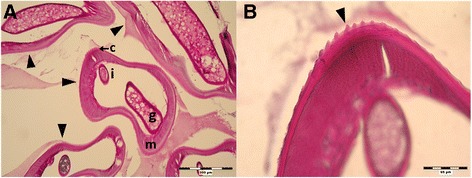
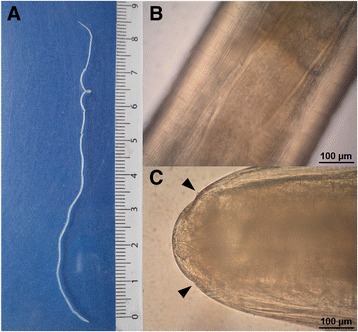
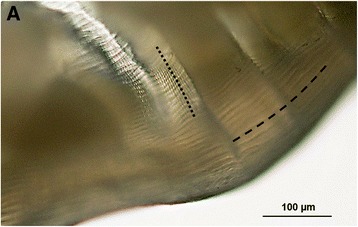
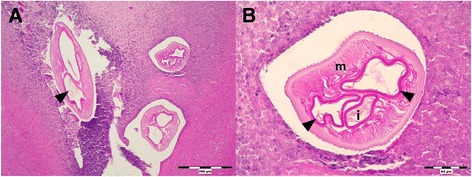
The samples from five patients with suspected tissue helminthiases were investigated. In particular cases, nematodes were isolated from various tissues including skin of lower leg, soft tissues of finger, subcutaneous tissue of hypogastrium, lymph node and peritoneum. The diagnosis was based on light microscopic morphology and/or DNA analysis of the worms. In addition, ELISA examination of patients' sera for anti-filaria IgG antibodies was performed.
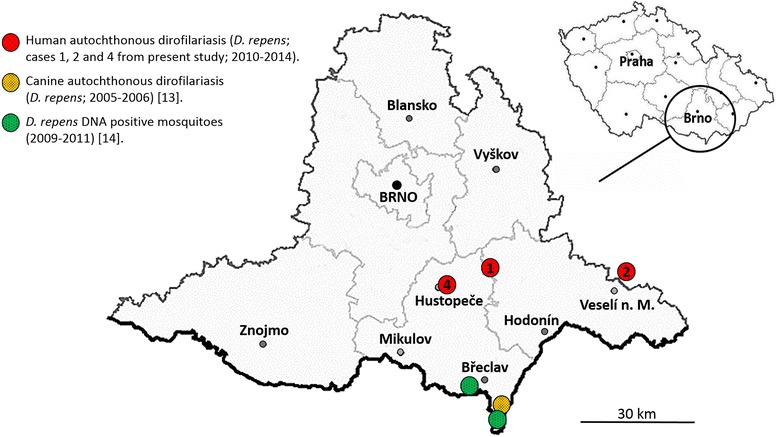
In the CR, five cases of human dirofilariasis caused by Dirofilaria repens were recorded during 2010-2014 (species determination for three of them was confirmed besides morphological also by DNA analysis). At least, three of the cases were of autochthonous origin (the patients are Czech citizens residing in South Moravian Region who have never travelled abroad). The findings confirm the natural setting of D. repens in South Moravian Region of the CR. Dirofilariasis should be therefore considered as endemic in this area where it may represent a significant risk factor for public health.
人体丝虫病是一种人畜共患感染病,目前仍在向欧洲以前未受影响的地区蔓延。在捷克共和国(CR)的南摩拉维亚地区,过去十年记录到了输入性以及本地犬类感染病例,并且在骚扰伊蚊体内检测到了寄生虫DNA。在本文中,首次报道了该国的人体恶丝虫感染病例。
对五例疑似组织蠕虫病患者的样本进行了调查。在个别病例中,从包括小腿皮肤、手指软组织、下腹皮下组织、淋巴结和腹膜在内的各种组织中分离出了线虫。诊断基于蠕虫的光学显微镜形态和/或DNA分析。此外,还对患者血清进行了抗丝虫IgG抗体的ELISA检测。
在捷克共和国,在2010年至2014年期间记录到了五例由匐行恶丝虫引起的人体丝虫病病例(其中三例除形态学鉴定外,还通过DNA分析确认了虫种)。至少其中三例为本地感染病例(患者为居住在南摩拉维亚地区、从未出过国的捷克公民)。这些发现证实了匐行恶丝虫在捷克共和国南摩拉维亚地区的自然生存环境。因此,在该地区应将丝虫病视为地方病,它可能是一个重大的公共卫生风险因素。