Chan Jasper Fuk-Woo, Lau Susanna Kar-Pui, Wong Sally Cheuk-Ying, To Kelvin Kai-Wang, So Simon Yung-Chun, Leung Sally Sau-Man, Chan Siu-Mang, Pang Chiu-Mei, Xiao Chenlu, Hung Ivan Fan-Ngai, Cheng Vincent Chi-Chung, Yuen Kwok-Yung, Woo Patrick Chiu-Yat
State Key Laboratory of Emerging Infectious Diseases, The University of Hong Kong, Hong Kong, China.
Department of Microbiology, The University of Hong Kong, Hong Kong, China.
Emerg Microbes Infect. 2016 Apr 20;5(4):e37. doi: 10.1038/emi.2016.31.
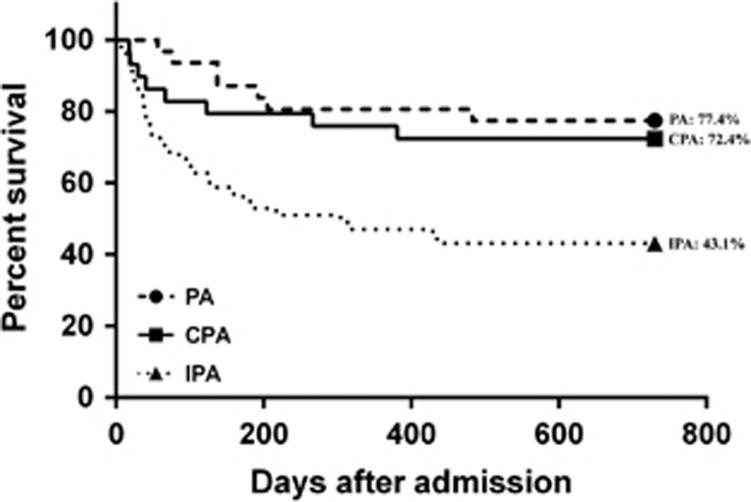
In recent years, infections caused by Aspergillus sp. have become an emerging focus of clinical microbiology and infectious disease, as the number of patients infected with Aspergillus sp. has increased markedly. Although chronic pulmonary aspergillosis (CPA) is considered a 'semi-invasive' or 'intermediate' disease, little data are available for the direct comparison of CPA with invasive pulmonary aspergillosis (IPA) and pulmonary aspergilloma (PA) to quantify invasiveness. In this study, we compared the characteristics of CPA with those of IPA and PA among hospitalized patients over a 10-year period. A total of 29, 51 and 31 cases of CPA, IPA and PA, respectively, were included. An increasing trend in galactomannan antigen seropositivity rate from PA (24.1%) to CPA (35.7%) to IPA (54.9%) and an opposite trend for anti-Aspergillus antibody (PA (71.0%) to CPA (45.8%) to IPA (7.1%)) were observed. Eight percent of CPA patients were infected with more than one Aspergillus sp. The survival rate of the CPA group also fell between the survival rate of PA and IPA, confirming the intermediate severity of CPA. The survival rate of the CPA group became significantly higher than that of the IPA group from day 180 onwards until 2 years after admission (P<0.05). The survival rate of the CPA group remained lower than that of the PA group from day 30 onwards until 2 years after admission. Poor prognostic factors for CPA included older age (P=0.019), higher total leukocyte count (P=0.011) and higher neutrophil count (P=0.012) on admission. This study provided clinical and laboratory evidence for the semi-invasive properties of CPA.
近年来,随着感染曲霉属的患者数量显著增加,曲霉属引起的感染已成为临床微生物学和传染病领域新出现的关注焦点。尽管慢性肺曲霉病(CPA)被认为是一种“半侵袭性”或“中间型”疾病,但关于将CPA与侵袭性肺曲霉病(IPA)和肺曲菌球(PA)进行直接比较以量化侵袭性的数据却很少。在本研究中,我们比较了10年间住院患者中CPA与IPA和PA的特征。分别纳入了29例CPA、51例IPA和31例PA患者。观察到从PA(24.1%)到CPA(35.7%)再到IPA(54.9%),半乳甘露聚糖抗原血清阳性率呈上升趋势,而抗曲霉抗体则呈相反趋势(PA(71.0%)到CPA(45.8%)再到IPA(7.1%))。8%的CPA患者感染了不止一种曲霉属。CPA组的生存率也介于PA组和IPA组之间,证实了CPA的病情严重程度处于中间水平。从入院后第180天直至入院后2年,CPA组的生存率显著高于IPA组(P<0.05)。从入院后第30天直至入院后2年,CPA组的生存率一直低于PA组。CPA的不良预后因素包括入院时年龄较大(P=0.019)、总白细胞计数较高(P=0.011)和中性粒细胞计数较高(P=0.012)。本研究为CPA的半侵袭性特性提供了临床和实验室证据。