Beal Sarah J, Grimm Kevin J, Dorn Lorah D, Susman Elizabeth J
Cincinnati Children's Hospital Medical Center.
University of Cincinnati.
Child Dev. 2016 Jul;87(4):1106-14. doi: 10.1111/cdev.12539. Epub 2016 Apr 20.
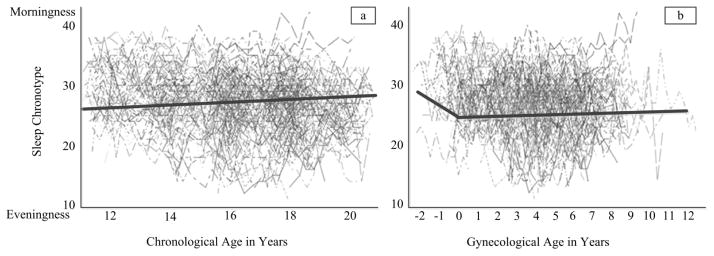
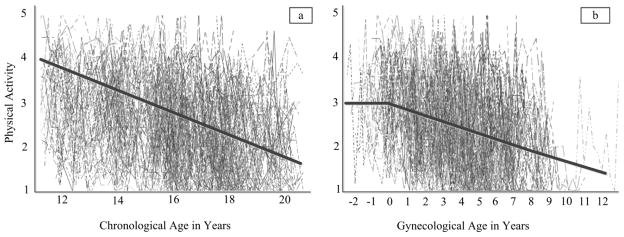
This study identified trajectories of morningness-eveningness (M-E) and physical activity when chronological (i.e., time since birth) versus gynecological (i.e., time since menarche) age is used to indicate maturation. Piecewise models were fit for girls (N = 262, ages 11-19) using chronological or gynecological age as the time metric. Girls stayed up later (i.e., eveningness) as they approach menarche. After menarche no change in M-E was observed. In contrast, no change in M-E was detected with chronological age. No change in physical activity was observed before menarche, and physical activity declined after menarche. With chronological age, physical activity declined as girls got older. Gynecological age may be more appropriate than chronological age as a metric for understanding changes in M-E and physical activity.
本研究确定了在使用实足年龄(即自出生起的时间)与妇科年龄(即初潮以来的时间)来指示成熟度时,晨型-夜型(M-E)和身体活动的轨迹。使用实足年龄或妇科年龄作为时间指标,对女孩(N = 262,年龄11 - 19岁)拟合了分段模型。女孩在接近初潮时睡得更晚(即夜型)。初潮后未观察到M-E有变化。相比之下,实足年龄未检测到M-E有变化。初潮前身体活动未观察到变化,初潮后身体活动下降。随着实足年龄增长,女孩身体活动下降。作为理解M-E和身体活动变化的指标,妇科年龄可能比实足年龄更合适。