Ybarra Michele L, Espelage Dorothy L, Langhinrichsen-Rohling Jennifer, Korchmaros Josephine D, Boyd Danah
Center for Innovative Public Health Research, 555 N. El Camino Real A347, San Clemente, CA, 92672, USA.
Department of Educational Psychology, University of Illinois at Urbana-Champaign, Champaign, IL, USA.
Arch Sex Behav. 2016 Jul;45(5):1083-99. doi: 10.1007/s10508-016-0748-9. Epub 2016 Apr 20.
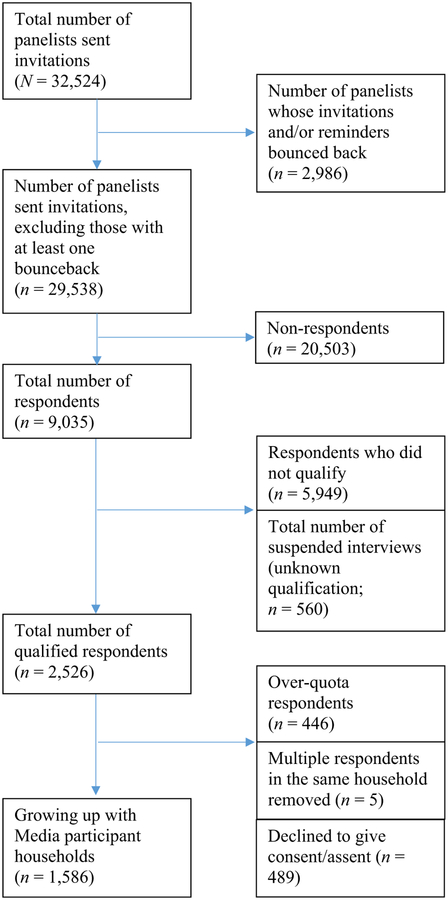
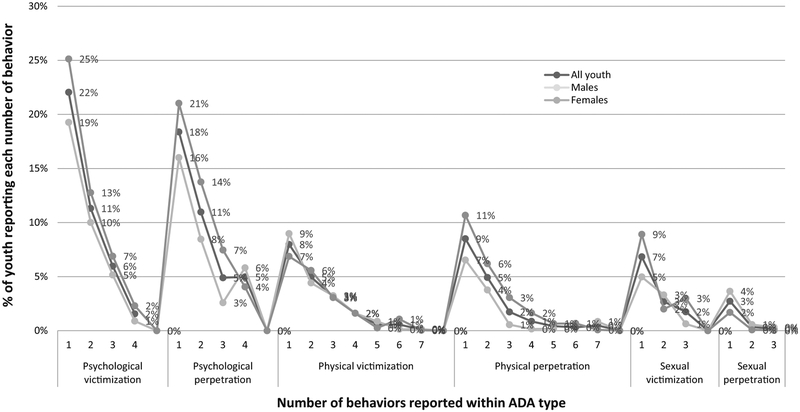
National, epidemiological data that provide lifetime rates of psychological, physical, and sexual adolescent data abuse (ADA) perpetration and victimization within the same sample of youth are lacking. To address this gap, data from 1058 randomly selected U.S. youth, 14-21 years old, surveyed online in 2011 and/or 2012, were weighted to be nationally representative and analyzed. In addition to reporting prevalence rates, we also examined the overlap of the six types of ADA queried. Results suggested that ADA was commonly reported by both male and female youth. Half (51 %) of female youth and 43 % of male youth reported victimization of at least one of the three types of ADA. Half (50 %) of female youth and 35 % of male youth reported at least one type of ADA perpetration. More male youth reported sexual ADA perpetration than female youth. More female youth reported perpetration of psychological and physical ADA and more reported psychological victimization than male youth. Rates were similar across race and ethnicity, but increased with age. This increase may have been because older youth spent longer time in relationships than younger youth, or perhaps because older youth were developmentally more likely than younger youth to be in abusive relationships. Many youth reported being both perpetrators and victims and/or involved in multiple forms of ADA across their dating history. Together, these findings suggested that interventions should acknowledge that youth may play multiple roles in abusive dyads. Understanding the overlap among ADA within the same as well as across multiple relationships will be invaluable to future interventions aiming to disrupt and prevent ADA.
目前缺乏全国性的流行病学数据,这些数据要能提供在同一青年样本中心理、身体和性方面的青少年数据滥用(ADA)行为及受害情况的终生发生率。为填补这一空白,我们对2011年和/或2012年在线调查的1058名随机抽取的14至21岁美国青年的数据进行加权处理,使其具有全国代表性并进行分析。除了报告发生率外,我们还研究了所询问的六种ADA类型之间的重叠情况。结果表明,男性和女性青年都普遍报告存在ADA情况。一半(51%)的女性青年和43%的男性青年报告至少遭受过三种ADA类型中的一种侵害。一半(50%)的女性青年和35%的男性青年报告至少实施过一种ADA行为。报告实施性方面ADA行为的男性青年多于女性青年。报告实施心理和身体方面ADA行为的女性青年更多,且报告遭受心理侵害的女性青年也多于男性青年。不同种族和族裔的发生率相似,但随年龄增长而上升。这种上升可能是因为年龄较大的青年在恋爱关系中花费的时间比年龄较小的青年更长,或者也许是因为年龄较大的青年在发育上比年龄较小的青年更有可能处于虐待关系中。许多青年报告在其恋爱经历中既是施害者又是受害者,和/或涉及多种形式的ADA行为。总之,这些发现表明干预措施应认识到青年在虐待关系中可能扮演多种角色。了解同一关系以及多种关系中ADA行为之间的重叠情况,对于未来旨在破坏和预防ADA行为的干预措施将非常宝贵。