Liu Ming-Sheng, Niu Jing-Wen, Li Yi, Guan Yu-Zhou, Cui Li-Ying
Department of Neurology, Peking Union Medical College Hospital, Chinese Academy of Medical Sciences, Beijing 100730, China.
Chin Med J (Engl). 2016 May 5;129(9):1036-40. doi: 10.4103/0366-6999.180533.
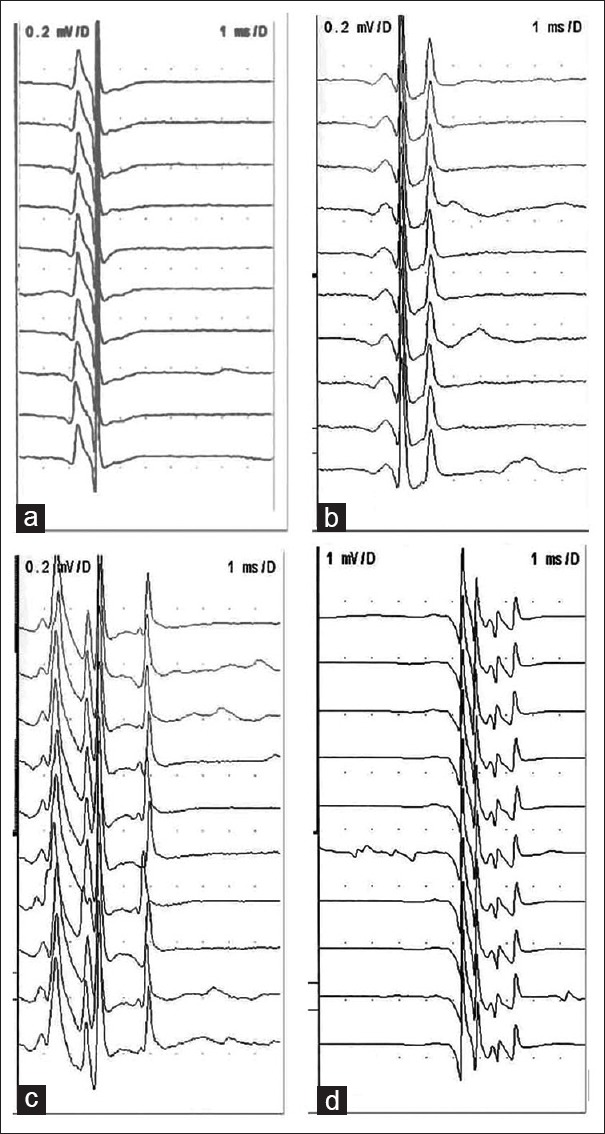
Single-fiber electromyography (SFEMG) has been suggested as a quantitative method for supporting chronic partial denervation in amyotrophic lateral sclerosis (ALS) by the revised EI Escorial criteria. Although concentric needle (CN) electrodes have been used to assess jitter in myasthenia gravis patients and healthy controls, there are few reports using CN electrodes to assess motor unit instability and denervation in neurogenic diseases. The aim of this study was to determine whether quantitative changes in jitter and spike number using CN electrodes could be used for ALS studies.
Twenty-seven healthy controls and 23 ALS patients were studied using both CN and single-fiber needle (SFN) electrodes on the extensor digitorum communis muscle with an SFEMG program. The SFN-jitter and SFN-fiber density data were measured using SFN electrodes. The CN-jitter and spike number were measured using CN electrodes.
The mean CN-jitter was significantly increased in ALS patients (47.3 ± 17.0 μs) than in healthy controls (27.4 ± 3.3 μs) (P < 0.001). Besides, the mean spike number was significantly increased in ALS patients (2.5 ± 0.5) than in healthy controls (1.7 ± 0.3) (P < 0.001). The sensitivity and specificity in the diagnosis of ALS were 82.6% and 92.6% for CN-jitter (cut-off value: 32 μs), and 91.3% and 96.3% for the spike number (cut-off value: 2.0), respectively. There was no significant difference between the SFN-jitter and CN-jitter in ALS patients; meanwhile, there was no significant difference between the SFN-jitter and CN-jitter in healthy controls.
CN-jitter and spike number could be used to quantitatively evaluate changes due to denervation-reinnervation in ALS.
根据修订后的埃斯科里亚尔(EI Escorial)标准,单纤维肌电图(SFEMG)已被提议作为支持肌萎缩侧索硬化症(ALS)慢性部分失神经的定量方法。虽然同心针电极(CN)已被用于评估重症肌无力患者和健康对照的颤抖,但很少有报告使用CN电极评估神经源性疾病中的运动单位不稳定性和失神经。本研究的目的是确定使用CN电极时,颤抖和棘波数量的定量变化是否可用于ALS研究。
使用SFEMG程序,在27名健康对照和23名ALS患者的指总伸肌上同时使用CN电极和单纤维针电极(SFN)进行研究。使用SFN电极测量SFN颤抖和SFN纤维密度数据。使用CN电极测量CN颤抖和棘波数量。
ALS患者的平均CN颤抖(47.3±17.0微秒)显著高于健康对照(27.4±3.3微秒)(P<0.001)。此外,ALS患者的平均棘波数量(2.5±0.5)显著高于健康对照(1.7±0.3)(P<0.001)。CN颤抖(临界值:32微秒)诊断ALS的敏感性和特异性分别为82.6%和92.6%,棘波数量(临界值:2.0)的敏感性和特异性分别为91.3%和96.3%。ALS患者的SFN颤抖和CN颤抖之间无显著差异;同时,健康对照的SFN颤抖和CN颤抖之间也无显著差异。
CN颤抖和棘波数量可用于定量评估ALS中失神经-再支配引起的变化。