Cuperlovic-Culf Miroslava, Wang Lipu, Forseille Lily, Boyle Kerry, Merkley Nadine, Burton Ian, Fobert Pierre R
National Research Council, Ottawa, Ontario, Canada.
National Research Council, Saskatoon, Saskatchewan, Canada.
PLoS One. 2016 Apr 21;11(4):e0153642. doi: 10.1371/journal.pone.0153642. eCollection 2016.
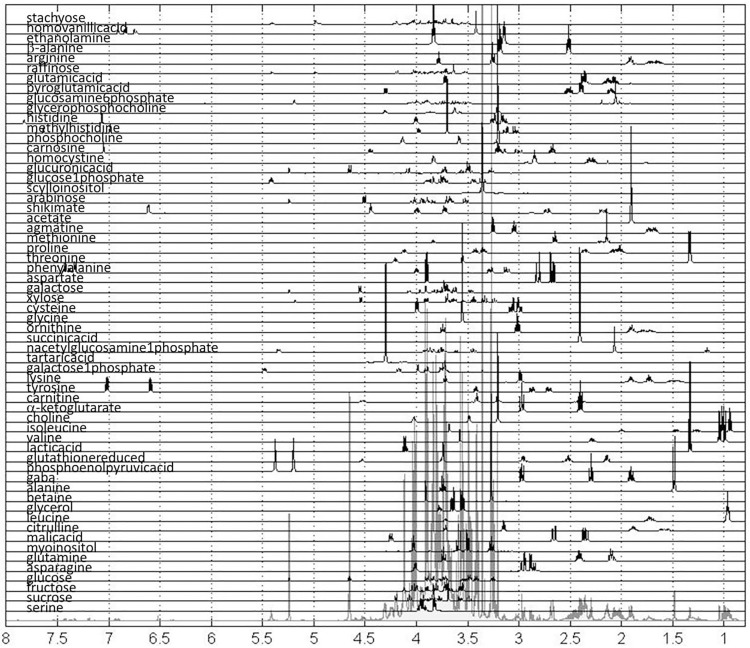
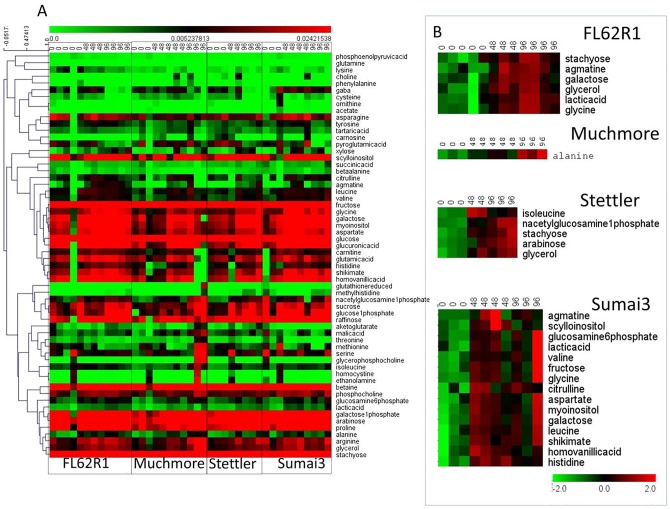
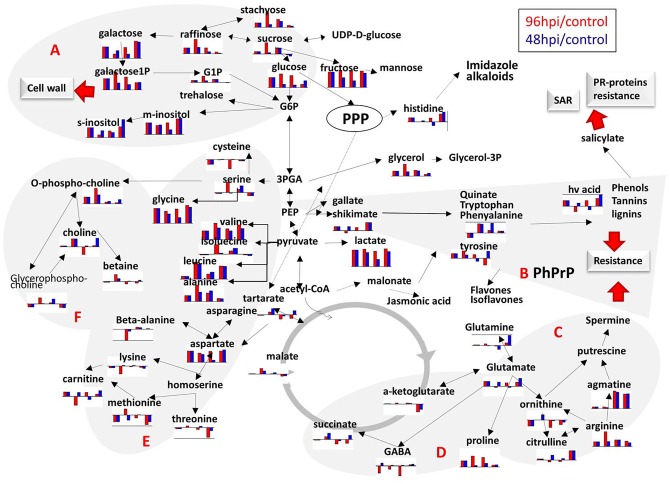
Metabolic changes in spikelets of wheat varieties FL62R1, Stettler, Muchmore and Sumai3 following Fusarium graminearum infection were explored using NMR analysis. Extensive 1D and 2D 1H NMR measurements provided information for detailed metabolite assignment and quantification leading to possible metabolic markers discriminating resistance level in wheat subtypes. In addition, metabolic changes that are observed in all studied varieties as well as wheat variety specific changes have been determined and discussed. A new method for metabolite quantification from NMR data that automatically aligns spectra of standards and samples prior to quantification using multivariate linear regression optimization of spectra of assigned metabolites to samples' 1D spectra is described and utilized. Fusarium infection-induced metabolic changes in different wheat varieties are discussed in the context of metabolic network and resistance.
利用核磁共振分析,研究了小麦品种FL62R1、斯泰特勒、穆奇莫尔和苏麦3在禾谷镰刀菌感染后小穗中的代谢变化。广泛的一维和二维氢核磁共振测量提供了详细代谢物鉴定和定量的信息,从而得出可能区分小麦亚型抗性水平的代谢标记。此外,还确定并讨论了所有研究品种中观察到的代谢变化以及小麦品种特有的变化。描述并使用了一种从核磁共振数据中定量代谢物的新方法,该方法在定量前使用指定代谢物光谱与样品一维光谱的多元线性回归优化,自动对齐标准品和样品的光谱。在代谢网络和抗性的背景下,讨论了不同小麦品种中镰刀菌感染诱导的代谢变化。