
感染性类肺炎性胸腔积液的代谢组学分析揭示了指导肺炎链球菌肺炎患儿管理的生物标志物。
Metabolomic Profiling of Infectious Parapneumonic Effusions Reveals Biomarkers for Guiding Management of Children with Streptococcus pneumoniae Pneumonia.
作者信息
Chiu Chih-Yung, Lin Gigin, Cheng Mei-Ling, Chiang Meng-Han, Tsai Ming-Han, Lai Shen-Hao, Wong Kin-Sun, Hsieh Sen-Yung
机构信息
Department of Pediatrics, Chang Gung Memorial Hospital at Keelung, and Chang Gung University, Taoyuan, Taiwan.
Graduate Institute of Clinical Medical Sciences, College of Medicine, Chang Gung University, Taoyuan, Taiwan.
出版信息
Sci Rep. 2016 Apr 22;6:24930. doi: 10.1038/srep24930.
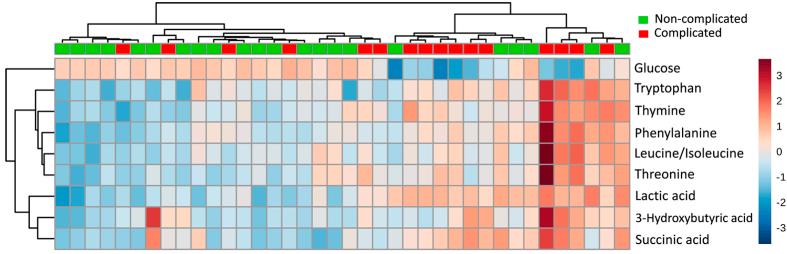
Metabolic markers in biofluids represent an attractive tool for guiding clinical management. The aim of this study was to identify metabolic mechanisms during the progress of pleural infection in children with Streptococcus pneumoniae pneumonia. Forty children diagnosed with pneumococcal pneumonia were enrolled and analysis of pleural fluid metabolites categorized by complicated parapneumonic effusions (CPE) and non-CPE was assessed by using (1)H-NMR spectroscopy. Multivariate statistical analysis including principal components analysis (PCA) and partial least-squares discriminant analysis (PLS-DA) were performed. Metabolites identified were studied in relation to subsequent intervention procedures by receiver operating characteristic (ROC) curve analysis. Ten metabolites significantly different between CPE and non-CPE were identified. A significantly lower level of glucose for glycolysis was found in CPE compared to non-CPE. Six metabolites involving bacterial biosynthesis and three metabolites involving bacterial fermentation were significantly higher in CPE compared to non-CPE. Glucose and 3-hydroxybutyric acid were the metabolites found to be useful in discriminating from receiving intervention procedures. Metabolic profiling of pleural fluid using (1)H-NMR spectroscopy provides direct observation of bacterial metabolism in the progress of pneumococcal pneumonia. An increase in the metabolism of butyric acid fermentation of glucose could potentially lead to the need of aggressive pleural drainage.
生物流体中的代谢标志物是指导临床管理的一种有吸引力的工具。本研究的目的是确定肺炎链球菌肺炎患儿胸膜感染进展过程中的代谢机制。招募了40名诊断为肺炎球菌肺炎的儿童,通过¹H-NMR光谱法对按复杂性类肺炎性胸腔积液(CPE)和非CPE分类的胸腔积液代谢物进行分析。进行了包括主成分分析(PCA)和偏最小二乘判别分析(PLS-DA)在内的多变量统计分析。通过受试者工作特征(ROC)曲线分析研究了鉴定出的代谢物与后续干预程序的关系。确定了CPE和非CPE之间有10种代谢物存在显著差异。与非CPE相比,CPE中糖酵解的葡萄糖水平显著降低。与非CPE相比,CPE中涉及细菌生物合成的6种代谢物和涉及细菌发酵的3种代谢物显著更高。葡萄糖和3-羟基丁酸是发现有助于区分是否接受干预程序的代谢物。使用¹H-NMR光谱法对胸腔积液进行代谢谱分析可直接观察肺炎球菌肺炎进展过程中的细菌代谢。葡萄糖丁酸发酵代谢的增加可能会导致需要积极进行胸腔引流。



 Zotero 插件