Blokzijl Andries, Chen Lei E, Gustafsdottir Sigrun M, Vuu Jimmy, Ullenhag Gustav, Kämpe Olle, Landegren Ulf, Kamali-Moghaddam Masood, Hedstrand Håkan
Dept. of Immunology, Genetics and Pathology, Science for Life Laboratory, Uppsala University, Box 815, SE-751 08 Uppsala, Sweden.
Ludwig Institute for Cancer Research, Science for Life Laboratory, Uppsala University, Box 595, SE-751 24, Uppsala, Sweden.
PLoS One. 2016 Apr 25;11(4):e0154214. doi: 10.1371/journal.pone.0154214. eCollection 2016.
The diagnosis of malignant melanoma currently relies on clinical inspection of the skin surface and on the histopathological status of the excised tumor. The serum marker S100B is used for prognostic estimates at later stages of the disease, but analyses are marred by false positives and inadequate sensitivity in predicting relapsing disorder.
To investigate SOX10 as a potential biomarker for melanoma and vitiligo.
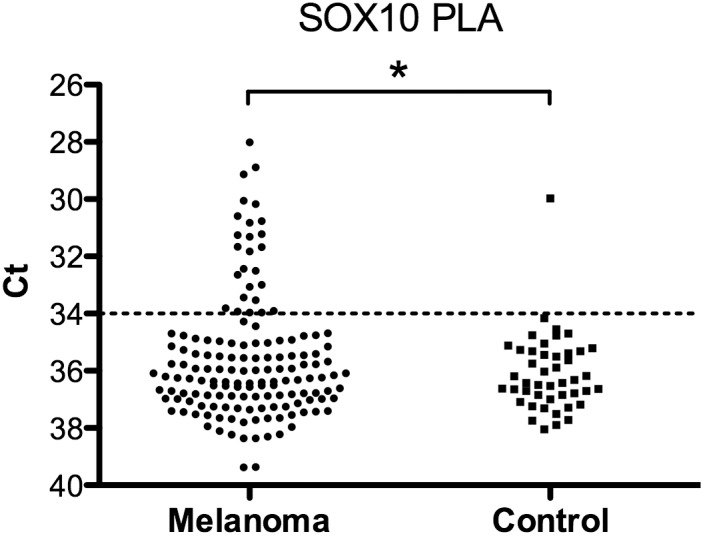
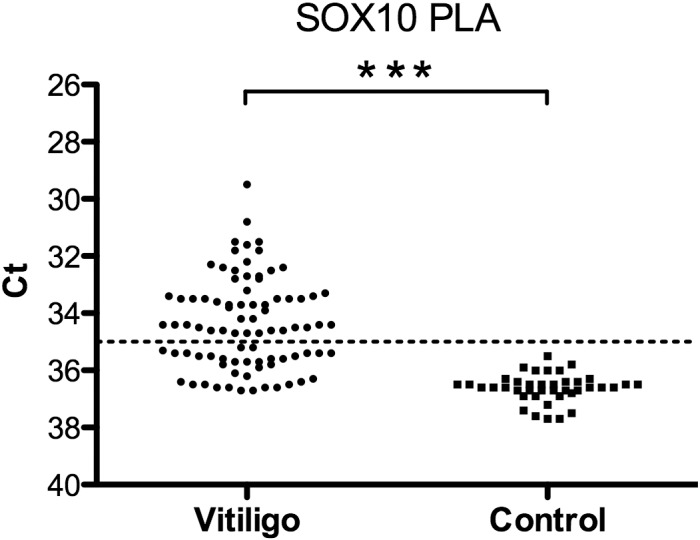
In this study we have applied proximity ligation assay (PLA) to detect the transcription factor SOX10 as a possible serum marker for melanoma. We studied a cohort of 110 melanoma patients. We further investigated a second cohort of 85 patients with vitiligo, which is a disease that also affects melanocytes.
The specificity of the SOX10 assay in serum was high, with only 1% of healthy blood donors being positive. In contrast, elevated serum SOX10 was found with high frequency among vitiligo and melanoma patients. In patients with metastases, lack of SOX10 detection was associated with treatment benefit. In two responding patients, a change from SOX10 positivity to undetectable levels was seen before the response was evident clinically.
We show for the first time that SOX10 represents a promising new serum melanoma marker for detection of early stage disease, complementing the established S100B marker. Our findings imply that SOX10 can be used to monitor responses to treatment and to assess if the treatment is of benefit at stages earlier than what is possible radiologically.
目前恶性黑色素瘤的诊断依赖于皮肤表面的临床检查以及切除肿瘤的组织病理学状况。血清标志物S100B用于疾病后期的预后评估,但分析存在假阳性以及预测复发疾病时敏感性不足的问题。
研究SOX10作为黑色素瘤和白癜风潜在生物标志物的情况。
在本研究中,我们应用了邻近连接分析(PLA)来检测转录因子SOX10,将其作为黑色素瘤可能的血清标志物。我们研究了110例黑色素瘤患者队列。我们还进一步研究了85例白癜风患者队列,白癜风也是一种影响黑素细胞的疾病。
血清中SOX10检测的特异性很高,只有1%的健康献血者呈阳性。相比之下,白癜风和黑色素瘤患者中血清SOX10升高的频率较高。在有转移的患者中,未检测到SOX10与治疗获益相关。在两名有反应的患者中,在临床反应明显之前,观察到SOX10从阳性变为检测不到。
我们首次表明,SOX10是一种有前景的新型血清黑色素瘤标志物,可用于检测早期疾病,补充已有的S100B标志物。我们的研究结果表明,SOX10可用于监测治疗反应,并在比影像学检查更早的阶段评估治疗是否有益。