Marturano-Kruik Alessandro, Villasante Aranzazu, Vunjak-Novakovic Gordana
Department of Biomedical Engineering, Columbia University, New York, NY, USA.
Laboratory for Stem Cells and Tissue Engineering, Columbia University, New York, NY, USA.
Methods Mol Biol. 2016;1502:203-11. doi: 10.1007/7651_2016_353.
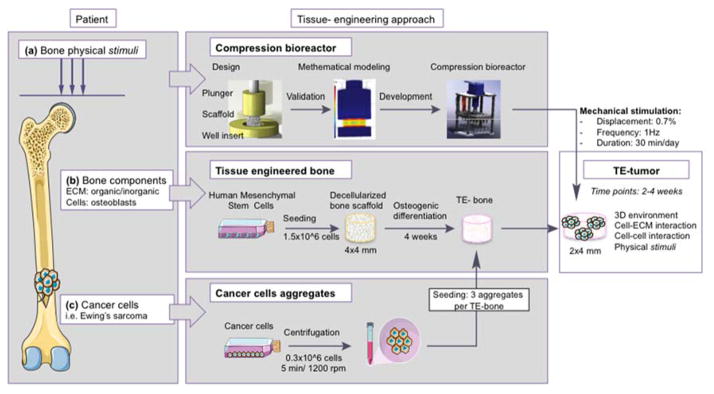
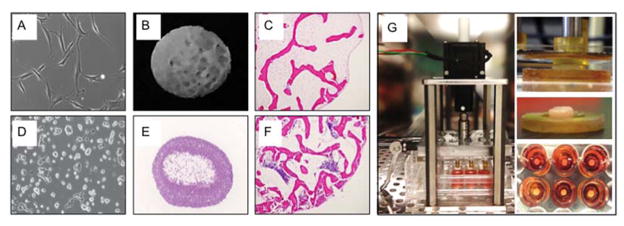
The lack of controllable in vitro models that can recapitulate the features of solid tumors such as Ewing's sarcoma limits our understanding of the tumor initiation and progression and impedes the development of new therapies. Cancer research still relies of the use of simple cell culture, tumor spheroids, and small animals. Tissue-engineered tumor models are now being grown in vitro to mimic the actual tumors in patients. Recently, we have established a new protocol for bioengineering the Ewing's sarcoma, by infusing tumor cell aggregates into the human bone engineered from the patient's mesenchymal stem cells. The bone niche allows crosstalk between the tumor cells, osteoblasts and supporting cells of the bone, extracellular matrix, and the tissue microenvironment. The bioreactor platform used in these experiments also allows the implementation of physiologically relevant mechanical signals. Here, we describe a method to build an in vitro model of Ewing's sarcoma that mimics the key properties of the native tumor and provides the tissue context and physical regulatory signals.
缺乏能够重现诸如尤因肉瘤等实体瘤特征的可控体外模型,限制了我们对肿瘤起始和进展的理解,并阻碍了新疗法的开发。癌症研究仍然依赖于简单的细胞培养、肿瘤球体和小动物。现在正在体外培养组织工程肿瘤模型,以模拟患者体内的实际肿瘤。最近,我们通过将肿瘤细胞聚集体注入由患者间充质干细胞工程化的人骨中,建立了一种新的尤因肉瘤生物工程方案。骨微环境允许肿瘤细胞、成骨细胞和骨的支持细胞、细胞外基质和组织微环境之间进行串扰。这些实验中使用的生物反应器平台还允许施加生理相关的机械信号。在这里,我们描述了一种构建尤因肉瘤体外模型的方法,该模型模拟天然肿瘤的关键特性,并提供组织背景和物理调节信号。