Bieri Tamaki, Onishi Masayuki, Xiang Tingting, Grossman Arthur R, Pringle John R
Department of Genetics, Stanford University School of Medicine, Stanford, California, United States of America.
Department of Biology, Stanford University, Stanford, California, United States of America.
PLoS One. 2016 Apr 27;11(4):e0152693. doi: 10.1371/journal.pone.0152693. eCollection 2016.
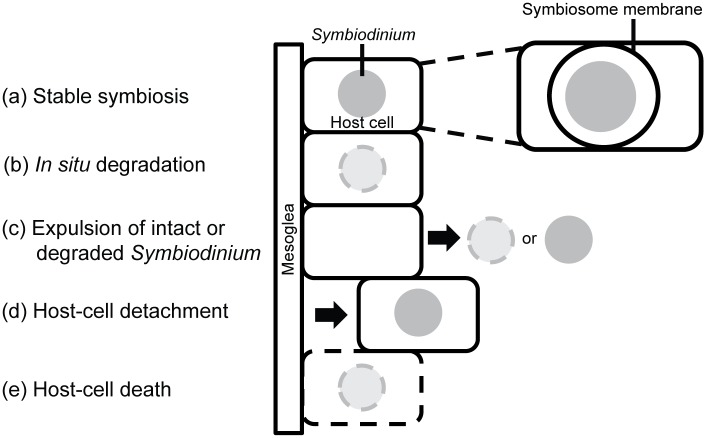
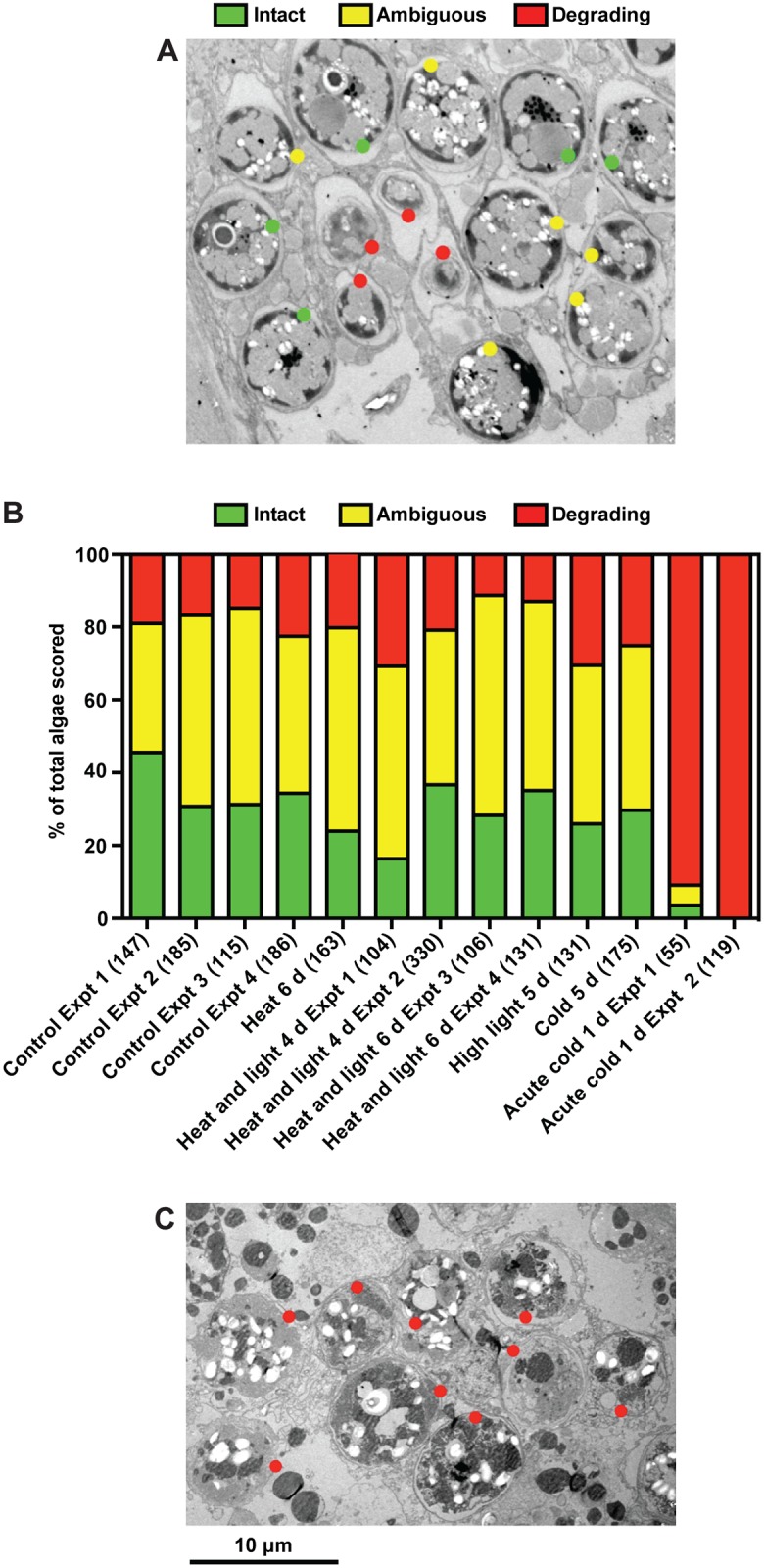
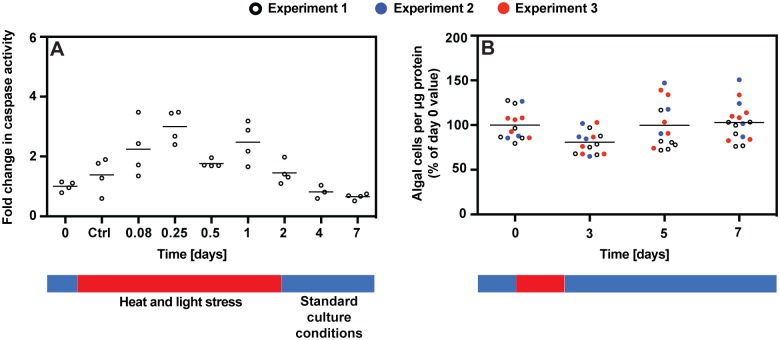
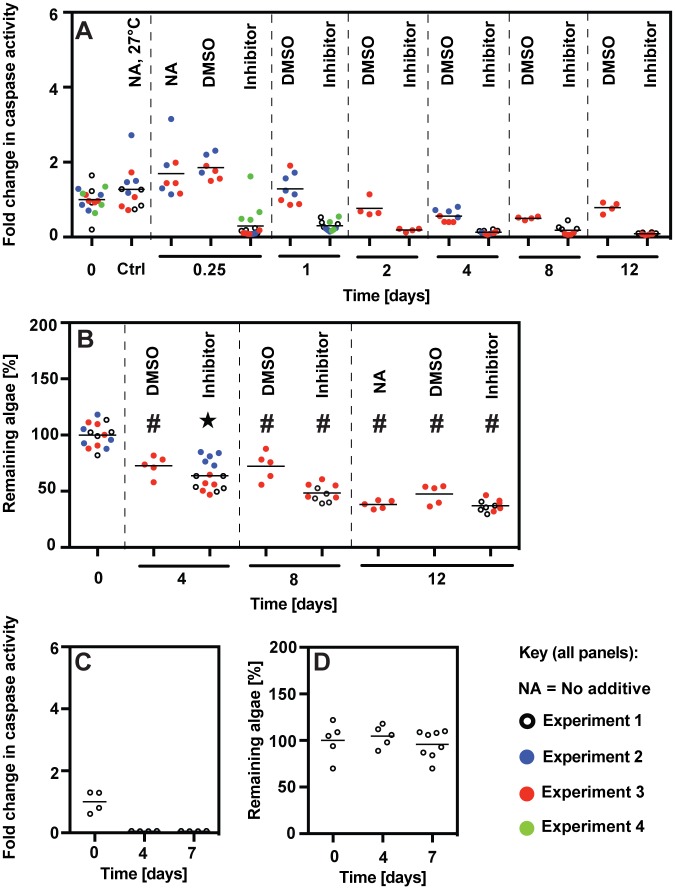
When exposed to stress such as high seawater temperature, corals and other cnidarians can bleach due to loss of symbiotic algae from the host tissue and/or loss of pigments from the algae. Although the environmental conditions that trigger bleaching are reasonably well known, its cellular and molecular mechanisms are not well understood. Previous studies have reported the occurrence of at least four different cellular mechanisms for the loss of symbiotic algae from the host tissue: in situ degradation of algae, exocytic release of algae from the host, detachment of host cells containing algae, and death of host cells containing algae. The relative contributions of these several mechanisms to bleaching remain unclear, and it is also not known whether these relative contributions change in animals subjected to different types and/or durations of stresses. In this study, we used a clonal population of the small sea anemone Aiptasia, exposed individuals to various precisely controlled stress conditions, and quantitatively assessed the several possible bleaching mechanisms in parallel. Under all stress conditions tested, except for acute cold shock at 4°C, expulsion of intact algae from the host cells appeared to be by far the predominant mechanism of bleaching. During acute cold shock, in situ degradation of algae and host-cell detachment also became quantitatively significant, and the algae released under these conditions appeared to be severely damaged.
当暴露于诸如海水温度升高等压力下时,珊瑚和其他刺胞动物会因宿主组织中共生藻类的丧失和/或藻类色素的丧失而白化。尽管引发白化的环境条件已为人熟知,但其细胞和分子机制仍不清楚。先前的研究报告了宿主组织中至少四种不同的共生藻类丧失的细胞机制:藻类的原位降解、藻类从宿主细胞的胞吐释放、含藻类宿主细胞的脱离以及含藻类宿主细胞的死亡。这几种机制对白化的相对贡献仍不清楚,而且也不知道在遭受不同类型和/或持续时间压力的动物中这些相对贡献是否会发生变化。在本研究中,我们使用了小型海葵艾氏海葵的克隆群体,将个体暴露于各种精确控制的压力条件下,并同时定量评估了几种可能的白化机制。在所有测试的压力条件下,除了4°C的急性冷休克外,完整藻类从宿主细胞的排出似乎是迄今为止主要的白化机制。在急性冷休克期间,藻类的原位降解和宿主细胞脱离在数量上也变得显著,并且在这些条件下释放的藻类似乎受到了严重损害。