Laporte Damien, Courtout Fabien, Tollis Sylvain, Sagot Isabelle
Université de Bordeaux-Institut de Biochimie et Génétique Cellulaires, 33000 Bordeaux, France CNRS-UMR5095 Bordeaux, 33077 Bordeaux cedex, France.
Wellcome Trust Centre for Cell Biology, University of Edinburgh, Edinburgh EH93BF, United Kingdom.
Mol Biol Cell. 2016 Jun 15;27(12):1875-84. doi: 10.1091/mbc.E16-01-0069. Epub 2016 Apr 27.
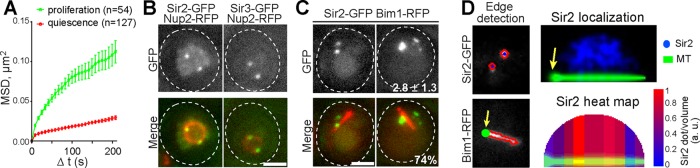
Like other eukaryotes, Saccharomyces cerevisiae spatially organizes its chromosomes within the nucleus. In G1 phase, the yeast's 32 telomeres are clustered into 6-10 foci that dynamically interact with the nuclear membrane. Here we show that, when cells leave the division cycle and enter quiescence, telomeres gather into two to three hyperclusters at the nuclear membrane vicinity. This localization depends on Esc1 but not on the Ku proteins. Telomere hypercluster formation requires the Sir complex but is independent of the nuclear microtubule bundle that specifically assembles in quiescent cells. Importantly, mutants deleted for the linker histone H1 Hho1 or defective in condensin activity or affected for histone H4 Lys-16 deacetylation are impaired, at least in part, for telomere hypercluster formation in quiescence, suggesting that this process involves chromosome condensation. Finally, we establish that telomere hypercluster formation is not necessary for quiescence establishment, maintenance, and exit, raising the question of the physiological raison d'être of this nuclear reorganization.
与其他真核生物一样,酿酒酵母在细胞核内对其染色体进行空间组织。在G1期,酵母的32个端粒聚集成6 - 10个焦点,这些焦点与核膜动态相互作用。我们在此表明,当细胞离开分裂周期进入静止期时,端粒在核膜附近聚集形成两到三个超簇。这种定位依赖于Esc1而不依赖于Ku蛋白。端粒超簇的形成需要Sir复合物,但独立于静止细胞中特异性组装的核微管束。重要的是,缺失连接组蛋白H1 Hho1的突变体、凝聚素活性有缺陷的突变体或组蛋白H4赖氨酸-16去乙酰化受影响的突变体,在静止期至少部分受损于端粒超簇的形成,这表明该过程涉及染色体凝聚。最后,我们确定端粒超簇的形成对于静止期的建立、维持和退出并非必要,这就引发了这种核重组的生理存在理由的问题。