DeSmet Ann, Thompson Debbe, Baranowski Tom, Palmeira Antonio, Verloigne Maïté, De Bourdeaudhuij Ilse
Ghent University, Department of Movement and Sport Sciences, Ghent, Belgium.
J Med Internet Res. 2016 Apr 29;18(4):e94. doi: 10.2196/jmir.4444.
Serious digital games can be effective at changing healthy lifestyles, but large differences in their effectiveness exist. The extent of user involvement in game design may contribute to game effectiveness by creating a better fit with user preferences. Participatory design (PD), which represents active user involvement as informant (ie, users are asked for input and feedback) or codesigner (ie, users as equal partners in the design) early on and throughout the game development, may be associated with higher game effectiveness, as opposed to no user involvement or limited user involvement.
This paper reports the results of a meta-analysis examining the moderating role of PD in the effectiveness of serious digital games for healthy lifestyle promotion.
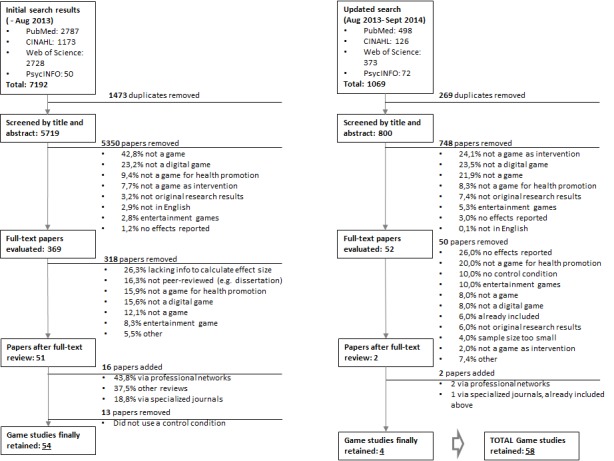
Four databases were searched for peer-reviewed papers in English that were published or in press before October 2014, using a (group-) randomized controlled trial design. Effectiveness data were derived from another meta-analysis assessing the role of behavior change techniques and game features in serious game effectiveness.
A total of 58 games evaluated in 61 studies were included. As previously reported, serious digital games had positive effects on healthy lifestyles and their determinants. Unexpectedly, PD (g=0.075, 95% CI 0.017 to 0.133) throughout game development was related to lower game effectiveness on behavior (Q=6.74, P<.05) than when users were only involved as testers (g=0.520, 95% CI 0.150 to 0.890, P<.01). Games developed with PD (g=0.171, 95% CI 0.061 to 0.281, P<.01) were also related to lower game effectiveness on self-efficacy (Q=7.83, P<.05) than when users were not involved in game design (g=0.384, 95% CI 0.283 to 0.485, P<.001). Some differences were noted depending on age group, publication year of the study, and on the specific role in PD (ie, informant or codesigner), and depending on the game design element. Games developed with PD were more effective in changing behavioral determinants when they included users in design elements on game dynamics (beta=.215, 95% CI .075 to .356, P<.01) and, more specifically, as an informant (beta=.235, 95% CI .079 to .329, P<.01). Involving users as informants in PD to create game levels was also related to higher game effectiveness (Q=7.02, P<.01). Codesign was related to higher effectiveness when used to create the game challenge (Q=11.23, P<.01), but to lower game effectiveness when used to create characters (Q=4.36, P<.05) and the game world (Q=3.99, P<.05).
The findings do not support higher effectiveness of games developed with PD. However, significant differences existed among PD games. More support was found for informant roles than for codesign roles. When PD was applied to game dynamics, levels, and game challenge, this was associated with higher effectiveness than when it was applied to game aesthetics. Since user involvement may have an important influence on reach, adoption, and implementation of the intervention, further research and design efforts are needed to enhance effectiveness of serious games developed with PD.
严肃的数字游戏在改变健康生活方式方面可能有效,但它们的效果存在很大差异。用户在游戏设计中的参与程度可能通过更好地契合用户偏好来提高游戏效果。参与式设计(PD),即在游戏开发的早期及整个过程中,让用户作为信息提供者(即征求用户的意见和反馈)或共同设计者(即用户作为设计中的平等伙伴)积极参与,与更高的游戏效果相关,这与没有用户参与或有限的用户参与形成对比。
本文报告一项荟萃分析的结果,该分析考察了参与式设计在促进健康生活方式的严肃数字游戏效果中的调节作用。
检索了四个数据库,查找2014年10月之前发表或即将发表的英文同行评审论文,采用(组)随机对照试验设计。有效性数据来自另一项荟萃分析,该分析评估了行为改变技术和游戏特征在严肃游戏效果中的作用。
共纳入61项研究中评估的58款游戏。如先前报道,严肃的数字游戏对健康生活方式及其决定因素有积极影响。出乎意料的是,与仅让用户作为测试者参与相比(g = 0.520,95%置信区间0.150至0.890,P <.01),在整个游戏开发过程中采用参与式设计(g = 0.075,95%置信区间0.017至0.133)与行为方面较低的游戏效果相关(Q = 6.74,P <.05)。与用户未参与游戏设计相比(g = 0.384,95%置信区间0.283至0.485,P <.001),采用参与式设计开发的游戏(g = 0.171,95%置信区间0.061至0.281,P <.01)在自我效能方面也与较低的游戏效果相关(Q = 7.83,P <.05)。根据年龄组、研究发表年份、参与式设计中的具体角色(即信息提供者或共同设计者)以及游戏设计元素,发现了一些差异。当采用参与式设计开发的游戏在游戏动态设计元素中纳入用户时,在改变行为决定因素方面更有效(β = 0.215,95%置信区间0.075至0.356,P <.01),更具体地说,当用户作为信息提供者时(β = 0.235,95%置信区间0.079至0.329,P <.01)。让用户作为信息提供者参与参与式设计以创建游戏关卡也与更高的游戏效果相关(Q = 7.02,P <.01)。共同设计在用于创建游戏挑战时与更高的有效性相关(Q = 11.23,P <.01),但在用于创建角色时(Q = 4.36,P <.05)和游戏世界时(Q = 3.99,P <.05)与较低的游戏效果相关。
研究结果不支持采用参与式设计开发的游戏具有更高的有效性。然而,参与式设计游戏之间存在显著差异。发现信息提供者角色比共同设计角色得到更多支持。当参与式设计应用于游戏动态、关卡和游戏挑战时,与应用于游戏美学相比,这与更高的有效性相关。由于用户参与可能对干预措施的覆盖范围、采用率和实施有重要影响,因此需要进一步的研究和设计努力来提高采用参与式设计开发的严肃游戏的有效性。
