Department of Psychiatry, University of Oxford, Warneford Hospital, Oxford, UK.
Department of Medical Epidemiology and Biostatistics, Karolinska Institutet, Stockholm, Sweden.
Transl Psychiatry. 2016 May 3;6(5):e796. doi: 10.1038/tp.2016.62.
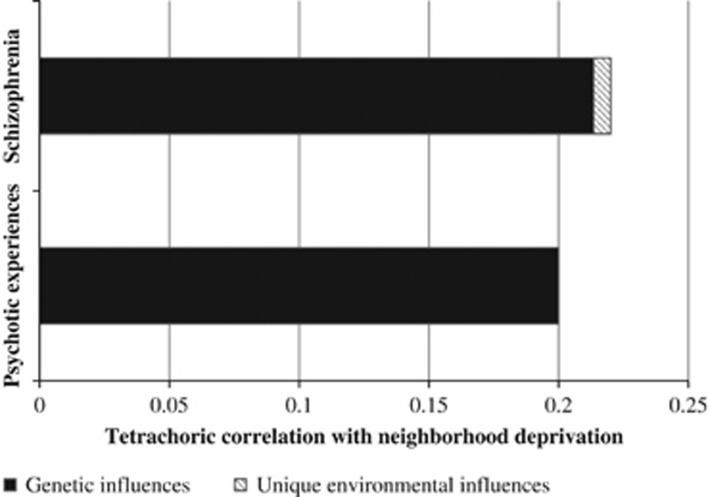
Neighborhood influences in the etiology of schizophrenia have been emphasized in a number of systematic reviews, but causality remains uncertain. To test the social drift hypothesis, we used three complementary genetically informed Swedish cohorts. First, we used nationwide Swedish data on approximately 760 000 full- and half-sibling pairs born between 1951 and 1974 and quantitative genetic models to study genetic and environmental influences on the overlap between schizophrenia in young adulthood and subsequent residence in socioeconomically deprived neighborhoods. Schizophrenia diagnoses were ascertained using the National Patient Registry. Second, we tested the overlap between childhood psychotic experiences and neighborhood deprivation in early adulthood in the longitudinal Twin Study of Child and Adolescent Development (TCHAD; n=2960). Third, we investigated to what extent polygenic risk scores for schizophrenia predicted residence in deprived neighborhoods during late adulthood using the TwinGene sample (n=6796). Sibling data suggested that living in deprived neighborhoods was substantially heritable; 65% (95% confidence interval (95% CI): 60-71%) of the variance was attributed to genetic influences. Although the correlation between schizophrenia and neighborhood deprivation was moderate in magnitude (r=0.22; 95% CI: 0.20-0.24), it was entirely explained by genetic influences. We replicated these findings in the TCHAD sample. Moreover, the association between polygenic risk for schizophrenia and neighborhood deprivation was statistically significant (R(2)=0.15%, P=0.002). Our findings are primarily consistent with a genetic selection interpretation where genetic liability for schizophrenia also predicts subsequent residence in socioeconomically deprived neighborhoods. Previous studies may have overemphasized the relative importance of environmental influences in the social drift of schizophrenia patients. Clinical and policy interventions will therefore benefit from the future identification of potentially causal pathways between different dimensions of cognitive functions and socioeconomic trajectories derived from studies adopting family-based research designs.
精神分裂症病因的邻里影响在一些系统评价中得到了强调,但因果关系仍不确定。为了检验社会漂移假说,我们使用了三个互补的瑞典遗传队列。首先,我们利用瑞典全国范围内出生于 1951 年至 1974 年的大约 76 万对全同胞和半同胞的数据,并采用定量遗传模型,研究了精神分裂症在青年期的重叠与随后居住在社会经济贫困社区之间的遗传和环境影响。精神分裂症的诊断是通过国家患者登记处确定的。其次,我们在纵向儿童和青少年发展双胞胎研究(TCHAD;n=2960)中检验了成年早期童年期精神病体验与社区贫困的重叠。第三,我们使用 TwinGene 样本(n=6796)研究了精神分裂症多基因风险评分对晚年贫困社区居住的预测程度。同胞数据表明,居住在贫困社区在很大程度上是遗传性的;65%(95%置信区间(95%CI):60-71%)的差异归因于遗传影响。尽管精神分裂症和社区贫困之间的相关性在数量上中等(r=0.22;95%CI:0.20-0.24),但这完全是由遗传影响解释的。我们在 TCHAD 样本中复制了这些发现。此外,精神分裂症多基因风险与社区贫困之间的关联具有统计学意义(R(2)=0.15%,P=0.002)。我们的研究结果主要与遗传选择解释一致,即精神分裂症的遗传易感性也预测了随后居住在社会经济贫困社区。先前的研究可能过于强调了环境影响在精神分裂症患者社会漂移中的相对重要性。因此,从采用基于家庭的研究设计的研究中得出的不同认知功能维度和社会经济轨迹之间的潜在因果途径的识别将使临床和政策干预措施受益。