Qureshi Sheharyar A, Burch Nicola, Druce Maralyn, Hattersley John G, Khan Saboor, Gopalakrishnan Kishore, Darby Catherine, Wong John L H, Davies Louise, Fletcher Simon, Shatwell William, Sothi Sharmila, Randeva Harpal S, Dimitriadis Georgios K, Weickert Martin O
The ARDEN NET Centre, European Neuroendocrine Tumour Society (ENETS) Centre of Excellence (CoE), University Hospitals Coventry and Warwickshire NHS Trust, Coventry, UK.
Department of Endocrinology, Barts and the London School of Medicine, London, UK.
BMJ Open. 2016 May 4;6(5):e010765. doi: 10.1136/bmjopen-2015-010765.
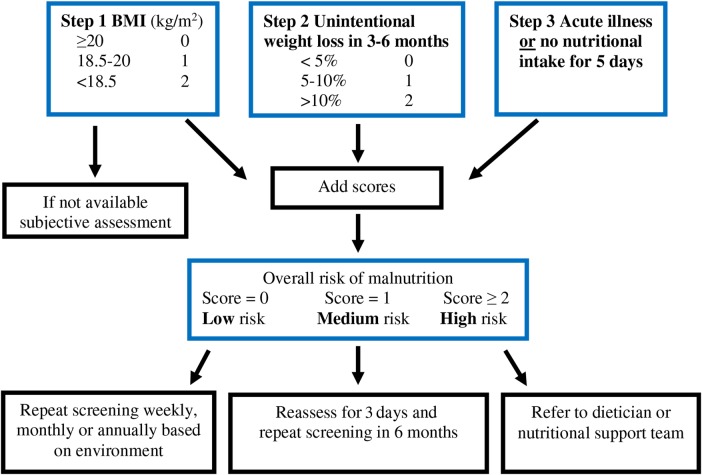
To investigate whether screening for malnutrition using the validated malnutrition universal screening tool (MUST) identifies specific characteristics of patients at risk, in patients with gastro-entero-pancreatic neuroendocrine tumours (GEP-NET).
Cross-sectional study.
University Hospitals Coventry & Warwickshire NHS Trust; European Neuroendocrine Tumour Society Centre of Excellence.
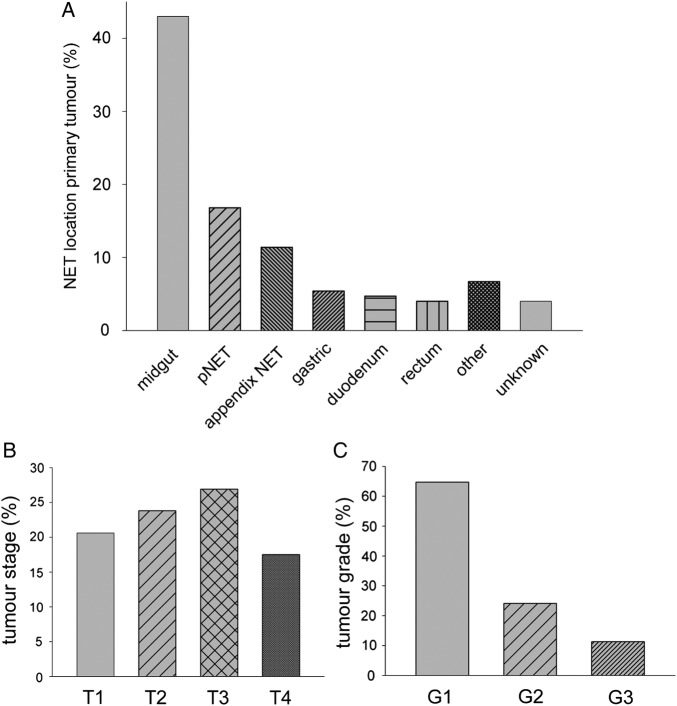
Patients with confirmed GEP-NET (n=161) of varying primary tumour sites, functioning status, grading, staging and treatment modalities.
To identify disease and treatment-related characteristics of patients with GEP-NET who score using MUST, and should be directed to detailed nutritional assessment.
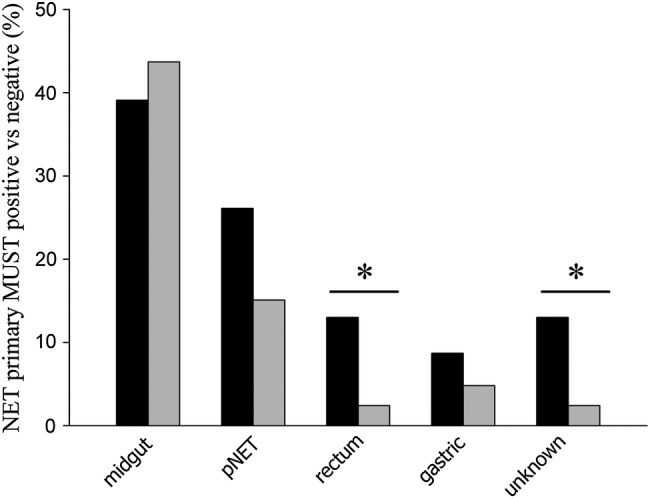
MUST score was positive (≥1) in 14% of outpatients with GEP-NET. MUST-positive patients had lower faecal elastase concentrations compared to MUST-negative patients (244±37 vs 383±20 µg/g stool; p=0.018), and were more likely to be on treatment with long-acting somatostatin analogues (65 vs 38%, p=0.021). MUST-positive patients were also more likely to have rectal or unknown primary NET, whereas, frequencies of other GEP-NET including pancreatic NET were comparable between MUST-positive and MUST-negative patients.
Given the frequency of patients identified at malnutrition risk using MUST in our relatively large and diverse GEP-NET cohort and the clinical implications of detecting malnutrition early, we recommend routine use of malnutrition screening in all patients with GEP-NET, and particularly in patients who are treated with long-acting somatostatin analogues.
在胃肠胰神经内分泌肿瘤(GEP-NET)患者中,研究使用经过验证的营养不良通用筛查工具(MUST)进行营养不良筛查是否能识别出有风险患者的特定特征。
横断面研究。
考文垂与沃里克郡大学医院国民保健服务信托基金;欧洲神经内分泌肿瘤卓越中心。
确诊为GEP-NET的患者(n = 161),其原发肿瘤部位、功能状态、分级、分期及治疗方式各不相同。
确定使用MUST评分的GEP-NET患者的疾病及治疗相关特征,这些患者应接受详细的营养评估。
GEP-NET门诊患者中14%的MUST评分呈阳性(≥1)。与MUST阴性患者相比,MUST阳性患者的粪便弹性蛋白酶浓度更低(分别为244±37 vs 383±20 μg/g粪便;p = 0.018),且更有可能正在接受长效生长抑素类似物治疗(分别为65% vs 38%,p = 0.021)。MUST阳性患者也更有可能患有直肠或原发部位不明的神经内分泌肿瘤,而其他GEP-NET(包括胰腺神经内分泌肿瘤)在MUST阳性和MUST阴性患者中的发生率相当。
鉴于在我们相对庞大且多样的GEP-NET队列中使用MUST识别出营养不良风险患者的频率,以及早期发现营养不良的临床意义,我们建议对所有GEP-NET患者常规进行营养不良筛查,尤其是对接受长效生长抑素类似物治疗的患者。