Li Shichen, Li Lingyan, Zhu Xiongzhao, Wang Yuping, Zhang Jinqiang, Zhao Liping, Li Lezhi, Yang Yanjie
Medical Psychological Institute, Second Xiangya Hospital, Central South University, Changsha, China.
Department of Nursing Care, Second Xiangya Hospital, Central South University, Changsha, China.
BMJ Open. 2016 May 4;6(5):e010829. doi: 10.1136/bmjopen-2015-010829.
This study aimed to investigate anxiety sensitivity (AS) in female Chinese nurses to better understand its characteristics and relationship with nursing stress based on the following hypotheses: (1) experienced nurses have higher AS than newly admitted nurses; and (2) specific nursing stresses are associated with AS after controlling general stress.
The cross-sectional survey was conducted from May 2014 to June 2015 among female nurses at the provincial and primary care levels in Hunan Province, China.
Among 793 nurses who volunteered to participate, 745 returned and completed the questionnaires. Eligible participants are healthy female nurses aged 18-55 years and exempt from a history of psychiatric disorder or severe somatic disease and/or a family history of psychiatric disorder.
AS was assessed by the Anxiety Sensitivity Index-3 (ASI-3). Anxiety symptoms, general stress and nursing stress were measured by the Beck Anxiety Inventory (BAI), the Perceived Stress Scale (PSS-10) and the Nursing Stress Scale (NSS).
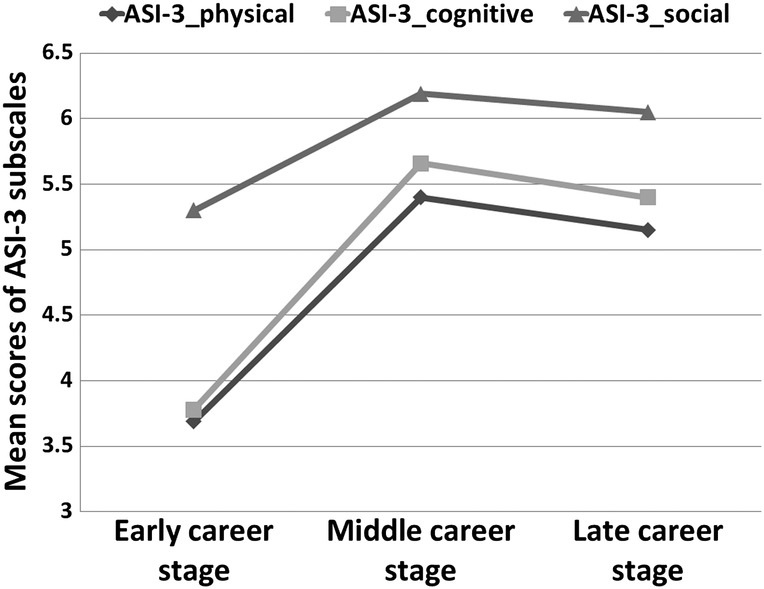
There were significant differences overall and in the three dimensions of AS across nurses of different career stages (all p<0.05). Middle and late career nurses had higher AS than early career nurses (all p<0.05), while no significant difference was found between middle and late career nurses. Conflict with physicians and heavy workload had a significant effect on all aspects of AS, whereas lack of support was related to cognitive AS (all p<0.05).
After years of exposure to stressful events during nursing, experienced female nurses may become more sensitive to anxiety. Middle career stage might be a critical period for psychological intervention targeting on AS. Hospital administrators should make efforts to reduce nurses' workload and improve their professional status. Meanwhile, more social support and appropriate psychological intervention would be beneficial to nurses with higher AS.
本研究旨在调查中国女性护士的焦虑敏感性(AS),以便基于以下假设更好地了解其特征及其与护理压力的关系:(1)经验丰富的护士比新入职护士具有更高的AS;(2)在控制一般压力后,特定的护理压力与AS相关。
2014年5月至2015年6月在中国湖南省省级和基层医疗机构对女性护士进行了横断面调查。
在793名自愿参与的护士中,745名返回并完成了问卷。符合条件的参与者为年龄在18 - 55岁的健康女性护士,且无精神疾病或严重躯体疾病史和/或精神疾病家族史。
采用焦虑敏感性指数 - 3(ASI - 3)评估AS。采用贝克焦虑量表(BAI)、感知压力量表(PSS - 10)和护理压力量表(NSS)测量焦虑症状、一般压力和护理压力。
不同职业阶段的护士在AS的总体及三个维度上均存在显著差异(均p<0.05)。职业生涯中期和后期的护士比早期护士具有更高的AS(均p<0.05),而职业生涯中期和后期的护士之间未发现显著差异。与医生的冲突和工作量大会对AS的各个方面产生显著影响,而缺乏支持与认知AS相关(均p<0.05)。
在多年接触护理工作中的压力事件后,经验丰富的女性护士可能会对焦虑变得更加敏感。职业生涯中期可能是针对AS进行心理干预的关键时期。医院管理人员应努力减轻护士的工作量并提高其职业地位。同时,更多的社会支持和适当的心理干预将对AS较高的护士有益。