Department of Clinical and Experimental Sciences, University of Brescia, Brescia, Italy.
Unit of Child Neurology and Psychiatry, ASST Spedali Civili of Brescia, Brescia, Italy.
Dev Med Child Neurol. 2021 Oct;63(10):1180-1193. doi: 10.1111/dmcn.14865. Epub 2021 May 4.
To evaluate the effectiveness of early visual training and environmental adaptation on visual function and neurological development in infants with visual impairment.
This was a pilot intervention clinical trial study. Thirty infants (mean age 5.9mo, SD 2.1mo, range 4-11mo; 16 males, 14 females) with peripheral visual impairment (PVI, n=15) or cerebral visual impairment (CVI, n=15) participated in a 6-month visual intervention programme. Thirty matched infants (mean age 6mo, SD 1.4mo, range 4-9mo; 18 males, 12 females) served as a comparison group. Primary outcome measures were visual acuity, contrast sensitivity, and qualitative ocular motor functions. Secondary outcomes were scores on the Griffiths Mental Developmental Scales (GMDS).
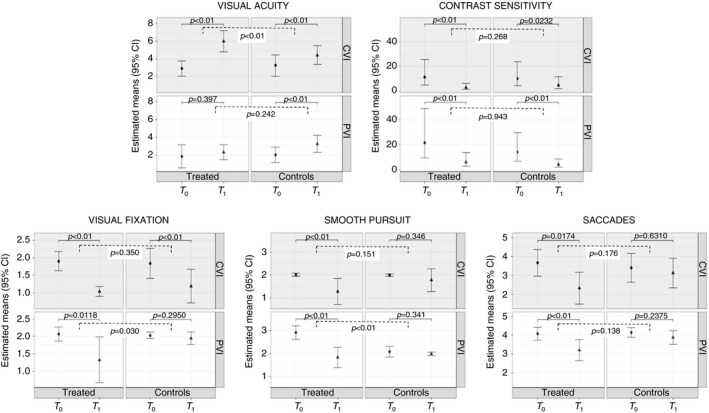
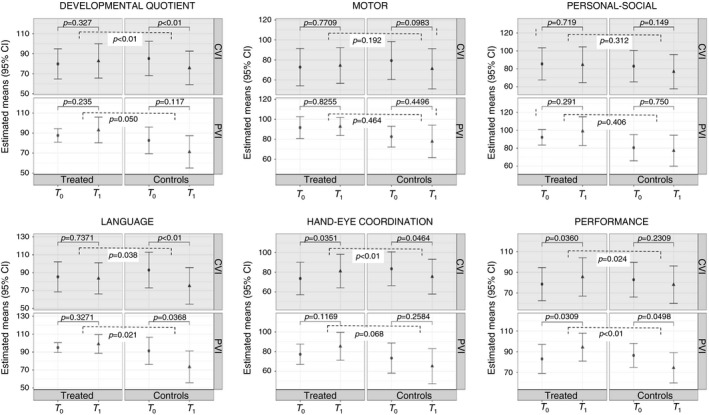
The treatment group showed a significant improvement in all the primary outcomes (p<0.01). The comparison group improved only in visual acuity and contrast sensitivity (p<0.01). The treatment group showed greater improvement than the comparison group in visual fixation (p=0.033) and smooth pursuit (p<0.01). The CVI subgroup showed greater improvement in visual acuity than the PVI subgroup (p<0.01). GMDS subscales of hand-eye coordination (p=0.01) and performance (p<0.01) increased in the treatment group, while the total score of the comparison group decreased, driven by language (p=0.039) and hand-eye coordination (p=0.025) subscales.
Results suggest that, in infants with visual impairment, visual function and certain developmental outcomes improve in response to early visual training and environmental adaptation, in an interactive context. What this paper adds Early visual training and environmental adaptation are associated with enhanced visual acuity and smooth pursuit. Early visual training and environmental adaptation are associated with an improvement of neurological developmental outcome. Performance, hand-eye coordination, and language scores in Griffiths Mental Developmental Scales increase after visual training. After training, visual acuity improves more in infants with cerebral rather than anterior visual impairment. Type and complexity of visual impairment contribute to determine infants' response to training.
评估早期视觉训练和环境适应对视力障碍婴儿视觉功能和神经发育的影响。
这是一项干预性临床试验研究。30 名婴儿(平均年龄 5.9 月龄,标准差 2.1 月龄,范围 4-11 月龄;男 16 名,女 14 名)患有周边视觉障碍(PVI,n=15)或脑性视觉障碍(CVI,n=15),参与了 6 个月的视觉干预计划。30 名匹配的婴儿(平均年龄 6 月龄,标准差 1.4 月龄,范围 4-9 月龄;男 18 名,女 12 名)作为对照组。主要结局指标为视力、对比敏感度和定性眼球运动功能。次要结局指标为 Griffiths 精神发育量表(GMDS)评分。
治疗组在所有主要结局指标上均有显著改善(p<0.01)。对照组仅在视力和对比敏感度方面有所改善(p<0.01)。治疗组在视觉固视(p=0.033)和平滑追踪(p<0.01)方面的改善优于对照组。CVI 亚组的视力改善优于 PVI 亚组(p<0.01)。治疗组的手眼协调(p=0.01)和表现(p<0.01)GMDS 子量表增加,而对照组的总分下降,主要由语言(p=0.039)和手眼协调(p=0.025)子量表驱动。
结果表明,在视力障碍婴儿中,早期视觉训练和环境适应可改善视觉功能和某些发育结局,这种改善是在互动的背景下发生的。本研究的意义在于,早期视觉训练和环境适应与提高视力和平滑追踪有关。早期视觉训练和环境适应与神经发育结果的改善有关。经过视觉训练后,Griffiths 精神发育量表的表现、手眼协调和语言评分增加。训练后,脑性视觉障碍婴儿的视力改善优于前视觉障碍婴儿。视觉障碍的类型和复杂程度决定了婴儿对训练的反应。