Fernández Pablo, Alcántara-de la Cruz Ricardo, Cruz-Hipólito Hugo, Osuna María D, De Prado Rafael
Department of Agricultural Chemistry and Edaphology, University of Cordoba Cordoba, Spain.
Bayer CropScience, Col. Ampl. Granada México.
Front Plant Sci. 2016 Apr 11;7:449. doi: 10.3389/fpls.2016.00449. eCollection 2016.
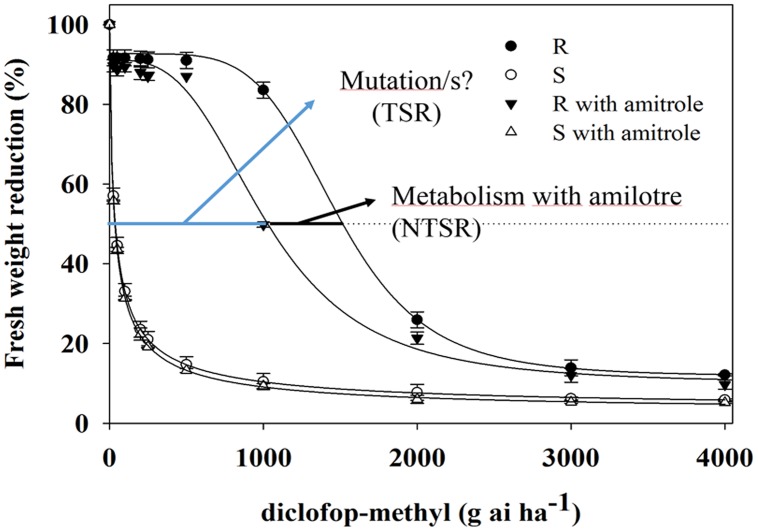
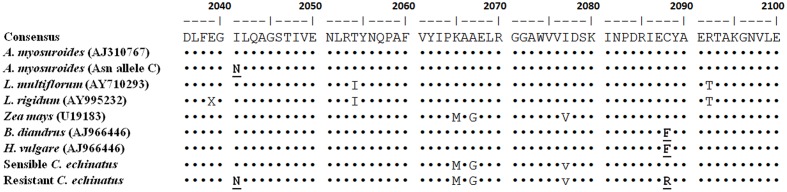
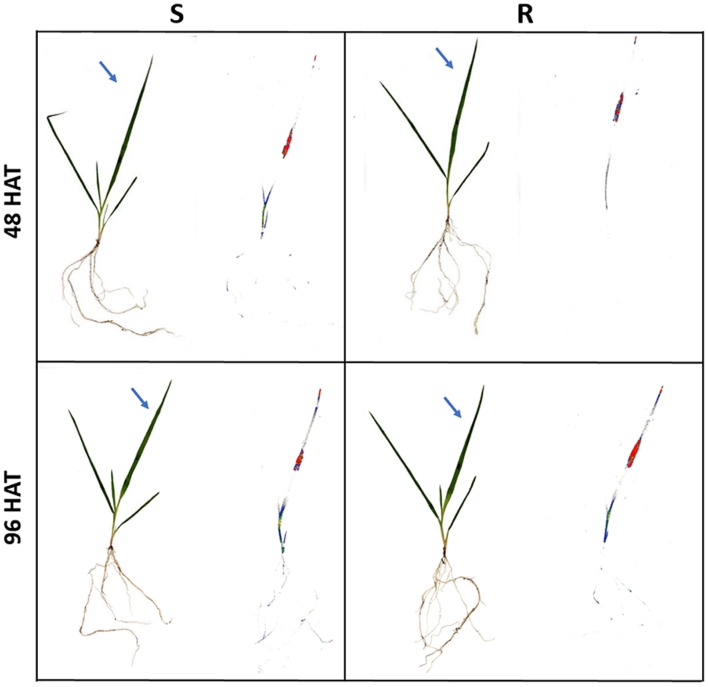
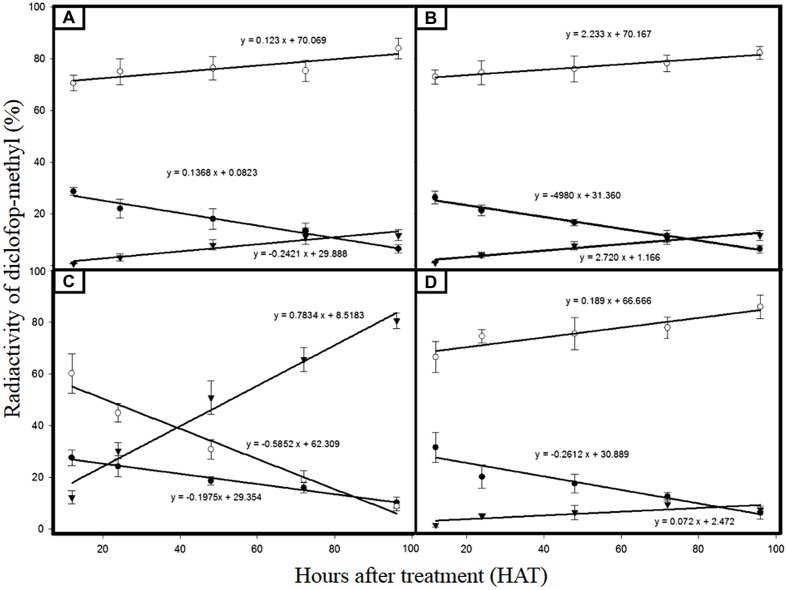
Hedgehog dogtail (Cynosurus echinatus) is an annual grass, native to Europe, but also widely distributed in North and South America, South Africa, and Australia. Two hedgehog dogtail biotypes, one diclofop-methyl (DM)-resistant and one DM-susceptible were studied in detail for experimental dose-response resistance mechanisms. Herbicide rates that inhibited shoot growth by 50% (GR50) were determined for DM, being the resistance factor (GR50R/GR50S) of 43.81. When amitrole (Cyt. P450 inhibitor) was applied before treatment with DM, the R biotype growth was significantly inhibited (GR50 of 1019.9 g ai ha(-1)) compared with the GR50 (1484.6 g ai ha(-1)) found for the R biotype without pretreatment with amitrole. However, GR50 values for S biotype do not vary with or without amitrole pretreatment. Dose-response experiments carried out to evaluate cross-resistance, showed resistance to aryloxyphenoxypropionate (APP), cyclohexanedione (CHD) and phenylpyrazoline (PPZ) inhibiting herbicides. Both R and S biotypes had a similar (14)C-DM uptake and translocation. The herbicide was poorly distributed among leaves, the rest of the shoot and roots with unappreciable acropetal and/or basipetal DM translocation at 96 h after treatment (HAT). The metabolism of (14)C-DM, D-acid and D-conjugate metabolites were identified by thin-layer chromatography. The results showed that DM resistance in C. echinatus is likely due to enhanced herbicide metabolism, involving Cyt. P450 as was demonstrated by indirect assays (amitrole pretreatment). The ACCase in vitro assays showed that the target site was very sensitive to APP, CHD and PPZ herbicides in the C. echinatus S biotype, while the R biotype was insensitive to the previously mentioned herbicides. DNA sequencing studies confirmed that C. echinatus cross-resistance to ACCase inhibitors has been conferred by specific ACCase double point mutations Ile-2041-Asn and Cys-2088-Arg.
猬草(Cynosurus echinatus)是一种一年生草本植物,原产于欧洲,但也广泛分布于南北美洲、南非和澳大利亚。对两种猬草生物型进行了详细研究,一种对精稳杀得(DM)具有抗性,另一种对DM敏感,以探究实验剂量反应抗性机制。测定了抑制地上部生长50%(GR50)的除草剂剂量,DM的抗性因子(GR50R/GR50S)为43.81。在用DM处理前施用杀草强(细胞色素P450抑制剂)时,与未用杀草强预处理的R生物型的GR50(1484.6克有效成分/公顷)相比,R生物型的生长受到显著抑制(GR50为1019.9克有效成分/公顷)。然而,S生物型的GR50值在有无杀草强预处理的情况下没有变化。为评估交互抗性而进行的剂量反应实验表明,对芳氧苯氧丙酸酯(APP)、环己二酮(CHD)和苯基吡唑啉(PPZ)类抑制性除草剂具有抗性。R和S生物型对(14)C-DM的吸收和转运相似。在处理后96小时(HAT),除草剂在叶片、地上部其余部分和根部的分布较差,没有明显的向顶和/或向基DM转运。通过薄层色谱法鉴定了(14)C-DM、D-酸和D-共轭代谢物的代谢情况。结果表明,猬草对DM的抗性可能是由于除草剂代谢增强,涉及细胞色素P450,这已通过间接试验(杀草强预处理)得到证明。体外乙酰辅酶A羧化酶(ACCase)测定表明,在猬草S生物型中,靶标位点对APP、CHD和PPZ除草剂非常敏感,而R生物型对上述除草剂不敏感。DNA测序研究证实,猬草对ACCase抑制剂的交互抗性是由特定的ACCase双点突变Ile-2041-Asn和Cys-2088-Arg赋予的。