Taparra Kekoa, Tran Phuoc T, Zachara Natasha E
Department of Radiation Oncology and Molecular Radiation Sciences, Sidney Kimmel Comprehensive Cancer Center, Johns Hopkins University School of Medicine, Baltimore, MD, USA; Program in Cellular and Molecular Medicine, Johns Hopkins University School of Medicine, Baltimore, MD, USA.
Department of Radiation Oncology and Molecular Radiation Sciences, Sidney Kimmel Comprehensive Cancer Center, Johns Hopkins University School of Medicine, Baltimore, MD, USA; Program in Cellular and Molecular Medicine, Johns Hopkins University School of Medicine, Baltimore, MD, USA; Department of Oncology, Sidney Kimmel Comprehensive Cancer Center, Johns Hopkins University School of Medicine, Baltimore, MD, USA; Department of Urology, Johns Hopkins University School of Medicine, Baltimore, MD, USA.
Front Oncol. 2016 Apr 18;6:85. doi: 10.3389/fonc.2016.00085. eCollection 2016.
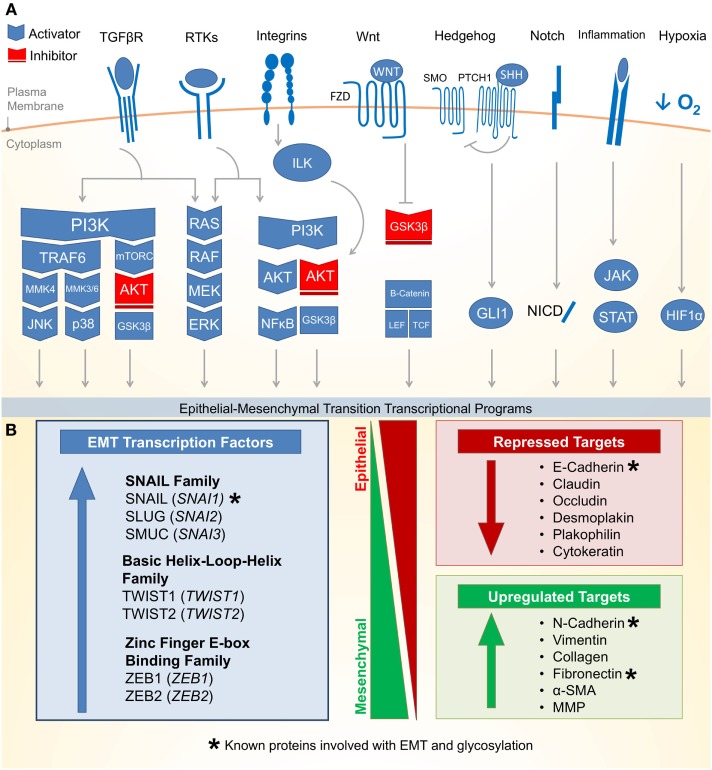
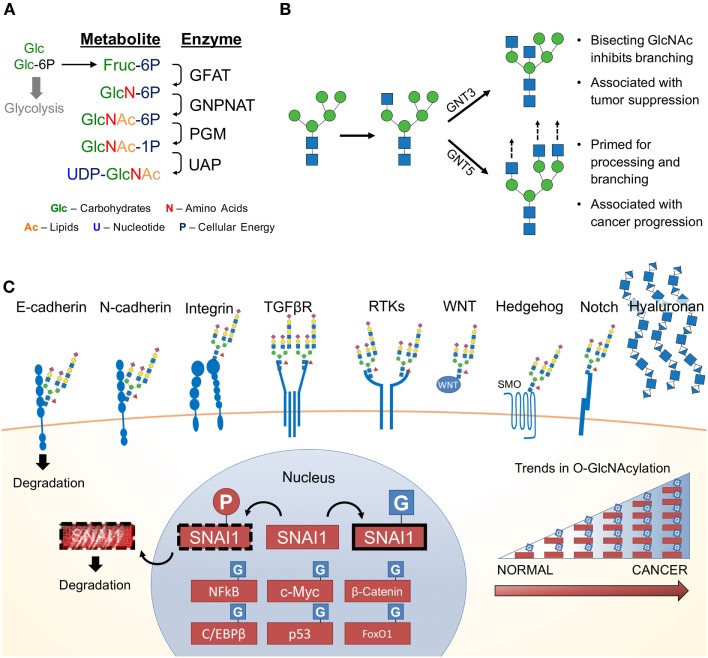
The epithelial-mesenchymal transition (EMT) is a highly conserved program necessary for orchestrating distant cell migration during embryonic development. Multiple studies in cancer have demonstrated a critical role for EMT during the initial stages of tumorigenesis and later during tumor invasion. Transcription factors (TFs) such as SNAIL, TWIST, and ZEB are master EMT regulators that are aberrantly overexpressed in many malignancies. Recent evidence correlates EMT-related transcriptomic alterations with metabolic reprograming in cancer. Metabolic alterations may allow cancer to adapt to environmental stressors, supporting the irregular macromolecular demand of rapid proliferation. One potential metabolic pathway of increasing importance is the hexosamine biosynthesis pathway (HBP). The HBP utilizes glycolytic intermediates to generate the metabolite UDP-GlcNAc. This and other charged nucleotide sugars serve as the basis for biosynthesis of glycoproteins and other glycoconjugates. Recent reports in the field of glycobiology have cultivated great curiosity within the cancer research community. However, specific mechanistic relationships between the HBP and fundamental pathways of cancer, such as EMT, have yet to be elucidated. Altered protein glycosylation downstream of the HBP is well positioned to mediate many cellular changes associated with EMT including cell-cell adhesion, responsiveness to growth factors, immune system evasion, and signal transduction programs. Here, we outline some of the basics of the HBP and putative roles the HBP may have in driving EMT-related cancer processes. With novel appreciation of the HBP's connection to EMT, we hope to illuminate the potential for new therapeutic targets of cancer.
上皮-间质转化(EMT)是胚胎发育过程中协调远距离细胞迁移所必需的高度保守程序。癌症领域的多项研究表明,EMT在肿瘤发生的初始阶段以及随后的肿瘤侵袭过程中发挥着关键作用。转录因子(TFs)如SNAIL、TWIST和ZEB是主要的EMT调节因子,在许多恶性肿瘤中异常过度表达。最近的证据将EMT相关的转录组改变与癌症中的代谢重编程联系起来。代谢改变可能使癌症适应环境应激源,支持快速增殖对大分子的不规则需求。一个越来越重要的潜在代谢途径是己糖胺生物合成途径(HBP)。HBP利用糖酵解中间体生成代谢物UDP-GlcNAc。这种以及其他带电荷的核苷酸糖是糖蛋白和其他糖缀合物生物合成的基础。糖生物学领域的最新报道引起了癌症研究界的极大兴趣。然而,HBP与癌症基本途径(如EMT)之间的具体机制关系尚未阐明。HBP下游改变的蛋白质糖基化很可能介导许多与EMT相关的细胞变化,包括细胞间粘附、对生长因子的反应、逃避免疫系统以及信号转导程序。在此,我们概述了HBP的一些基础知识以及HBP在驱动EMT相关癌症过程中可能具有的假定作用。随着对HBP与EMT联系的新认识,我们希望阐明癌症新治疗靶点的潜力。