Ecker Assis, Araujo Vieira Francielli, de Souza Prestes Alessandro, Mulling Dos Santos Matheus, Ramos Angelica, Dias Ferreira Rafael, Teixeira de Macedo Gabriel, Vargas Klimaczewski Claudia, Lopes Seeger Rodrigo, Teixeira da Rocha João Batista, de Vargas Barbosa Nilda B
Department of Biochemistry and Molecular Biology, Universidade Federal de Santa Maria, 97105-900, Santa Maria, RS, Brazil.
EXCLI J. 2015 Nov 27;14:1219-31. doi: 10.17179/excli2015-576. eCollection 2015.
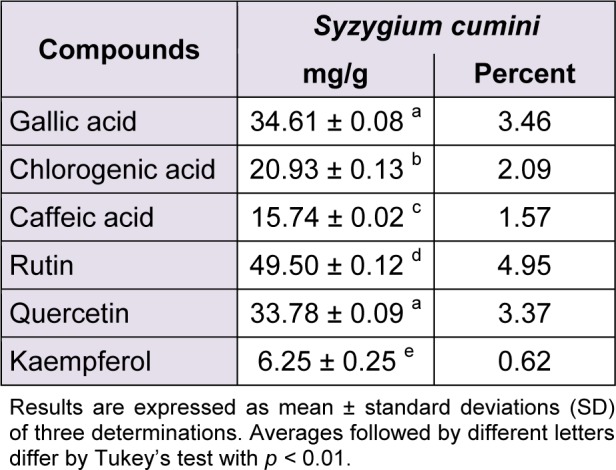
Aqueous-leaf extract of Syzygium cumini and Bauhinia forficata are traditionally used in the treatment of diabetes and cancer, especially in South America, Africa, and Asia. In this study, we analyzed the effects of these extracts on oxidative and mitochondrial parameters in vitro, as well as their protective activities against toxic agents. Phytochemical screenings of the extracts were carried out by HPLC analysis. The in vitro antioxidant capacities were compared by DPPH radical scavenging and Fe(2+) chelating activities. Mitochondrial parameters observed were swelling, lipid peroxidation and dehydrogenase activity. The major chemical constituent of S. cumini was rutin. In B. forficata were predominant quercetin and gallic acid. S. cumini reduced DPPH radical more than B. forficata, and showed iron chelating activity at all tested concentrations, while B. forficata had not similar property. In mitochondria, high concentrations of B. forficata alone induced a decrease in mitochondrial dehydrogenase activity, but low concentrations of this extract prevented the effect induced by Fe(2+)+H2O2. This was also observed with high concentrations of S. cumini. Both extracts partially prevented the lipid peroxidation induced by Fe(2+)/citrate. S. cumini was effective against mitochondrial swelling induced by Ca(2+), while B. forficata alone induced swelling more than Ca(2+). This study suggests that leaf extract of S. cumini might represent a useful therapeutic for the treatment of diseases related with mitochondrial dysfunctions. On the other hand, the consumption of B. forficata should be avoided because mitochondrial damages were observed, and this possibly may pose risk to human health.
蒲桃和紫铆树的水叶提取物传统上用于治疗糖尿病和癌症,尤其是在南美洲、非洲和亚洲。在本研究中,我们分析了这些提取物对体外氧化和线粒体参数的影响,以及它们对有毒物质的保护活性。通过高效液相色谱分析对提取物进行植物化学筛选。通过DPPH自由基清除和Fe(2+)螯合活性比较体外抗氧化能力。观察到的线粒体参数包括肿胀、脂质过氧化和脱氢酶活性。蒲桃的主要化学成分是芦丁。在紫铆树中,主要成分是槲皮素和没食子酸。蒲桃比紫铆树更能降低DPPH自由基,并在所有测试浓度下均表现出铁螯合活性,而紫铆树没有类似特性。在体外培养的线粒体中,单独使用高浓度的紫铆树提取物会导致线粒体脱氢酶活性降低,但低浓度的该提取物可防止由Fe(2+)+H2O2诱导的这种影响。高浓度的蒲桃提取物也观察到了同样的现象。两种提取物都部分地阻止了由Fe(2+)/柠檬酸盐诱导的脂质过氧化。蒲桃提取物对由Ca(2+)诱导的线粒体肿胀有效,而单独使用紫铆树提取物比Ca(2+)更易诱导肿胀。本研究表明,蒲桃叶提取物可能是治疗与线粒体功能障碍相关疾病的有效药物。另一方面,应避免食用紫铆树提取物,因为观察到了线粒体损伤,这可能对人类健康构成风险。