Santiago Alina, Barczyk Steffen, Jelen Urszula, Engenhart-Cabillic Rita, Wittig Andrea
Department of Radiotherapy and Radiation Oncology, University Hospital Giessen and Marburg, Philipps-University Marburg, Baldingerstrasse, Marburg, 35043, Germany.
Present address: Gemeinschaftspraxis Strahlentherapie am St. Agnes Hospital, Bocholt, Germany.
Radiat Oncol. 2016 May 6;11:67. doi: 10.1186/s13014-016-0643-5.
To study the dose-response of stage I non-small-cell lung cancer (NSCLC) in terms of long-term local tumor control (LC) after conventional and hypofractionated photon radiotherapy, modeled with the linear-quadratic (LQ) and linear-quadratic-linear (LQ-L) approaches and to estimate the clinical α/β ratio within the LQ frame.
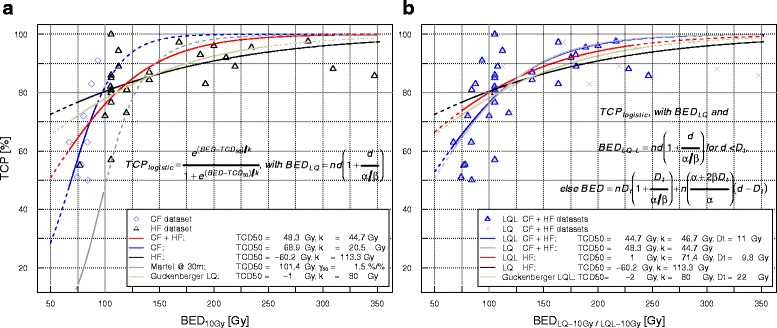
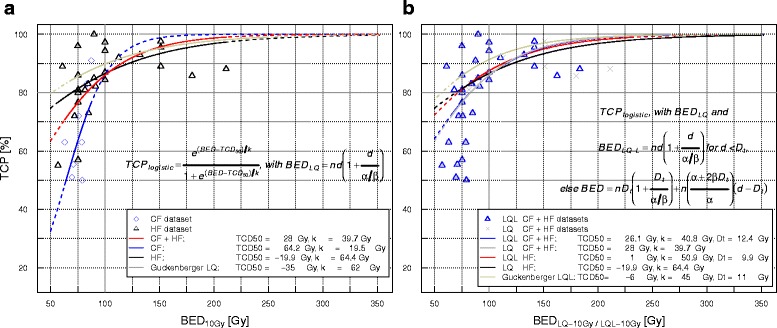
We identified studies of curative radiotherapy as single treatment through MedLine search reporting 3-year LC as primary outcome of interest. Logistic models coupled with the biologically effective dose (BED) at isocenter and PTV edge according to both the LQ and LQ-L models with α/β = 10 Gy were fitted. Additionally, α/β was estimated from direct LQ fits.
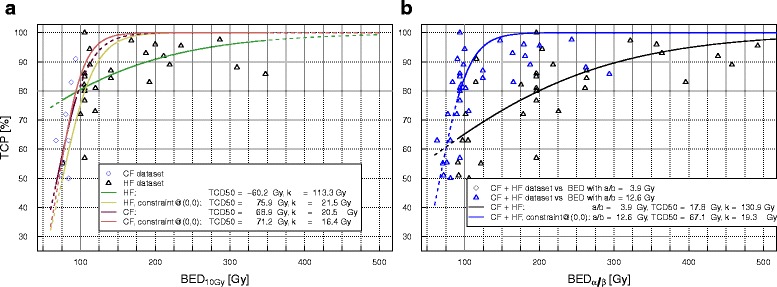
Thirty one studies were included reporting outcome of 2319 patients. The LQ-L fit yielded a significant value of 11.0 ± 5.2 Gy for the dose threshold (Dt) for BED10 at the isocenter. The LQ and LQ-L fits did not differ substantially. Concerning the estimation of α/β, the value obtained from the direct LQ fit for the complete fractionation range was 3.9 [68 % CI: 2.2-9.0] Gy (p > 0.05).
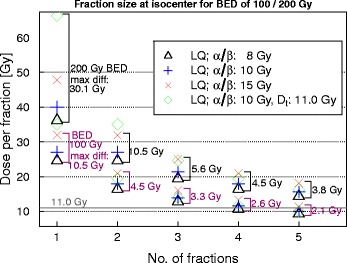
Both LQ and LQ-L fits can model local tumor control after conventionally and hypofractionated irradiation and are robust methods for predicting clinical effects. The observed dose-effect for local control in NSCLC is weaker at high doses due to data dispersion. For BED10 values of 100-150 Gy in ≥3 fractions, the differences in isoeffects predicted by both models can be neglected.
采用线性二次(LQ)和线性二次线性(LQ-L)方法,研究Ⅰ期非小细胞肺癌(NSCLC)在常规和大分割光子放疗后长期局部肿瘤控制(LC)方面的剂量反应,并在LQ框架内估计临床α/β比值。
我们通过MedLine搜索确定了将根治性放疗作为单一治疗的研究,报告3年LC作为主要关注结果。根据α/β = 10 Gy的LQ和LQ-L模型,拟合了与等中心和计划靶区(PTV)边缘的生物等效剂量(BED)相关的逻辑模型。此外,通过直接的LQ拟合估计α/β。
纳入了31项研究,报告了2319例患者的结果。对于等中心处BED10的剂量阈值(Dt),LQ-L拟合得出的显著值为11.0±5.2 Gy。LQ和LQ-L拟合没有实质性差异。关于α/β的估计,在整个分割范围通过直接LQ拟合获得的值为3.9 [68%可信区间:2.2 - 9.0] Gy(p>0.05)。
LQ和LQ-L拟合均可模拟常规和大分割照射后的局部肿瘤控制,是预测临床效果的可靠方法。由于数据离散,NSCLC中观察到的高剂量局部控制剂量效应较弱。对于≥3次分割中BED10值为100 - 150 Gy的情况,两种模型预测的等效效应差异可忽略不计。