
民族聚居地和土地管理状况对物种分布格局的影响:以中国云南西北部濒危麝类(Moschus spp.)为例
Effects of Ethnic Settlements and Land Management Status on Species Distribution Patterns: A Case Study of Endangered Musk Deer (Moschus spp.) in Northwest Yunnan, China.
作者信息
Li Xueyou, Bleisch William V, Jiang Xuelong
机构信息
State Key Laboratory of Genetic Resources and Evolution, Kunming Institute of Zoology, Chinese Academy of Sciences, Kunming, Yunnan, China.
China Exploration and Research Society, Wong Chuk Hang, Hong Kong, PRC.
出版信息
PLoS One. 2016 May 9;11(5):e0155042. doi: 10.1371/journal.pone.0155042. eCollection 2016.
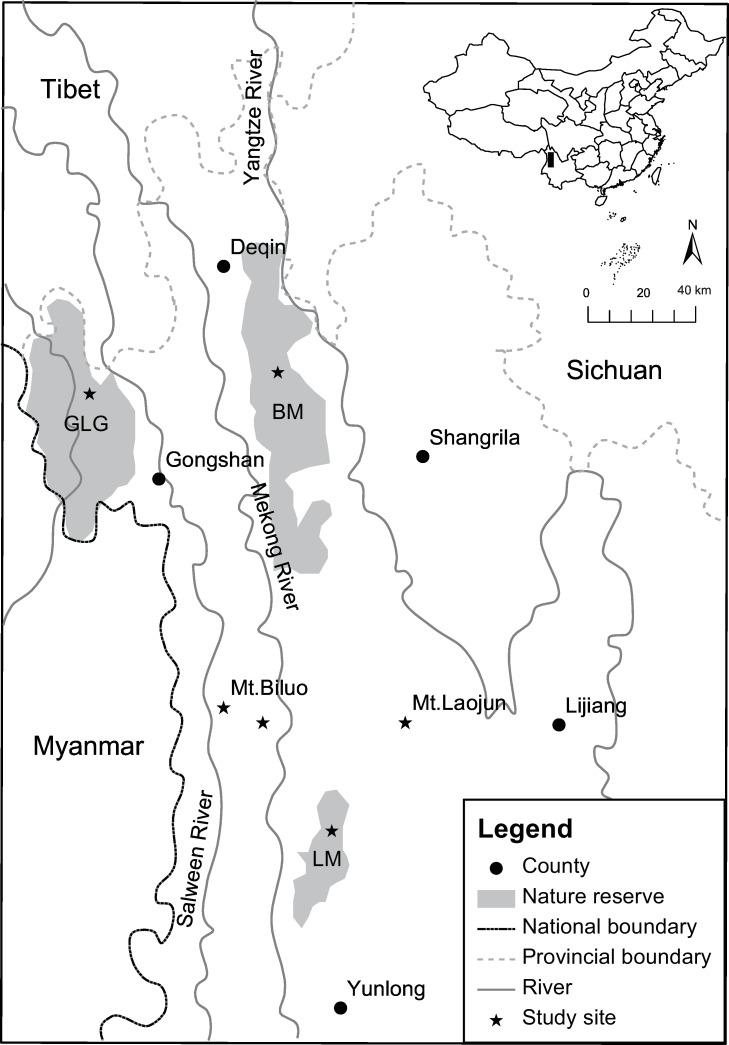
Understanding the status and spatial distribution of endangered species in biologically and ethnologically diverse areas is important to address correlates of cultural and biological diversity. We developed models for endangered musk deer (Moschus spp.) abundance indices in and around protected areas inhabited by different ethnic groups in northwest Yunnan China to address different anthropogenic and management-related questions. We found that prediction of relative abundance of musk deer was best accomplished using ethnicity of settlements, conservation status and poaching pressure in an area. Musk deer were around 5 times more abundant in Tibetan regions relative to Lisu regions. We found no significant negative correlates of gathering and transhumance activities on musk deer abundance. Hunting pressure showed no significant differences between protected and non-protected areas, but showed significant differences among ethnic groups. Hunting pressures in areas adjacent to Lisu settlements was 7.1 times more than in areas adjacent to Tibetan settlements. Our findings indicate protected areas in southwest China are not fully effective in deterring human disturbance caused by traditional practices. We suggest that conservation and management strategies should engage traditional culture and practices with a positive conservation impact. Better understanding of indigenous culture may open up new opportunities for species conservation in much wider tracts of unprotected and human-dominated lands. Traditional practices that are not destructive to biodiversity should be allowed as a way of providing a link between the local communities and protected areas thereby creating incentives for conservation.
了解生物和民族多样化地区濒危物种的现状和空间分布,对于解决文化和生物多样性的相关问题至关重要。我们针对中国云南西北部不同民族聚居的保护区及其周边地区的濒危麝类(麝属)丰度指数建立了模型,以解决不同的人为因素和与管理相关的问题。我们发现,利用一个地区的聚落民族构成、保护状况和偷猎压力,能够最好地预测麝类的相对丰度。相对于傈僳族地区,麝类在藏族地区的数量大约多5倍。我们发现采集和游牧活动与麝类数量之间没有显著的负相关关系。狩猎压力在保护区和非保护区之间没有显著差异,但在不同民族之间存在显著差异。傈僳族聚落附近地区的狩猎压力比藏族聚落附近地区高7.1倍。我们的研究结果表明,中国西南地区的保护区在遏制传统习俗造成的人为干扰方面并不完全有效。我们建议,保护和管理策略应将传统文化和习俗纳入其中,并产生积极的保护效果。更好地了解本土文化可能会为更广阔的未受保护和人类主导地区的物种保护带来新机遇。不应破坏生物多样性的传统习俗应被允许,作为连接当地社区和保护区的一种方式,从而创造保护的激励机制。

 Zotero 插件