Kulakova Eugenia, Nieuwland Mante S
Centre for Cognitive Neuroscience, Department of Psychology, University of Salzburg, Salzburg, Austria.
Department of Psychology, School of Philosophy, Psychology and Language Sciences, University of Edinburgh, Edinburgh, UK.
Cogn Affect Behav Neurosci. 2016 Oct;16(5):814-24. doi: 10.3758/s13415-016-0433-4.
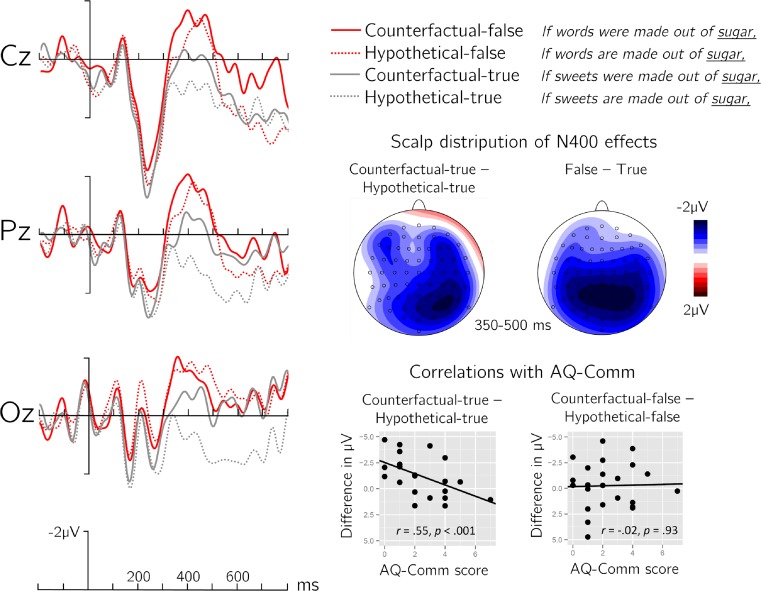
Counterfactual thought allows people to consider alternative worlds they know to be false. Communicating these thoughts through language poses a social-communicative challenge because listeners typically expect a speaker to produce true utterances, but counterfactuals per definition convey information that is false. Listeners must therefore incorporate overt linguistic cues (subjunctive mood, such as in If I loved you then) in a rapid way to infer the intended counterfactual meaning. The present EEG study focused on the comprehension of such counterfactual antecedents and investigated if pragmatic ability-the ability to apply knowledge of the social-communicative use of language in daily life-predicts the online generation of counterfactual worlds. This yielded two novel findings: (1) Words that are consistent with factual knowledge incur a semantic processing cost, as reflected in larger N400 amplitude, in counterfactual antecedents compared to hypothetical antecedents (If sweets were/are made of sugar). We take this to suggest that counterfactuality is quickly incorporated during language comprehension and reduces online expectations based on factual knowledge. (2) Individual scores on the Autism Quotient Communication subscale modulated this effect, suggesting that individuals who are better at understanding the communicative intentions of other people are more likely to reduce knowledge-based expectations in counterfactuals. These results are the first demonstration of the real-time pragmatic processes involved in creating possible worlds.
反事实思维使人们能够思考他们明知为假的替代世界。通过语言来传达这些想法会带来社会交际方面的挑战,因为听众通常期望说话者说出真实的话语,但根据定义,反事实陈述传达的是虚假信息。因此,听众必须迅速纳入明显的语言线索(如虚拟语气,例如在“如果我爱过你”中),以推断出预期的反事实含义。目前的脑电图研究聚焦于对这类反事实前提的理解,并探究实用能力——即在日常生活中运用语言社会交际知识的能力——是否能预测反事实世界的在线生成。这产生了两个新发现:(1)与事实知识相符的词语在反事实前提中会产生语义加工成本,这在反事实前提与假设前提(如果糖果是由糖制成的)相比时,表现为更大的N400波幅。我们认为这表明在语言理解过程中,反事实性会迅速被纳入,并降低基于事实知识的在线预期。(2)自闭症商数交流子量表上的个体得分调节了这种效应,这表明更善于理解他人交际意图的个体更有可能在反事实陈述中降低基于知识的预期。这些结果首次证明了在创造可能世界过程中所涉及的实时语用过程。