Gao Jie, Fu Shanmin, Zeng Zhaobin, Li Feifei, Niu Qiannan, Jing Da, Feng Xue
State Key Laboratory of Military Stomatology, Department of Orthodontics, School of Stomatology, Fourth Military Medical University, Xi'an, Shaanxi 710032, P.R. China.
Department of Stomatology, General Hospital of Shenyang Military Area Command, Shenyang, Liaoning 110084, P.R. China.
Mol Med Rep. 2016 Jul;14(1):218-24. doi: 10.3892/mmr.2016.5239. Epub 2016 May 10.
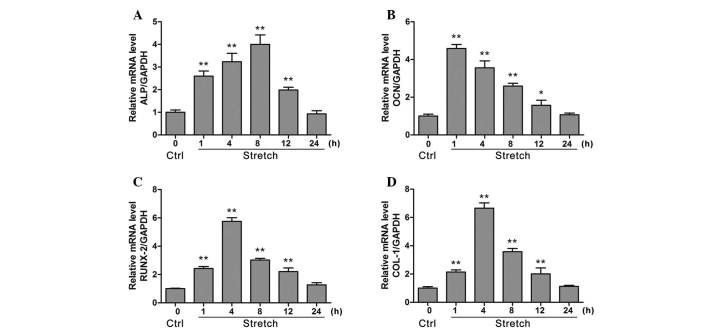
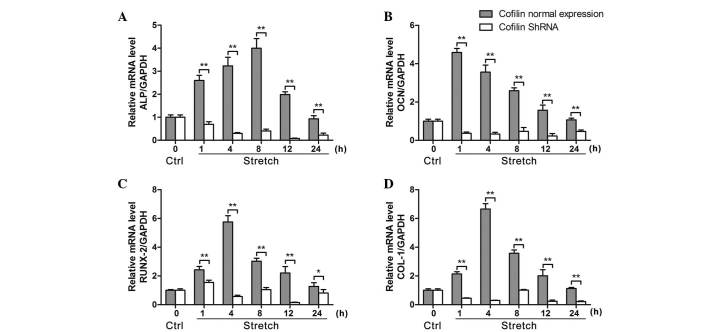
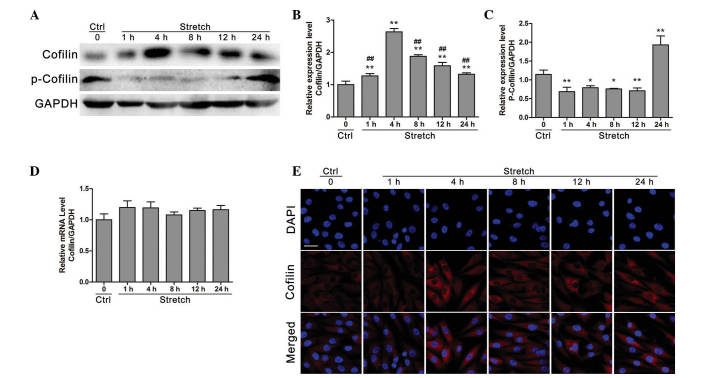
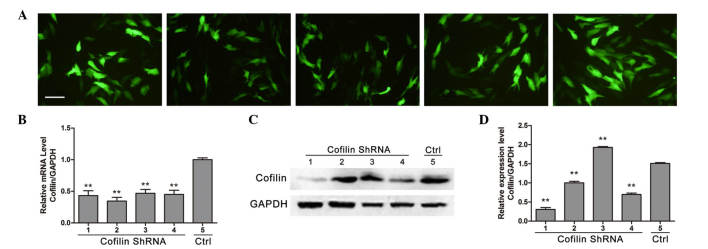
Osteoblasts have the capacity to perceive and transduce mechanical signals, and thus, regulate the mRNA and protein expression of a variety of genes associated with osteogenesis. Cytoskeletal reconstruction, as one of the earliest perception events for external mechanical stimulation, has previously been demonstrated to be essential for mechanotransduction in bone cells. However, the mechanism by which mechanical signals induce cytoskeletal deformation remains poorly understood. The actin‑binding protein, cofilin, promotes the depolymerization of actin and is understood to be important in the regulation of activities in various cell types, including endothelial, neuronal and muscle cells. However, to the best of our knowledge, the importance of cofilin in osteoblastic mechanotransduction has not been previously investigated. In the present study, osteoblast‑like MG‑63 cells were subjected to physiological cyclic stretch stimulation (12% elongation) for 1, 4, 8, 12 and 24 h, and the expression levels of cofilin and osteogenesis-associated genes were quantified with reverse transcription‑quantitative polymerase chain reaction, immunofluorescence staining and western blotting analyses. Additionally, knockdown of cofilin using RNA interference was conducted, and the mRNA levels of osteogenesis‑associated genes were compared between osteoblast‑like cells in the presence and absence of cofilin gene knockdown. The results of the present study demonstrated that cyclic stretch stimulates the expression of genes associated with osteoblastic activities in MG‑63 cells, including alkaline phosphatase (ALP), osteocalcin (OCN), runt‑related transcription factor 2 (Runx2) and collagen‑1 (COL‑1). Cyclic stretch also regulates the mRNA and protein expression of cofilin in MG‑63 cells. Furthermore, stretch‑induced increases in the levels of osteogenesis-associated genes, including ALP, OCN, Runx2 and COL‑1, were reduced following cofilin gene knockdown. Together, these results demonstrate that cofilin is involved in the regulation of mechanical load‑induced osteogenesis and, to the best of our knowledge, provides the first evidence demonstrating the importance of cofilin in osteoblastic mechanotransduction.
成骨细胞具有感知和转导机械信号的能力,因此能够调节多种与骨生成相关基因的mRNA和蛋白质表达。细胞骨架重建作为对外界机械刺激最早的感知事件之一,此前已被证明对骨细胞的机械转导至关重要。然而,机械信号诱导细胞骨架变形的机制仍知之甚少。肌动蛋白结合蛋白cofilin可促进肌动蛋白解聚,并且在包括内皮细胞、神经元细胞和肌肉细胞在内的各种细胞类型的活性调节中具有重要作用。然而,据我们所知,cofilin在成骨细胞机械转导中的重要性此前尚未得到研究。在本研究中,对成骨样MG-63细胞进行1、4、8、12和24小时的生理性循环拉伸刺激(伸长12%),并通过逆转录-定量聚合酶链反应、免疫荧光染色和蛋白质印迹分析对cofilin和骨生成相关基因的表达水平进行定量。此外,使用RNA干扰敲低cofilin,并比较存在和不存在cofilin基因敲低的成骨样细胞中骨生成相关基因的mRNA水平。本研究结果表明,循环拉伸可刺激MG-63细胞中与成骨细胞活性相关基因的表达,包括碱性磷酸酶(ALP)、骨钙素(OCN)、 runt相关转录因子2(Runx2)和胶原蛋白-1(COL-1)。循环拉伸还可调节MG-63细胞中cofilin的mRNA和蛋白质表达。此外,在敲低cofilin基因后,拉伸诱导的包括ALP、OCN、Runx2和COL-1在内的骨生成相关基因水平的增加有所降低。总之,这些结果表明cofilin参与机械负荷诱导的骨生成调节,并且据我们所知,首次提供了证据证明cofilin在成骨细胞机械转导中的重要性。