Song Xinzhang, Peng Changhui, Zhou Guomo, Gu Honghao, Li Quan, Zhang Chao
The Nurturing Station for the State Key Laboratory of Subtropical Silviculture, Zhejiang A&F University, Lin'an, 311300, China.
Department of Biology Sciences, Institute of Environmental Sciences, University of Quebec at Montreal (UQAM), Case postale 8888, Succursale Centre-Ville, Montréal, QC, H3C 3P8, Canada.
Sci Rep. 2016 May 16;6:25908. doi: 10.1038/srep25908.
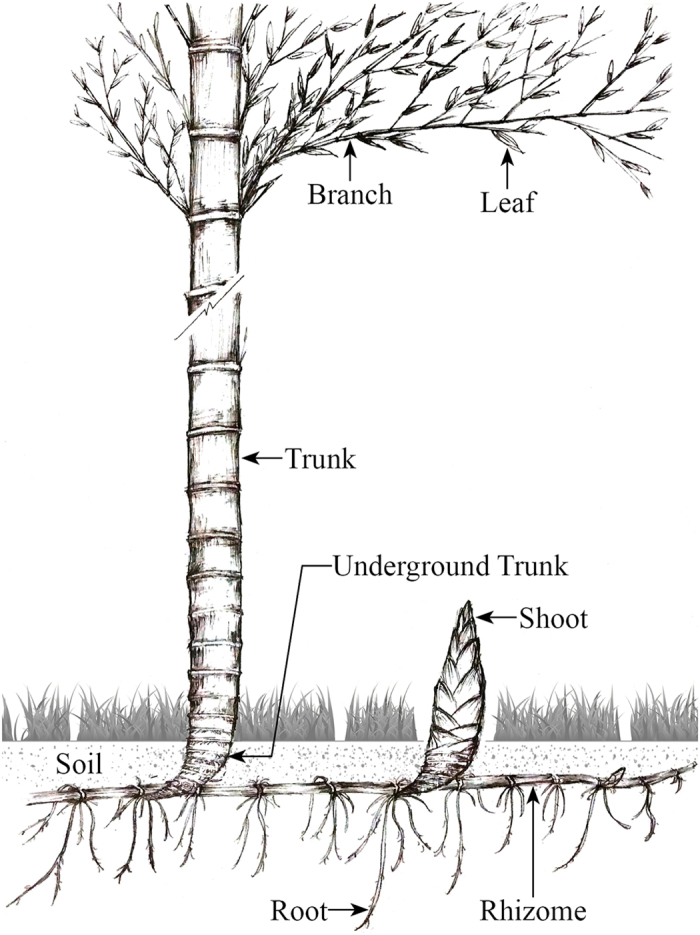
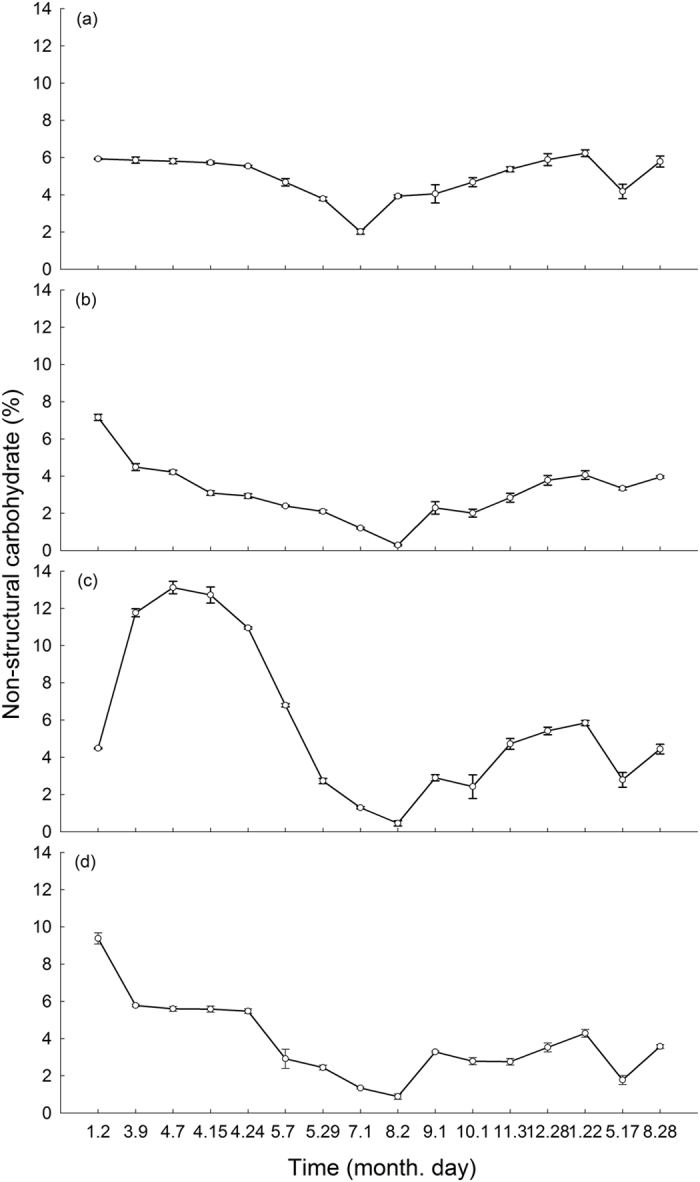
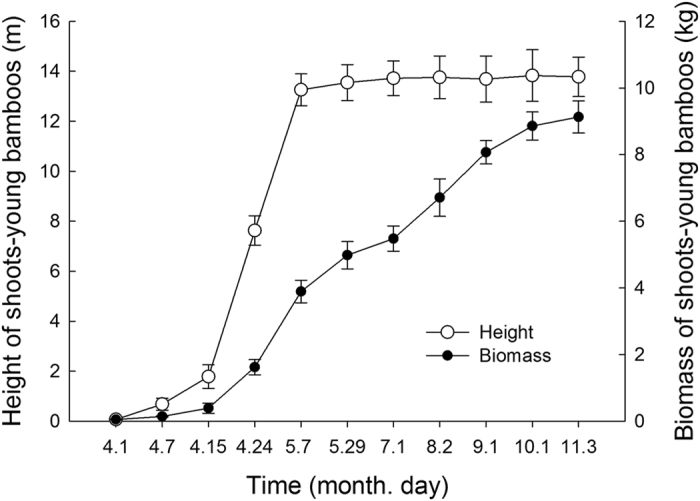
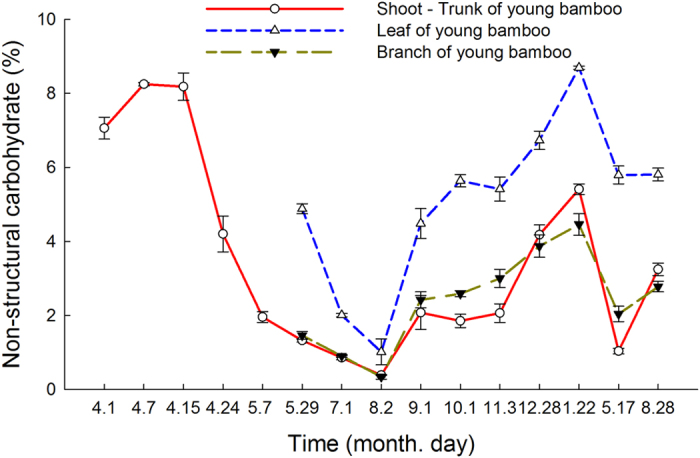
Moso bamboo can rapidly complete its growth in both height and diameter within only 35-40 days after shoot emergence. However, the underlying mechanism for this "explosive growth" remains poorly understood. We investigated the dynamics of non-structural carbohydrates (NSCs) in shoots and attached mature bamboos over a 20-month period. The results showed that Moso bamboos rapidly completed their height and diameter growth within 38 days. At the same time, attached mature bamboos transferred almost all the NSCs of their leaves, branches, and especially trunks and rhizomes to the "explosively growing" shoots via underground rhizomes for the structural growth and metabolism of shoots. Approximately 4 months after shoot emergence, this transfer stopped when the leaves of the young bamboos could independently provide enough photoassimilates to meet the carbon demands of the young bamboos. During this period, the NSC content of the leaves, branches, trunks and rhizomes of mature bamboos declined by 1.5, 23, 28 and 5 fold, respectively. The trunk contributed the most NSCs to the shoots. Our findings provide new insight and a possible rational mechanism explaining the "explosive growth" of Moso bamboo and shed new light on understanding the role of NSCs in the rapid growth of Moso bamboo.
毛竹在出笋后仅35 - 40天内就能迅速完成高度和直径的生长。然而,这种“爆发式生长”的潜在机制仍知之甚少。我们在20个月的时间里研究了笋和相连成熟竹子中非结构性碳水化合物(NSCs)的动态变化。结果表明,毛竹在38天内迅速完成了高度和直径的生长。与此同时,相连的成熟竹子通过地下根茎将其叶片、枝条,尤其是树干和根茎中的几乎所有NSCs转移到“快速生长”的笋中,以供笋的结构生长和新陈代谢。出笋约4个月后,当幼竹的叶片能够独立提供足够的光合产物以满足幼竹的碳需求时,这种转移停止。在此期间,成熟竹子的叶片、枝条、树干和根茎中的NSC含量分别下降了1.5倍、23倍、28倍和5倍。树干对笋的NSCs贡献最大。我们的研究结果为解释毛竹的“爆发式生长”提供了新的见解和可能的合理机制,并为理解NSCs在毛竹快速生长中的作用提供了新的思路。