Kim Su-Young, Shin Sung Jae, Jeong Byeong-Ho, Koh Won-Jung
Division of Pulmonary and Critical Care Medicine, Department of Medicine, Samsung Medical Center, Sungkyunkwan University School of Medicine, Irwon-ro 81, Gangnam-gu, Seoul, 06351, South Korea.
Department of Microbiology, Yonsei University College of Medicine, Seoul, South Korea.
BMC Infect Dis. 2016 May 17;16:207. doi: 10.1186/s12879-016-1554-7.
Mycobacterium abscessus complex (MABC) is the most drug resistant of the mycobacterial pathogens. M. abscessus subsp. abscessus encodes a functional erythromycin ribosomal methylase gene, erm(41), causing inducible macrolide resistance. However, some clinical isolates of M. abscessus subsp. abscessus harboring nonfunctional erm(41) were susceptible to macrolide, even after extended incubation of 14 days. Loss of function of the erm(41) genes was associated with a T-to-C substitution at position 28 of the gene (T28C), leading to an amino acid change from Trp to Arg at codon 10. Pulmonary disease caused by M. abscessus subsp. abscessus strains with an nonfunctional erm(41) (C28 sequevar) may be responsive to macrolide-containing antibiotic regimens. Therefore, all M. abscessus subsp. abscessus strains with a functional erm(41) (T28 sequevar) were thought to be resistant to macrolide with extended incubation. Here, we report the first case of pulmonary disease caused by a strain of M. abscessus subsp. abscessus which was susceptible to macrolide due to T19 sequevar of erm(41) gene.
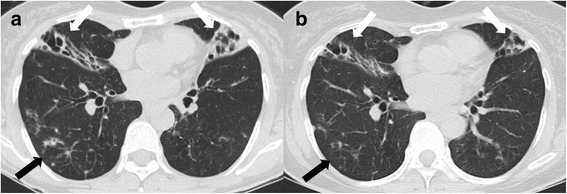
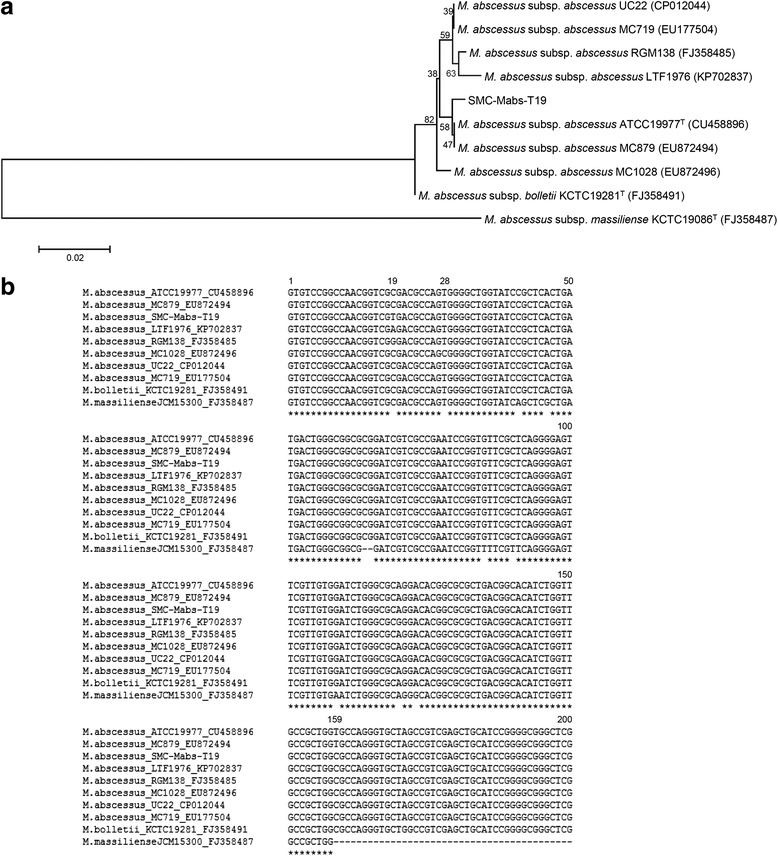
A 62-year-old Korean female was referred to our hospital due to chronic cough, sputum, and hemoptysis lasting more than 5 months. The patient's sputum was positive for acid-fast bacilli staining and nontuberculous mycobacteria (NTM) were isolated twice from sputum specimens. The isolate was identified as M. abscessus subsp. abscessus. The isolate had a point mutation of C → T at position 19 (C19 → T) in the erm(41) gene, instead of expected C28 sequevar of erm(41), and had no rrl mutation. The isolate displayed a clarithromycin susceptible phenotype with an Arg → Stop codon change in erm(41). The patient was successfully treated with a macrolide-containing regimen.
This is the first case of pulmonary disease caused by a strain of M. abscessus subsp. abscessus showing clarithromycin susceptible phenotype due to T19 sequevar of the erm(41) gene. The erm(41) gene is clinically important, and non-functional erm alleles may be an important issue for the management of MABC lung disease. The presence of a non-functional erm(41) allele in M. abscessus subsp. abscessus isolates may be associated with better outcomes.
脓肿分枝杆菌复合群(MABC)是分枝杆菌病原体中耐药性最强的。脓肿分枝杆菌亚种脓肿分枝杆菌编码一个功能性红霉素核糖体甲基化酶基因erm(41),导致诱导型大环内酯类耐药。然而,一些携带无功能erm(41)的脓肿分枝杆菌亚种临床分离株即使在延长培养14天后仍对大环内酯类敏感。erm(41)基因功能丧失与该基因第28位的T到C替换(T28C)有关,导致密码子10处的氨基酸从色氨酸变为精氨酸。由无功能erm(41)(C28序列变异体)的脓肿分枝杆菌亚种菌株引起的肺部疾病可能对含大环内酯类抗生素方案有反应。因此,所有具有功能性erm(41)(T28序列变异体)的脓肿分枝杆菌亚种菌株被认为在延长培养后对大环内酯类耐药。在此,我们报告首例由一株脓肿分枝杆菌亚种引起的肺部疾病,该菌株因erm(41)基因的T19序列变异体而对大环内酯类敏感。
一名62岁的韩国女性因持续5个多月的慢性咳嗽、咳痰和咯血被转诊至我院。患者痰液抗酸杆菌染色呈阳性,痰标本两次分离出非结核分枝杆菌(NTM)。分离株被鉴定为脓肿分枝杆菌亚种脓肿分枝杆菌。该分离株在erm(41)基因的第19位有一个C→T的点突变(C19→T),而不是预期的erm(41)的C28序列变异体,且没有rrl突变。该分离株表现出克拉霉素敏感表型,erm(41)中有一个从精氨酸到终止密码子的变化。患者接受含大环内酯类方案治疗成功。
这是首例由一株脓肿分枝杆菌亚种引起的肺部疾病,该菌株因erm(41)基因的T19序列变异体而表现出克拉霉素敏感表型。erm(41)基因在临床上很重要,无功能的erm等位基因可能是MABC肺部疾病管理中的一个重要问题。脓肿分枝杆菌亚种分离株中无功能erm(41)等位基因的存在可能与更好的治疗结果相关。