Pasquier Jeremy, Cabau Cédric, Nguyen Thaovi, Jouanno Elodie, Severac Dany, Braasch Ingo, Journot Laurent, Pontarotti Pierre, Klopp Christophe, Postlethwait John H, Guiguen Yann, Bobe Julien
INRA, Laboratoire de Physiologie et Génomique des poissons, Campus de Beaulieu, F-35042, Rennes cedex, France.
INRA, SIGENAE, GenPhySE, F-31326, Castanet-Tolosan, France.
BMC Genomics. 2016 May 18;17:368. doi: 10.1186/s12864-016-2709-z.
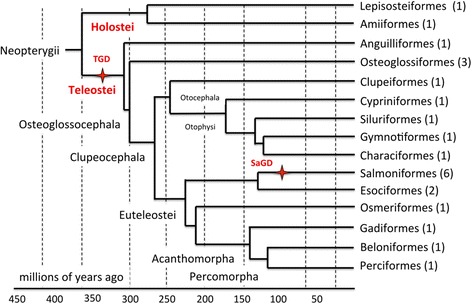
With more than 30,000 species, ray-finned fish represent approximately half of vertebrates. The evolution of ray-finned fish was impacted by several whole genome duplication (WGD) events including a teleost-specific WGD event (TGD) that occurred at the root of the teleost lineage about 350 million years ago (Mya) and more recent WGD events in salmonids, carps, suckers and others. In plants and animals, WGD events are associated with adaptive radiations and evolutionary innovations. WGD-spurred innovation may be especially relevant in the case of teleost fish, which colonized a wide diversity of habitats on earth, including many extreme environments. Fish biodiversity, the use of fish models for human medicine and ecological studies, and the importance of fish in human nutrition, fuel an important need for the characterization of gene expression repertoires and corresponding evolutionary histories of ray-finned fish genes. To this aim, we performed transcriptome analyses and developed the PhyloFish database to provide (i) de novo assembled gene repertoires in 23 different ray-finned fish species including two holosteans (i.e. a group that diverged from teleosts before TGD) and 21 teleosts (including six salmonids), and (ii) gene expression levels in ten different tissues and organs (and embryos for many) in the same species. This resource was generated using a common deep RNA sequencing protocol to obtain the most exhaustive gene repertoire possible in each species that allows between-species comparisons to study the evolution of gene expression in different lineages. The PhyloFish database described here can be accessed and searched using RNAbrowse, a simple and efficient solution to give access to RNA-seq de novo assembled transcripts.
辐鳍鱼有30000多个物种,约占脊椎动物的一半。辐鳍鱼的进化受到了几次全基因组复制(WGD)事件的影响,包括大约3.5亿年前(Mya)在硬骨鱼谱系根部发生的一次硬骨鱼特异性WGD事件(TGD),以及鲑鱼、鲤鱼、吸盘鱼等物种中最近发生的WGD事件。在植物和动物中,WGD事件与适应性辐射和进化创新有关。WGD引发的创新在硬骨鱼的情况下可能尤其重要,因为硬骨鱼在地球上广泛多样的栖息地中生存,包括许多极端环境。鱼类生物多样性、将鱼类模型用于人类医学和生态研究,以及鱼类在人类营养中的重要性,使得迫切需要对辐鳍鱼基因的表达谱及其相应的进化历史进行表征。为此,我们进行了转录组分析,并开发了PhyloFish数据库,以提供:(i)23种不同辐鳍鱼物种(包括两种全骨鱼,即一个在TGD之前从硬骨鱼分化出来的类群)和21种硬骨鱼(包括六种鲑鱼)的从头组装基因库,以及(ii)同一物种中十个不同组织和器官(许多物种还包括胚胎)中的基因表达水平。该资源是使用通用的深度RNA测序方案生成的,以获得每个物种尽可能详尽的基因库,从而能够进行种间比较,以研究不同谱系中基因表达的进化。这里描述的PhyloFish数据库可以使用RNAbrowse进行访问和搜索,RNAbrowse是一种简单有效的方法,用于访问RNA-seq从头组装的转录本。