Department of Molecular and Cellular Biology and Alkek Center for Molecular Discovery, Baylor College of Medicine, Houston, Texas 77030, USA.
Verna and Marrs McLean Department of Biochemistry and Molecular Biology, Baylor College of Medicine, Houston, Texas 77030, USA.
Nat Commun. 2016 May 19;7:11612. doi: 10.1038/ncomms11612.
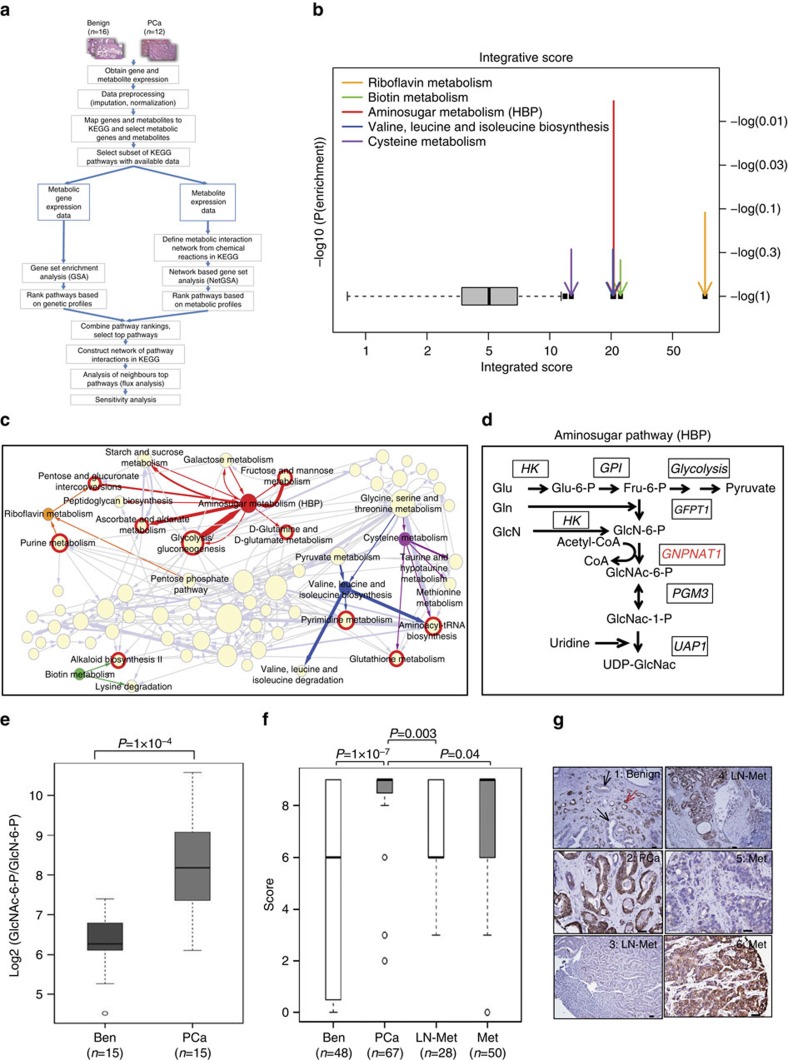
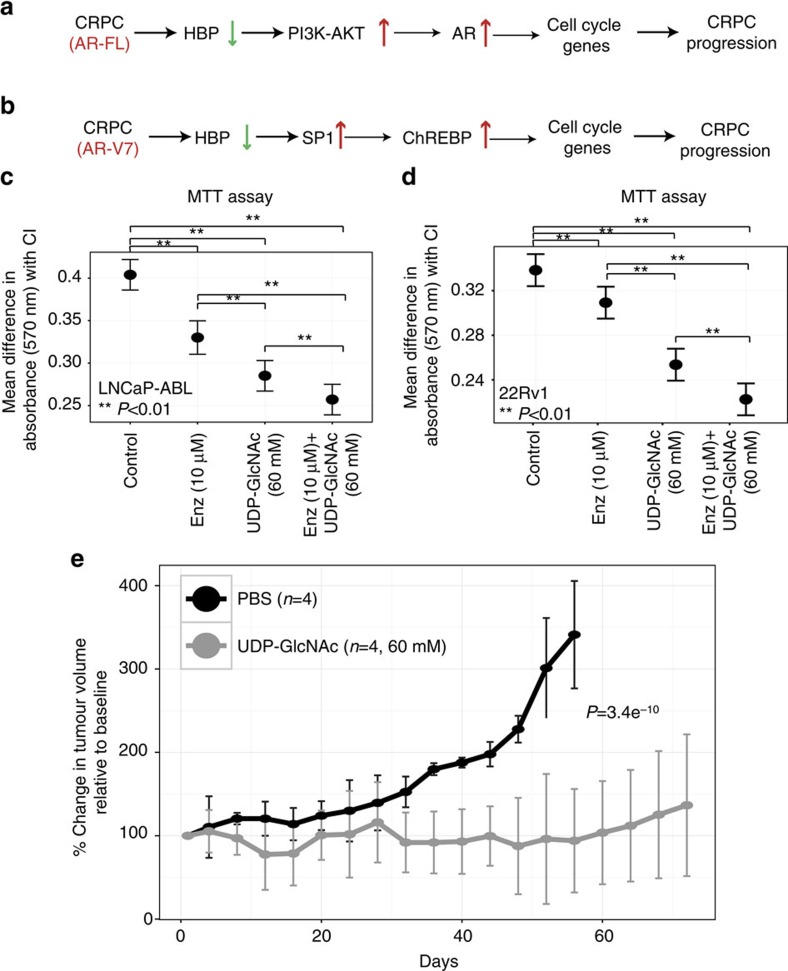
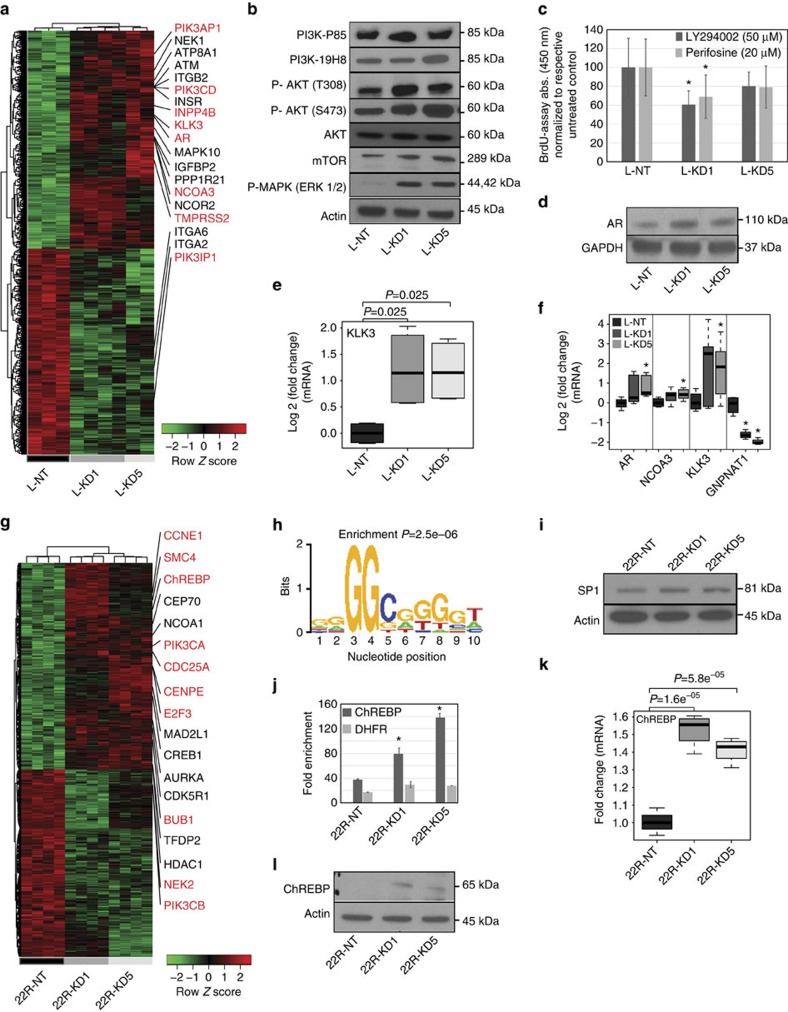
The precise molecular alterations driving castration-resistant prostate cancer (CRPC) are not clearly understood. Using a novel network-based integrative approach, here, we show distinct alterations in the hexosamine biosynthetic pathway (HBP) to be critical for CRPC. Expression of HBP enzyme glucosamine-phosphate N-acetyltransferase 1 (GNPNAT1) is found to be significantly decreased in CRPC compared with localized prostate cancer (PCa). Genetic loss-of-function of GNPNAT1 in CRPC-like cells increases proliferation and aggressiveness, in vitro and in vivo. This is mediated by either activation of the PI3K-AKT pathway in cells expressing full-length androgen receptor (AR) or by specific protein 1 (SP1)-regulated expression of carbohydrate response element-binding protein (ChREBP) in cells containing AR-V7 variant. Strikingly, addition of the HBP metabolite UDP-N-acetylglucosamine (UDP-GlcNAc) to CRPC-like cells significantly decreases cell proliferation, both in-vitro and in animal studies, while also demonstrates additive efficacy when combined with enzalutamide in-vitro. These observations demonstrate the therapeutic value of targeting HBP in CRPC.
导致去势抵抗性前列腺癌(CRPC)的确切分子改变尚不清楚。在这里,我们使用一种新颖的基于网络的综合方法,表明己糖胺生物合成途径(HBP)的明显改变对于 CRPC 是至关重要的。与局限性前列腺癌(PCa)相比,CRPC 中发现 HBP 酶葡萄糖胺-磷酸 N-乙酰转移酶 1(GNPNAT1)的表达显著降低。在 CRPC 样细胞中,GNPNAT1 的遗传功能丧失会增加体外和体内的增殖和侵袭性。这是通过在表达全长雄激素受体(AR)的细胞中激活 PI3K-AKT 途径,或在含有 AR-V7 变体的细胞中通过特定蛋白 1(SP1)调节碳水化合物反应元件结合蛋白(ChREBP)的表达来介导的。引人注目的是,将 HBP 代谢物 UDP-N-乙酰葡萄糖胺(UDP-GlcNAc)添加到 CRPC 样细胞中,无论是在体外还是在动物研究中,都显著降低了细胞增殖,而与体外恩杂鲁胺联合使用时也具有相加的疗效。这些观察结果表明,靶向 CRPC 中的 HBP 具有治疗价值。