Gibbons Cheryl L, van Bunnik Bram A D, Blatchford Oliver, Robertson Chris, Porphyre Thibaud, Imrie Laura, Wilson Julie, Fitzgerald J Ross, Woolhouse Mark E J, Chase-Topping Margo E
Centre for Immunity, Infection and Evolution (CIIE), Ashworth Laboratories, University of Edinburgh, Edinburgh, UK.
Health Protection Scotland, Clifton House, Clifton Place, Glasgow, UK.
BMC Infect Dis. 2016 May 21;16:222. doi: 10.1186/s12879-016-1563-6.
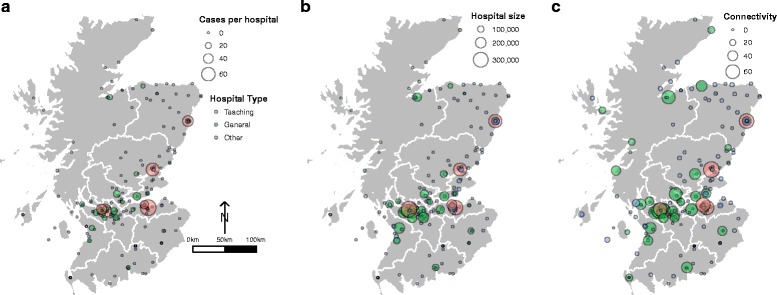
Worldwide, there is a wealth of literature examining patient-level risk factors for methicillin-resistant Staphylococcus aureus (MRSA) bacteraemia. At the hospital-level it is generally accepted that MRSA bacteraemia is more common in larger hospitals. In Scotland, size does not fully explain all the observed variation among hospitals. The aim of this study was to identify risk factors for the presence and rate of MRSA bacteraemia cases in Scottish mainland hospitals. Specific hypotheses regarding hospital size, type and connectivity were examined.
Data from 198 mainland Scottish hospitals (defined as having at least one inpatient per year) were analysed for financial year 2007-08 using logistic regression (Model 1: presence/absence of MRSA bacteraemia) and Poisson regression (Model 2: rate of MRSA bacteraemia). The significance of risk factors representing various measures of hospital size, type and connectivity were investigated.
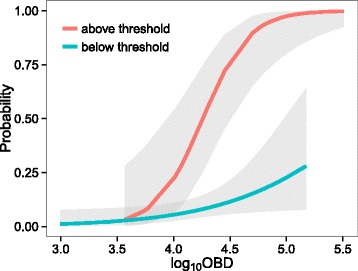
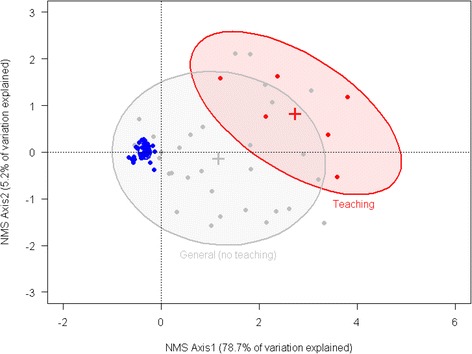
In Scotland, size was not the only significant risk factor identified for the presence and rate of MRSA bacteraemia. The probability of a hospital having at least one case of MRSA bacteraemia increased with hospital size only if the hospital exceeded a certain level of connectivity. Higher levels of MRSA bacteraemia were associated with the large, highly connected teaching hospitals with high ratios of patients to domestic staff.
A hospital's level of connectedness within a network may be a better measure of a hospital's risk of MRSA bacteraemia than size. This result could be used to identify high risk hospitals which would benefit from intensified infection control measures.
在全球范围内,有大量文献研究耐甲氧西林金黄色葡萄球菌(MRSA)菌血症的患者层面风险因素。在医院层面,人们普遍认为MRSA菌血症在大型医院更为常见。在苏格兰,规模并不能完全解释各医院间观察到的所有差异。本研究的目的是确定苏格兰大陆医院中MRSA菌血症病例存在情况及发生率的风险因素。对有关医院规模、类型和连通性的具体假设进行了检验。
分析了198家苏格兰大陆医院(定义为每年至少有一名住院患者)2007 - 2008财政年度的数据,使用逻辑回归(模型1:MRSA菌血症的存在与否)和泊松回归(模型2:MRSA菌血症的发生率)。研究了代表医院规模、类型和连通性各种指标的风险因素的显著性。
在苏格兰,规模并非MRSA菌血症存在情况及发生率唯一确定的显著风险因素。只有当医院超过一定连通水平时,医院出现至少一例MRSA菌血症的概率才会随医院规模增加。较高的MRSA菌血症发生率与患者与勤杂人员比例高的大型、高度连通的教学医院相关。
医院在网络中的连通水平可能比规模更能衡量医院发生MRSA菌血症的风险。这一结果可用于识别那些将从强化感染控制措施中受益的高风险医院。