Langel Stephanie N, Paim Francine Chimelo, Lager Kelly M, Vlasova Anastasia N, Saif Linda J
Food Animal Health Research Program, Ohio Agricultural Research and Development Center, Department of Veterinary Preventive Medicine, The Ohio State University, Wooster, OH, USA.
Virus and Prion Research Unit, National Animal Disease Center, USDA, Agricultural Research Service, Ames, IA 50010, USA.
Virus Res. 2016 Dec 2;226:93-107. doi: 10.1016/j.virusres.2016.05.016. Epub 2016 May 19.
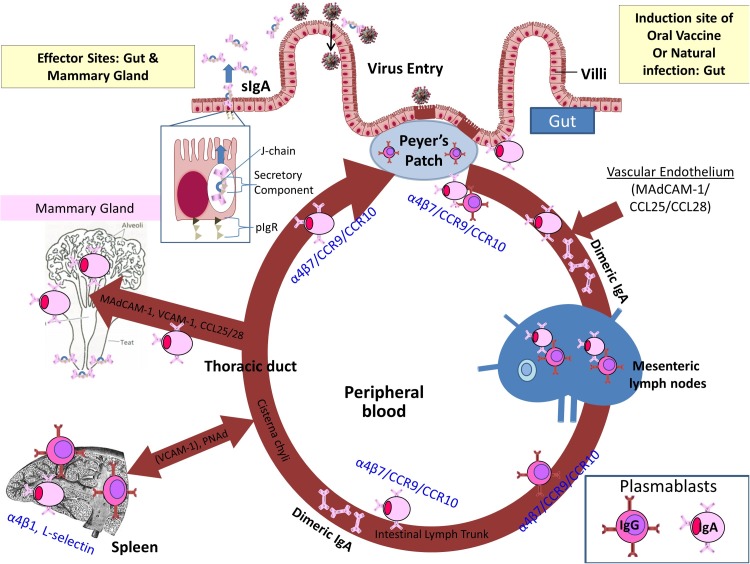
Morbidity, mortality, and loss of productivity from enteric diseases in neonatal piglets cost swine producers millions of dollars annually. In 2013-2014, the porcine epidemic diarrhea virus (PEDV) outbreak led to $900 million to $1.8 billion in annual losses to US swine producers. Passive lactogenic immunity remains the most promising and effective way to protect neonatal suckling piglets from enteric diseases like PEDV. Protecting suckling piglets through lactogenic immunity is dependent on trafficking of pathogen-specific IgA plasmablasts to the mammary gland and accumulation of secretory IgA (sIgA) antibodies in milk, defined as the gut-mammary-sIgA axis. Due to an impermeable placenta, piglets are born agammaglobulinic, and are highly susceptible to a plethora of infectious agents. They rely solely on colostrum and milk antibodies for maternal lactogenic immunity. Previous advances in the development of live and attenuated vaccines for another devastating diarrheal virus of pigs, transmissible gastroenteritis virus (TGEV), provide insights into the mechanisms of maternal immunity and piglet protection. In this chapter, we will review previous research on TGEV-induced lactogenic immunity to provide a historical perspective on current efforts for PEDV control and vaccines in the swine industry. Identifying factors that influence lactogenic immunity and the gut-mammary-sIgA axis may lead to improved vaccine regimens for PEDV and other enteric pathogens in gestating swine and improved overall herd immunity, swine health and industry productivity.
新生仔猪肠道疾病导致的发病率、死亡率和生产力损失每年给养猪生产者造成数百万美元的损失。2013 - 2014年,猪流行性腹泻病毒(PEDV)疫情给美国养猪生产者造成了每年9亿至18亿美元的损失。被动乳源性免疫仍然是保护新生哺乳仔猪免受PEDV等肠道疾病侵害的最有前景和最有效的方法。通过乳源性免疫保护哺乳仔猪取决于病原体特异性IgA浆母细胞向乳腺的转运以及乳汁中分泌型IgA(sIgA)抗体的积累,这被定义为肠 - 乳腺 - sIgA轴。由于胎盘具有不透性,仔猪出生时无丙种球蛋白,极易感染多种病原体。它们完全依赖初乳和乳汁中的抗体获得母体乳源性免疫。此前针对猪的另一种毁灭性腹泻病毒——传染性胃肠炎病毒(TGEV)研发活疫苗和减毒疫苗所取得的进展,为母体免疫和仔猪保护机制提供了见解。在本章中,我们将回顾以往关于TGEV诱导的乳源性免疫的研究,以便从历史角度了解当前养猪业控制PEDV和疫苗的努力。确定影响乳源性免疫和肠 - 乳腺 - sIgA轴的因素可能会导致妊娠母猪针对PEDV和其他肠道病原体的疫苗方案得到改进,并提高整体猪群免疫力、猪的健康水平和行业生产力。