Lu Hang, McComas Katherine A, Buttke Danielle E, Roh Sungjong, Wild Margaret A
Department of Communication, Cornell University, Ithaca, New York, United States of America.
Wildlife Health Branch, Biological Resources Division, National Park Service, Fort Collins, Colorado, United States of America.
PLoS One. 2016 May 25;11(5):e0156205. doi: 10.1371/journal.pone.0156205. eCollection 2016.
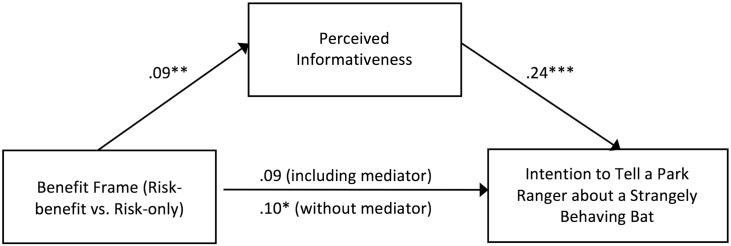
Since 1960, bat rabies variants have become the greatest source of human rabies deaths in the United States. Improving rabies awareness and preventing human exposure to rabid bats remains a national public health priority today. Concurrently, conservation of bats and the ecosystem benefits they provide is of increasing importance due to declining populations of many bat species. This study used a visitor-intercept experiment (N = 521) in two U.S. national parks where human and bat interactions occur on an occasional basis to examine the relative persuasiveness of four messages differing in the provision of benefit and uncertainty information on intentions to adopt a rabies exposure prevention behavior. We found that acknowledging benefits of bats in a risk message led to greater intentions to adopt the recommended rabies exposure prevention behavior without unnecessarily stigmatizing bats. These results signify the importance of communicating benefits of bats in bat rabies prevention messages to benefit both human and wildlife health.
自1960年以来,蝙蝠狂犬病变种已成为美国人类狂犬病死亡的最大来源。提高狂犬病意识并防止人类接触狂犬病蝙蝠在当今仍是国家公共卫生的重点。与此同时,由于许多蝙蝠物种的数量在减少,保护蝙蝠及其提供的生态系统益处变得越来越重要。本研究在美国的两个国家公园进行了一项游客拦截实验(N = 521),在这两个公园中人类与蝙蝠偶尔会有互动,以检验四条在提供益处和不确定性信息方面有所不同的信息对采取狂犬病暴露预防行为意图的相对说服力。我们发现,在风险信息中承认蝙蝠的益处会导致人们更愿意采取推荐的狂犬病暴露预防行为,同时又不会不必要地诋毁蝙蝠。这些结果表明,在蝙蝠狂犬病预防信息中传达蝙蝠的益处对于人类和野生动物健康都有益处。