Nass Norbert, Dittmer Angela, Hellwig Vicky, Lange Theresia, Beyer Johanna Mirjam, Leyh Benjamin, Ignatov Atanas, Weiβenborn Christine, Kirkegaard Tove, Lykkesfeldt Anne E, Kalinski Thomas, Dittmer Jürgen
Otto-von-Guericke-Universität Magdeburg, Institut für Pathologie, Magdeburg, Germany.
Klinik für Gynäkologie, Martin-Luther-Universität Halle-Wittenberg, Halle/Saale, Germany.
Oncotarget. 2016 Jun 21;7(25):38408-38426. doi: 10.18632/oncotarget.9493.
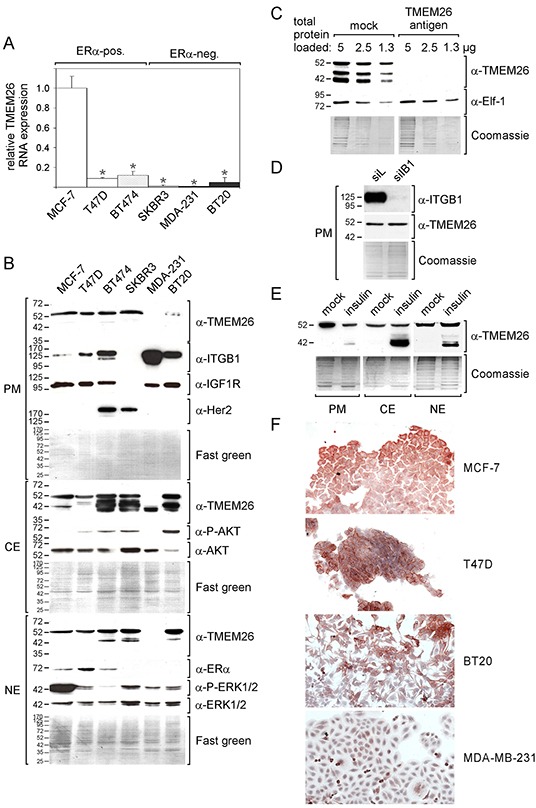
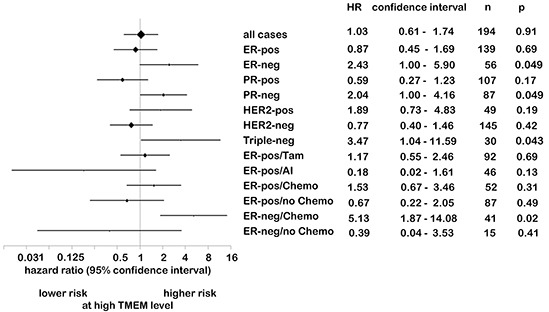
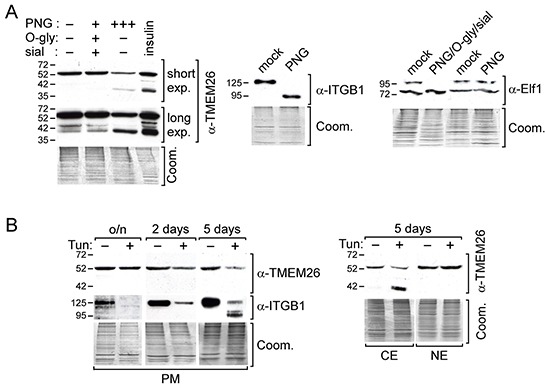
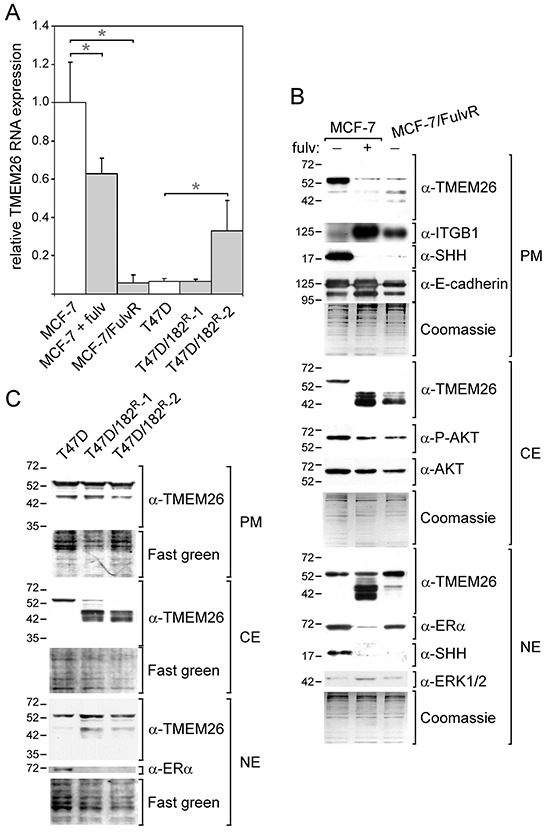
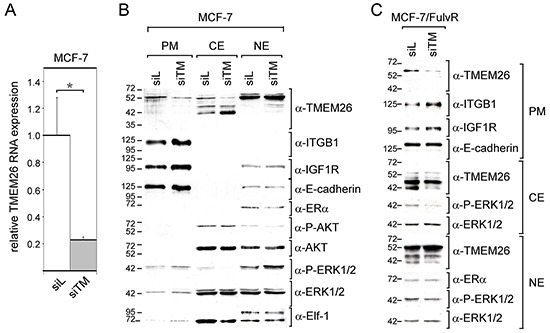
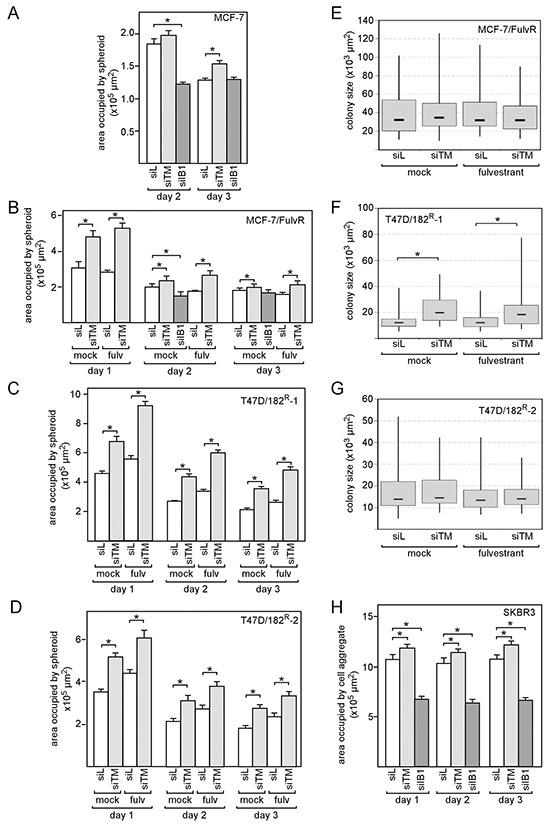
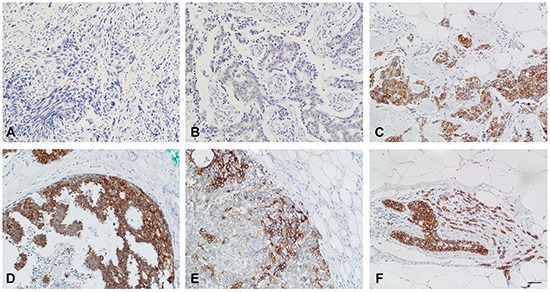
We have previously shown that stromal cells desensitize breast cancer cells to the anti-estrogen fulvestrant and, along with it, downregulate the expression of TMEM26 (transmembrane protein 26). In an effort to study the function and regulation of TMEM26 in breast cancer cells, we found that breast cancer cells express non-glycosylated and N-glycosylated isoforms of the TMEM26 protein and demonstrate that N-glycosylation is important for its retention at the plasma membrane. Fulvestrant induced significant changes in expression and in the N-glycosylation status of TMEM26. In primary breast cancer, TMEM26 protein expression was higher in ERα (estrogen receptor α)/PR (progesterone receptor)-positive cancers. These data suggest that ERα is a major regulator of TMEM26. Significant changes in TMEM26 expression and N-glycosylation were also found, when MCF-7 and T47D cells acquired fulvestrant resistance. Furthermore, patients who received aromatase inhibitor treatment tend to have a higher risk of recurrence when tumoral TMEM26 protein expression is low. In addition, TMEM26 negatively regulates the expression of integrin β1, an important factor involved in endocrine resistance. Data obtained by spheroid formation assays confirmed that TMEM26 and integrin β1 can have opposite effects in breast cancer cells. These data are consistent with the hypothesis that, in ERα-positive breast cancer, TMEM26 may function as a tumor suppressor by impeding the acquisition of endocrine resistance. In contrast, in ERα-negative breast cancer, particularly triple-negative cancer, high TMEM26 expression was found to be associated with a higher risk of recurrence. This implies that TMEM26 has different functions in ERα-positive and -negative breast cancer.
我们之前已经表明,基质细胞会使乳腺癌细胞对抗雌激素药物氟维司群产生脱敏作用,同时下调跨膜蛋白26(TMEM26)的表达。为了研究TMEM26在乳腺癌细胞中的功能和调控机制,我们发现乳腺癌细胞表达TMEM26蛋白的非糖基化和N-糖基化异构体,并证明N-糖基化对于其在质膜上的保留很重要。氟维司群诱导了TMEM26表达及其N-糖基化状态的显著变化。在原发性乳腺癌中,ERα(雌激素受体α)/PR(孕激素受体)阳性癌症中TMEM26蛋白表达较高。这些数据表明ERα是TMEM26的主要调节因子。当MCF-7和T47D细胞获得氟维司群抗性时,也发现了TMEM26表达和N-糖基化的显著变化。此外,当肿瘤TMEM26蛋白表达较低时,接受芳香化酶抑制剂治疗的患者复发风险往往较高。此外,TMEM26负向调节整合素β1的表达,整合素β1是参与内分泌抗性的一个重要因子。通过球体形成试验获得的数据证实,TMEM26和整合素β1在乳腺癌细胞中可能具有相反的作用。这些数据与以下假设一致:在ERα阳性乳腺癌中,TMEM26可能通过阻碍内分泌抗性的获得而发挥肿瘤抑制作用。相反,在ERα阴性乳腺癌,尤其是三阴性乳腺癌中,发现高TMEM26表达与较高的复发风险相关。这意味着TMEM26在ERα阳性和阴性乳腺癌中具有不同的功能。