RIKEN Center for Emergent Matter Science (CEMS), Wako 351-0198, Japan.
Institute for Materials Research, Tohoku University, Sendai 908-8577, Japan.
Nat Commun. 2016 May 27;7:11631. doi: 10.1038/ncomms11631.
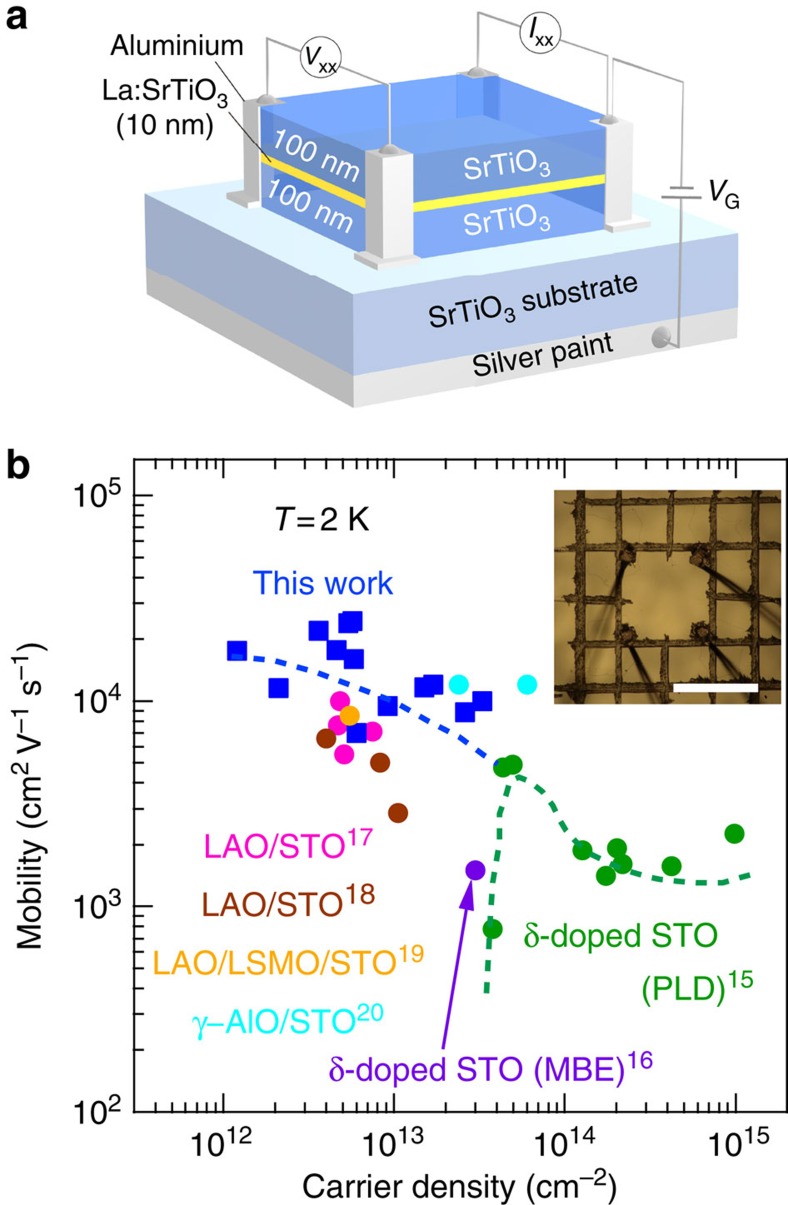
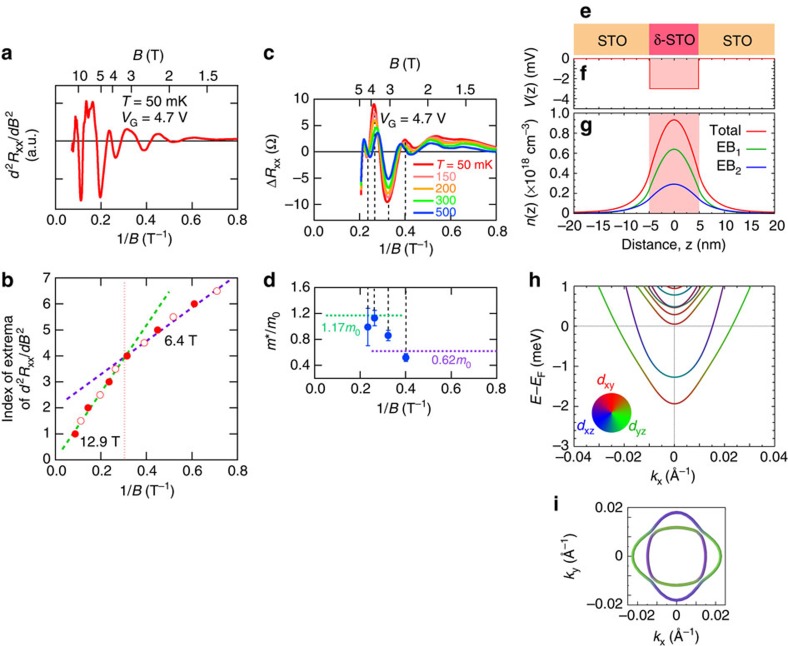
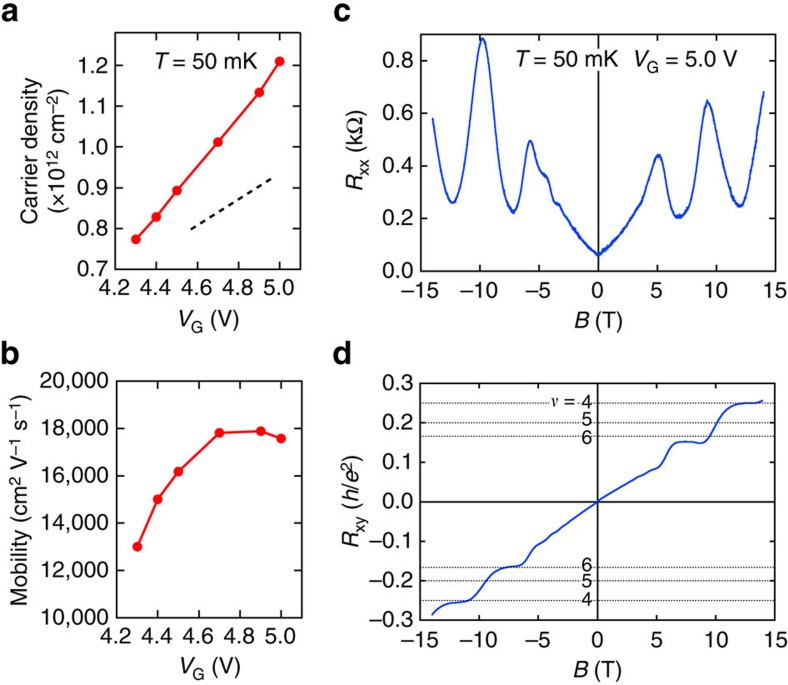
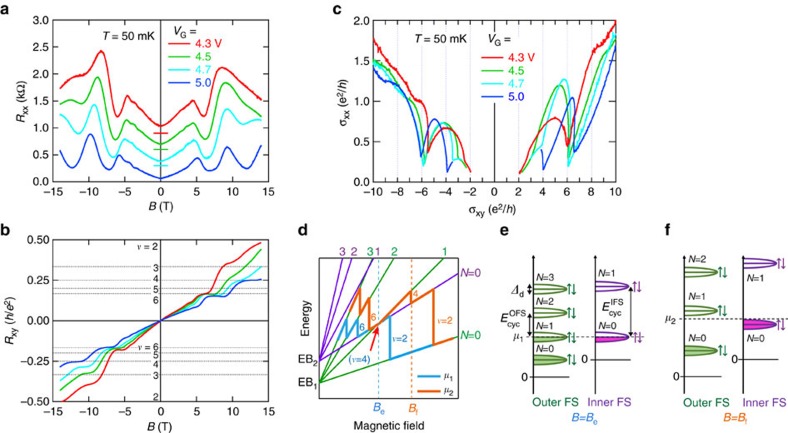
The quantum Hall effect is a macroscopic quantum phenomenon in a two-dimensional electron system. The two-dimensional electron system in SrTiO3 has sparked a great deal of interest, mainly because of the strong electron correlation effects expected from the 3d orbitals. Here we report the observation of the quantum Hall effect in a dilute La-doped SrTiO3-two-dimensional electron system, fabricated by metal organic molecular-beam epitaxy. The quantized Hall plateaus are found to be solely stemming from the low Landau levels with even integer-filling factors, ν=4 and 6 without any contribution from odd ν's. For ν=4, the corresponding plateau disappears on decreasing the carrier density. Such peculiar behaviours are proposed to be due to the crossing between the Landau levels originating from the two subbands composed of d orbitals with different effective masses. Our findings pave a way to explore unprecedented quantum phenomena in d-electron systems.
量子霍尔效应是二维电子系统中的一种宏观量子现象。SrTiO3 中的二维电子系统引起了极大的兴趣,主要是因为预期来自 3d 轨道的强电子相关效应。在这里,我们报告了通过金属有机分子束外延制备的稀 La 掺杂 SrTiO3-二维电子系统中量子霍尔效应的观察结果。发现量化的霍尔平台仅源自具有偶数填充因子 ν=4 和 6 的低 Landau 能级,而没有奇数 ν 的贡献。对于 ν=4,当载流子密度降低时,相应的平台会消失。这种特殊的行为被认为是由于源自由具有不同有效质量的 d 轨道组成的两个子带的 Landau 能级之间的交叉所致。我们的发现为探索 d 电子系统中前所未有的量子现象铺平了道路。