Flacio Eleonora, Engeler Lukas, Tonolla Mauro, Müller Pie
Laboratory of Applied Microbiology, University of Applied Sciences and Arts of Southern Switzerland, via Mirasole 22A, 6500, Bellinzona, Switzerland.
Laboratory of Eco-Epidemiology of Parasites, Institute of Biology, University of Neuchâtel, Emile-Argand 11, 2000, Neuchâtel, Switzerland.
Parasit Vectors. 2016 May 26;9(1):304. doi: 10.1186/s13071-016-1577-3.
The Asian tiger mosquito, Aedes albopictus, is a highly invasive mosquito species of public health importance. In the wake of its arrival in neighbouring Italy the authorities of the canton of Ticino in southern Switzerland initiated a surveillance programme in 2000 that is still on-going. Here we explored the unique data set, compiled from 2003 to 2014, to analyse the local dynamic of introduction and establishment of Ae. albopictus, its relative density in relation to precipitation and temperature, and its potential distribution at the passage from southern to northern Europe.
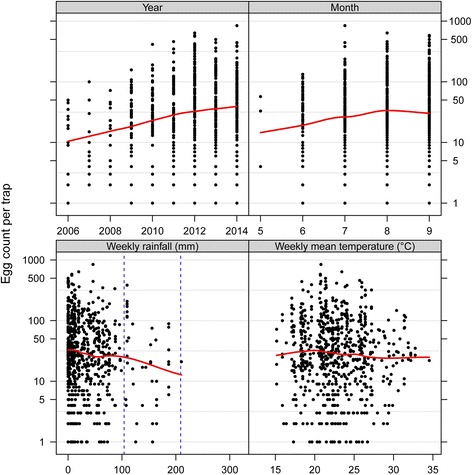
The presence of Ae. albopictus was recorded by ovitraps placed across Ticino. In addition to presence-absence, the relationship between relative egg densities and year, month, temperature and precipitation was analysed by a generalised linear mixed model.
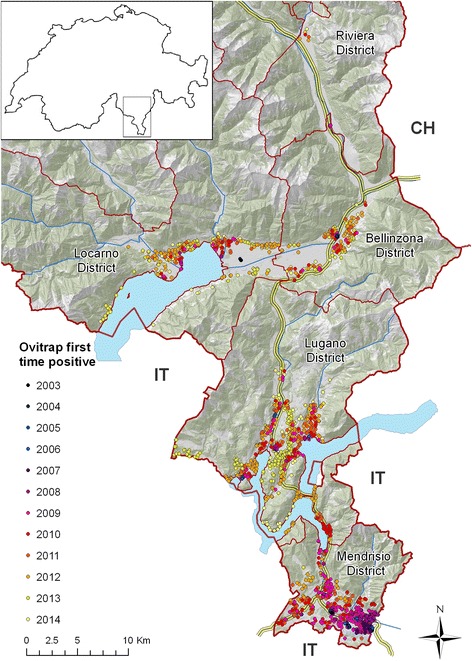
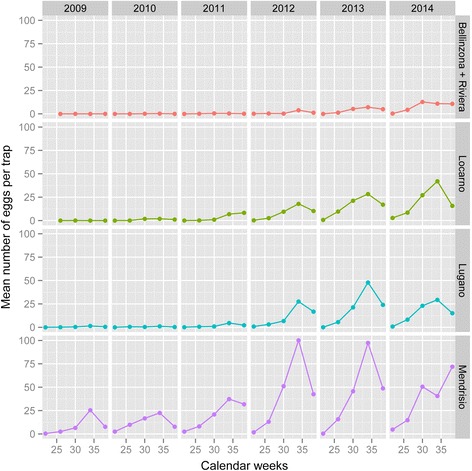
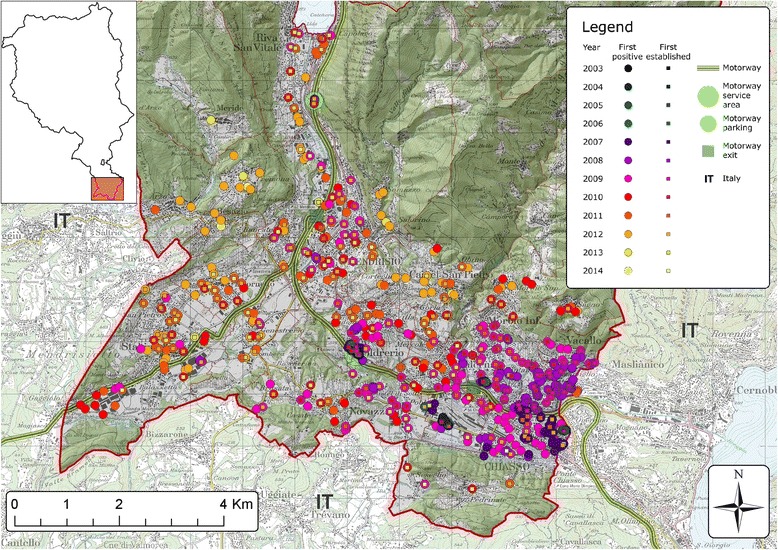
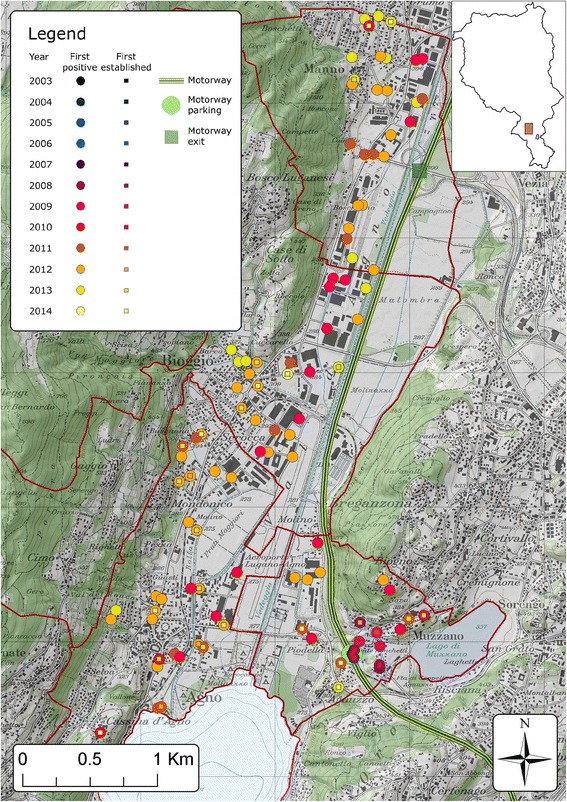
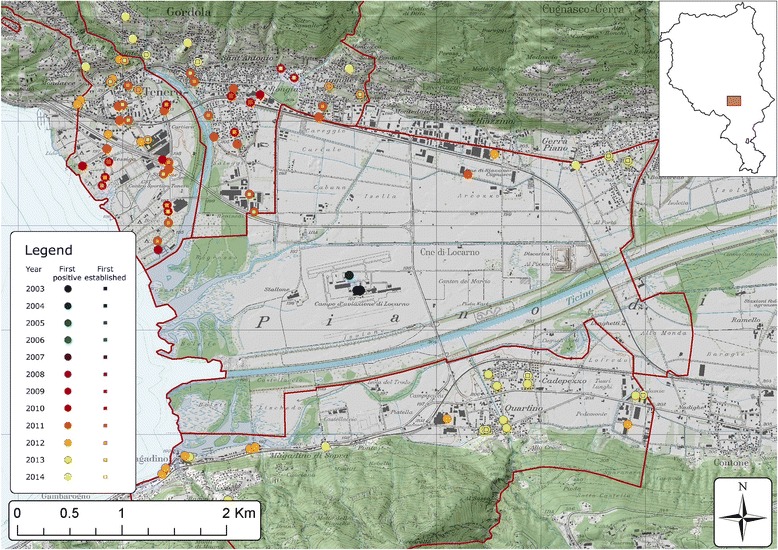
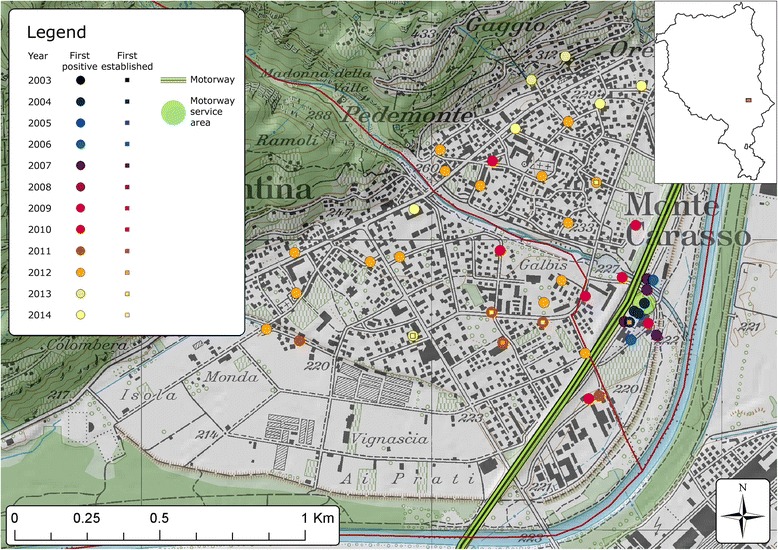
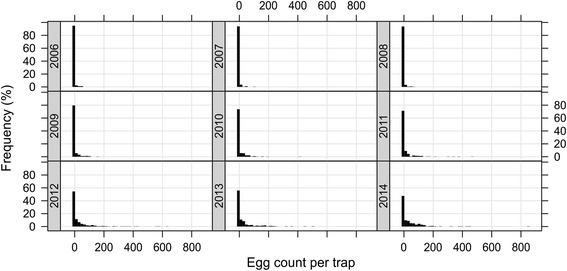
Since its first detection in 2003 at Ticino's border with Italy Ae. albopictus has continuously spread north across the lower valleys, mainly along the trans-European motorway, E35. Detailed local analysis showed that industrial areas were colonised by the mosquito before residential areas and that, afterwards, the mosquito was more present in residential than in industrial areas. Ae. albopictus appeared sporadically and then became more present in the same places the following years, suggesting gradual establishment of locally reproducing populations that manage to overwinter. This trend continues as witnessed by both a growing area being infested and increasing egg counts in the ovitraps. There was a clear South-North gradient with more traps being repeatedly positive in the South and fewer eggs laid during periods of intensive precipitation. In the North, the mosquito appeared repeatedly through the years, but never managed to establish, probably because of unfavourable weather conditions and low road traffic.
Given the present results we assume that additional areas may still become infested. While the current study provides good estimates of relative egg densities and shows the local and regional dynamics of Ae. albopictus invasion, additional parameters ought to be measured to make an objective risk assessment for epidemic disease transmission. The likelihood of Ae. albopictus to further spread and increase in densities calls for continued surveillance.
白纹伊蚊是一种具有重要公共卫生意义的高度入侵性蚊种。在其抵达邻国意大利后,瑞士南部提契诺州当局于2000年启动了一项仍在进行的监测计划。在此,我们利用2003年至2014年汇编的独特数据集,分析白纹伊蚊引入和定殖的当地动态、其相对密度与降水和温度的关系,以及其在从南欧向北欧过渡时的潜在分布。
通过放置在提契诺州各地的诱蚊产卵器记录白纹伊蚊的存在情况。除了存在与否,还通过广义线性混合模型分析了相对卵密度与年份、月份、温度和降水之间的关系。
自2003年在提契诺州与意大利的边境首次发现白纹伊蚊以来,它一直在向北沿着较低山谷不断扩散,主要沿着泛欧高速公路E35。详细的局部分析表明,工业区比居民区更早被蚊子定殖,之后,居民区的蚊子比工业区更多。白纹伊蚊偶尔出现,随后在接下来的几年里在同一地点变得更加常见,这表明当地繁殖种群逐渐定殖并成功越冬。这种趋势仍在继续,受侵染面积不断扩大以及诱蚊产卵器中的卵数增加都证明了这一点。存在明显的南北梯度,南部更多诱捕器反复呈阳性,在强降水期间产卵较少。在北部,这些年蚊子反复出现,但从未成功定殖,可能是由于天气条件不利和道路交通量低。
根据目前的结果,我们假设其他地区可能仍会受到侵染。虽然当前研究对白纹伊蚊的相对卵密度提供了良好估计,并显示了其入侵的局部和区域动态,但还应测量其他参数,以便对传染病传播进行客观的风险评估。白纹伊蚊进一步扩散和密度增加的可能性要求持续进行监测。