Zhang Fan, Zhang Liping, Qi Yun, Xu Hong
National Heart, Lung, and Blood Institute, National Institutes of Health, Bethesda, MD, 20892, USA.
National Institute of Dental and Craniofacial Research, National Institutes of Health, Bethesda, MD, 20892, USA.
Cell Mol Life Sci. 2016 Dec;73(24):4577-4590. doi: 10.1007/s00018-016-2282-2. Epub 2016 May 28.
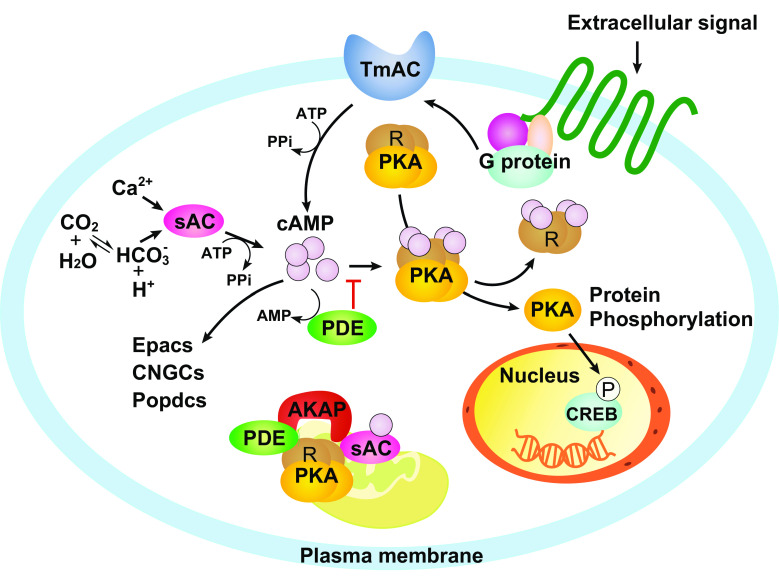
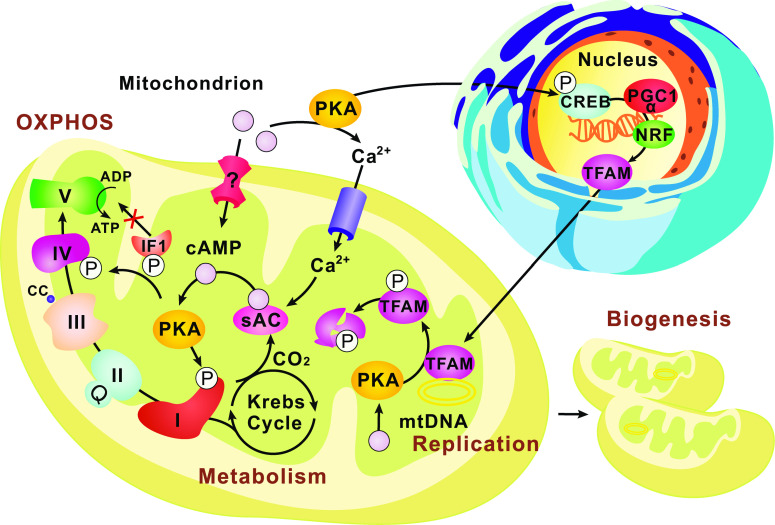
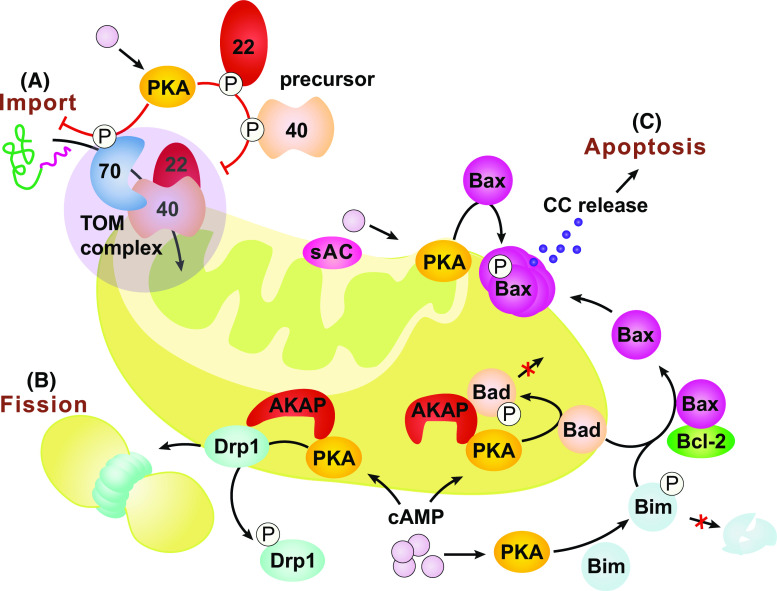
Cyclic adenosine 3, 5'-monophosphate (cAMP) is a ubiquitous second messenger regulating many biological processes, such as cell migration, differentiation, proliferation and apoptosis. cAMP signaling functions not only on the plasma membrane, but also in the nucleus and in organelles such as mitochondria. Mitochondrial cAMP signaling is an indispensable part of the cytoplasm-mitochondrion crosstalk that maintains mitochondrial homeostasis, regulates mitochondrial dynamics, and modulates cellular stress responses and other signaling pathways. Recently, the compartmentalization of mitochondrial cAMP signaling has attracted great attentions. This new input should be carefully taken into account when we interpret the findings of mitochondrial cAMP signaling. In this review, we summarize previous and recent progress in our understanding of mitochondrial cAMP signaling, including the components of the signaling cascade, and the function and regulation of this signaling pathway in different mitochondrial compartments.
环磷酸腺苷(cAMP)是一种普遍存在的第二信使,可调节许多生物过程,如细胞迁移、分化、增殖和凋亡。cAMP信号不仅在质膜上起作用,还在细胞核和线粒体等细胞器中起作用。线粒体cAMP信号是细胞质-线粒体相互作用的一个不可或缺的部分,它维持线粒体稳态,调节线粒体动力学,并调节细胞应激反应和其他信号通路。最近,线粒体cAMP信号的区室化引起了极大的关注。在我们解释线粒体cAMP信号的研究结果时,应该仔细考虑这一新的因素。在这篇综述中,我们总结了以往和最近在理解线粒体cAMP信号方面取得的进展,包括信号级联的组成部分,以及该信号通路在不同线粒体区室中的功能和调节。