Chen B, Huang S G, Ju L, Li M, Nie F F, Zhang Y, Zhang Y H, Chen X, Gao F
Department of Orthopedics, Linyi Second People's Hospital, Linyi, China.
Department of General Surgery, Affiliated Hospital of Taishan Medical University, Taian, China.
Braz J Med Biol Res. 2016 May 24;49(6). doi: 10.1590/1414-431X20155020.
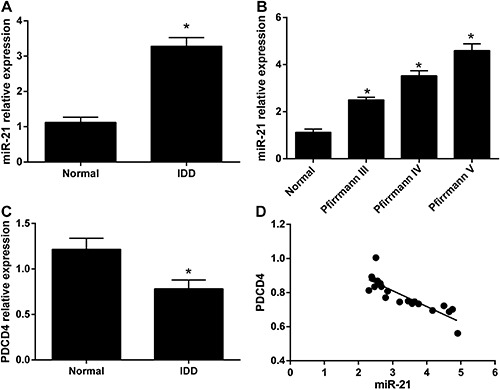
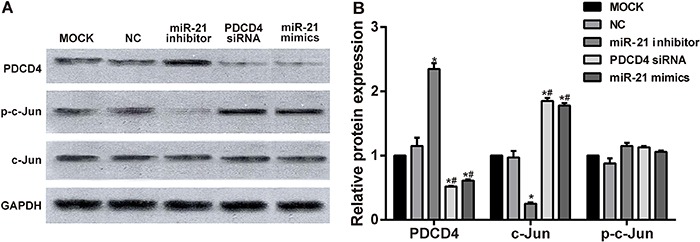
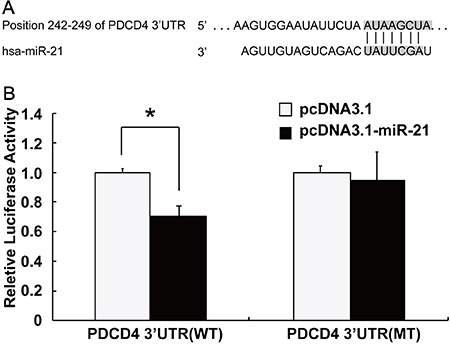
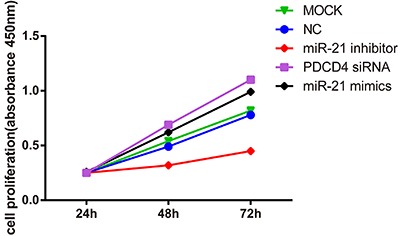
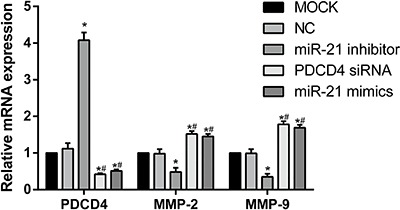
This study aims to explore the effect of microRNA-21 (miR-21) on the proliferation of human degenerated nucleus pulposus (NP) by targeting programmed cell death 4 (PDCD4) tumor suppressor. NP tissues were collected from 20 intervertebral disc degeneration (IDD) patients, and from 5 patients with traumatic spine fracture. MiR-21 expressions were tested. NP cells from IDD patients were collected and divided into blank control group, negative control group (transfected with miR-21 negative sequences), miR-21 inhibitor group (transfected with miR-21 inhibitors), miR-21 mimics group (transfected with miR-21 mimics) and PDCD4 siRNA group (transfected with PDCD4 siRNAs). Cell growth was estimated by Cell Counting Kit-8; PDCD4, MMP-2,MMP-9 mRNA expressions were evaluated by qRT-PCR; PDCD4, c-Jun and p-c-Jun expressions were tested using western blot. In IDD patients, the expressions of miR-21 and PDCD4 mRNA were respectively elevated and decreased (both P<0.05). The miR-21 expressions were positively correlated with Pfirrmann grades, but negatively correlated with PDCD4 mRNA (both P<0.001). In miR-21 inhibitor group, cell growth, MMP-2 and MMP-9 mRNA expressions, and p-c-Jun protein expressions were significantly lower, while PDCD4 mRNA and protein expressions were higher than the other groups (all P<0.05). These expressions in the PDCD4 siRNA and miR-21 mimics groups was inverted compared to that in the miR-21 inhibitor group (all P<0.05). MiR-21 could promote the proliferation of human degenerated NP cells by targeting PDCD4, increasing phosphorylation of c-Jun protein, and activating AP-1-dependent transcription of MMPs, indicating that miR-21 may be a crucial biomarker in the pathogenesis of IDD.
本研究旨在通过靶向程序性细胞死亡4(PDCD4)肿瘤抑制因子,探讨微小RNA-21(miR-21)对人退变髓核(NP)细胞增殖的影响。收集20例椎间盘退变(IDD)患者及5例创伤性脊柱骨折患者的NP组织,检测miR-21表达。收集IDD患者的NP细胞,分为空白对照组、阴性对照组(转染miR-21阴性序列)、miR-21抑制剂组(转染miR-21抑制剂)、miR-21模拟物组(转染miR-21模拟物)和PDCD4 siRNA组(转染PDCD4 siRNA)。采用细胞计数试剂盒-8评估细胞生长;通过qRT-PCR检测PDCD4、基质金属蛋白酶-2(MMP-2)、基质金属蛋白酶-9(MMP-9)mRNA表达;使用蛋白质免疫印迹法检测PDCD4、c-Jun和磷酸化c-Jun(p-c-Jun)表达。在IDD患者中,miR-21和PDCD4 mRNA表达分别升高和降低(均P<0.05)。miR-21表达与Pfirrmann分级呈正相关,但与PDCD4 mRNA呈负相关(均P<0.001)。在miR-21抑制剂组中,细胞生长、MMP-2和MMP-9 mRNA表达以及p-c-Jun蛋白表达均显著降低,而PDCD4 mRNA和蛋白表达高于其他组(均P<0.05)。与miR-21抑制剂组相比,PDCD4 siRNA组和miR-21模拟物组的这些表达情况相反(均P<0.05)。miR-21可通过靶向PDCD4、增加c-Jun蛋白磷酸化以及激活AP-1依赖的基质金属蛋白酶转录来促进人退变NP细胞的增殖,表明miR-21可能是IDD发病机制中的关键生物标志物。