Computational Epidemiology Group, Division of Emergency Medicine, Boston Children's Hospital, Boston, MA, United States.
JMIR Public Health Surveill. 2016 Jun 1;2(1):e30. doi: 10.2196/publichealth.5814.
Approximately 40 countries in Central and South America have experienced local vector-born transmission of Zika virus, resulting in nearly 300,000 total reported cases of Zika virus disease to date. Of the cases that have sought care thus far in the region, more than 70,000 have been reported out of Colombia.
In this paper, we use nontraditional digital disease surveillance data via HealthMap and Google Trends to develop near real-time estimates for the basic (R) and observed (Robs) reproductive numbers associated with Zika virus disease in Colombia. We then validate our results against traditional health care-based disease surveillance data.
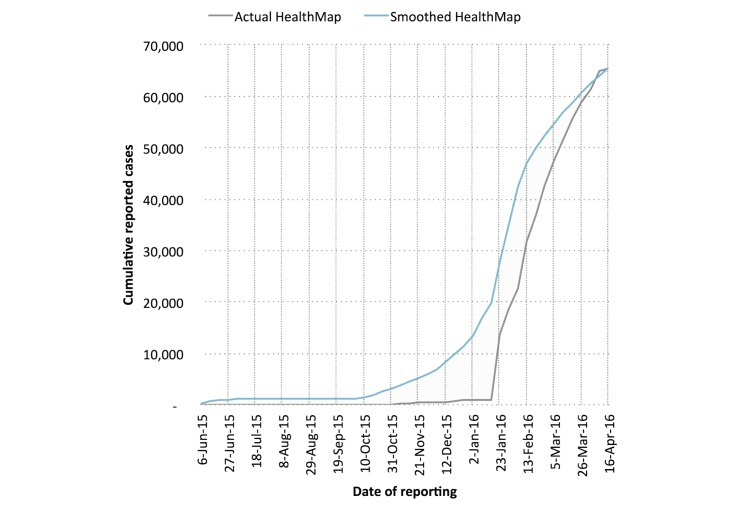
Cumulative reported case counts of Zika virus disease in Colombia were acquired via the HealthMap digital disease surveillance system. Linear smoothing was conducted to adjust the shape of the HealthMap cumulative case curve using Google search data. Traditional surveillance data on Zika virus disease were obtained from weekly Instituto Nacional de Salud (INS) epidemiological bulletin publications. The Incidence Decay and Exponential Adjustment (IDEA) model was used to estimate R0 and Robs for both data sources.
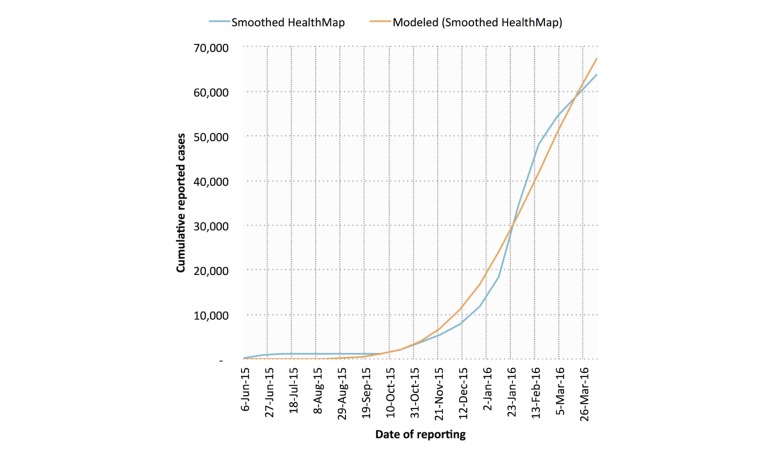
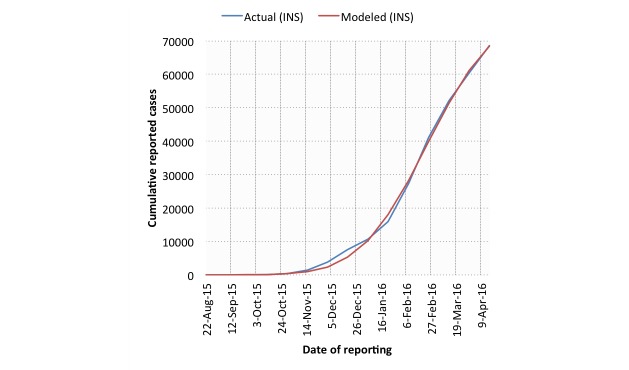
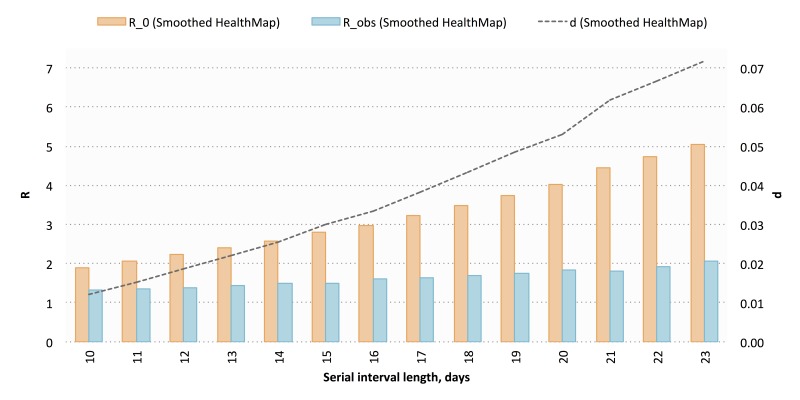
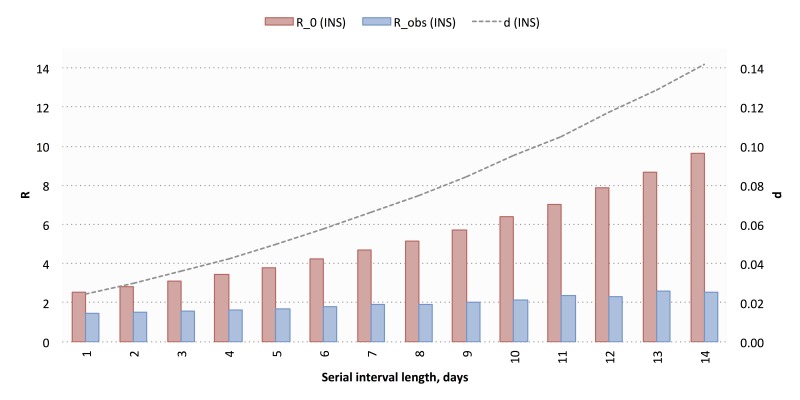
Using the digital (smoothed HealthMap) data, we estimated a mean R0 of 2.56 (range 1.42-3.83) and a mean Robs of 1.80 (range 1.42-2.30). The traditional (INS) data yielded a mean R0 of 4.82 (range 2.34-8.32) and a mean Robs of 2.34 (range 1.60-3.31).
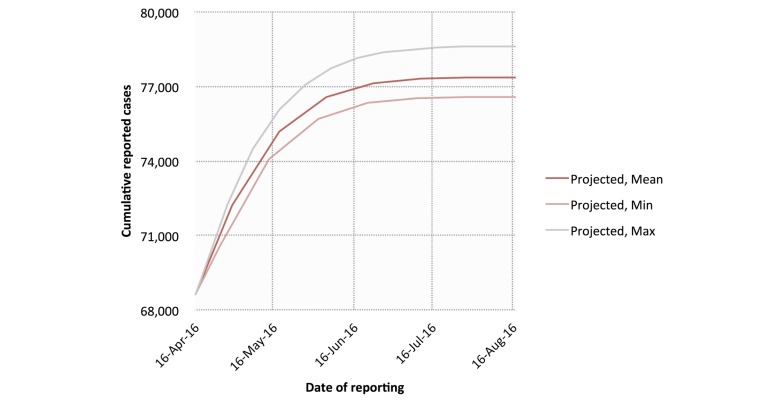
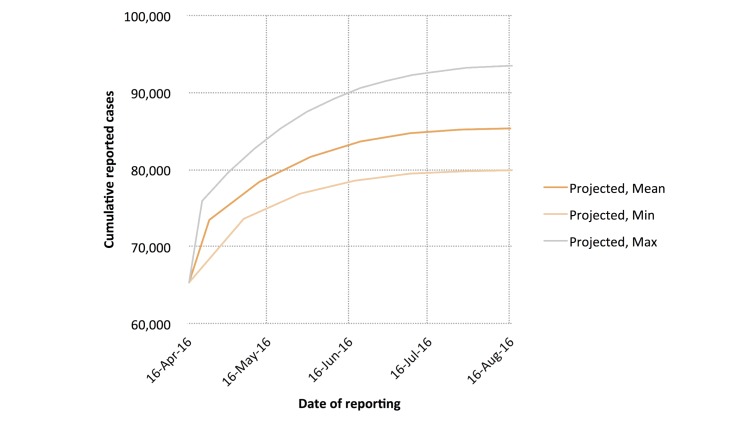
Although modeling using the traditional (INS) data yielded higher R estimates than the digital (smoothed HealthMap) data, modeled ranges for Robs were comparable across both data sources. As a result, the narrow range of possible case projections generated by the traditional (INS) data was largely encompassed by the wider range produced by the digital (smoothed HealthMap) data. Thus, in the absence of traditional surveillance data, digital surveillance data can yield similar estimates for key transmission parameters and should be utilized in other Zika virus-affected countries to assess outbreak dynamics in near real time.
中美洲和南美洲约有 40 个国家发生了寨卡病毒的本地媒介传播,迄今为止,全球报告的寨卡病毒病总病例数已接近 30 万例。迄今为止,该地区寻求治疗的病例中,哥伦比亚报告的病例超过 7 万例。
在本文中,我们使用 HealthMap 和 Google Trends 的非传统数字疾病监测数据,针对哥伦比亚寨卡病毒病的基本繁殖数(R0)和观察繁殖数(Robs)开发接近实时的估计值。然后,我们将结果与传统的基于医疗保健的疾病监测数据进行验证。
通过 HealthMap 数字疾病监测系统获取哥伦比亚寨卡病毒病的累积报告病例数。使用 Google 搜索数据对 HealthMap 累积病例曲线的形状进行线性平滑处理。从每周 Instituto Nacional de Salud(INS)流行病学公报出版物中获取寨卡病毒病的传统监测数据。使用发病率衰减和指数调整(IDEA)模型分别对两种数据源进行 R0 和 Robs 的估计。
使用数字(平滑的 HealthMap)数据,我们估计出平均 R0 为 2.56(范围 1.42-3.83),平均 Robs 为 1.80(范围 1.42-2.30)。传统(INS)数据得出的平均 R0 为 4.82(范围 2.34-8.32),平均 Robs 为 2.34(范围 1.60-3.31)。
虽然使用传统(INS)数据进行建模得出的 R 估计值高于数字(平滑的 HealthMap)数据,但 Robs 的模型范围在两个数据源之间是可比的。因此,传统(INS)数据生成的病例预测的狭窄范围主要被数字(平滑的 HealthMap)数据生成的更广泛范围所包含。因此,在缺乏传统监测数据的情况下,数字监测数据可以为关键传播参数提供类似的估计值,并且应该在其他寨卡病毒流行的国家中使用,以便实时评估疫情动态。