Masaki Charles, Sharpley Ann L, Cooper Charlotte M, Godlewska Beata R, Singh Nisha, Vasudevan Sridhar R, Harmer Catherine J, Churchill Grant C, Sharp Trevor, Rogers Robert D, Cowen Philip J
Department of Psychiatry, University of Oxford, Warneford Hospital, Oxford, OX3 7JX, UK.
Department of Pharmacology, University of Oxford, Mansfield Road, Oxford, OX1 3QT, UK.
Psychopharmacology (Berl). 2016 Jul;233(14):2655-61. doi: 10.1007/s00213-016-4319-5. Epub 2016 Jun 2.
Lithium remains the most effective treatment for bipolar disorder and also has important effects to lower suicidal behaviour, a property that may be linked to its ability to diminish impulsive, aggressive behaviour. The antioxidant drug, ebselen, has been proposed as a possible lithium-mimetic based on its ability in animals to inhibit inositol monophosphatase (IMPase), an action which it shares with lithium.
The aim of the study was to determine whether treatment with ebselen altered emotional processing and diminished measures of risk-taking behaviour.
We studied 20 healthy participants who were tested on two occasions receiving either ebselen (3600 mg over 24 h) or identical placebo in a double-blind, randomized, cross-over design. Three hours after the final dose of ebselen/placebo, participants completed the Cambridge Gambling Task (CGT) and a task that required the detection of emotional facial expressions (facial emotion recognition task (FERT)).
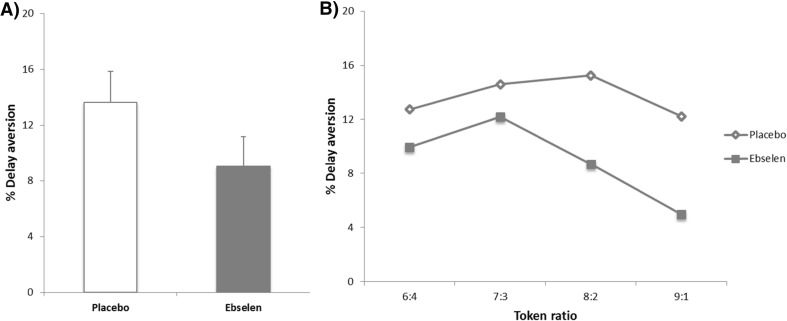
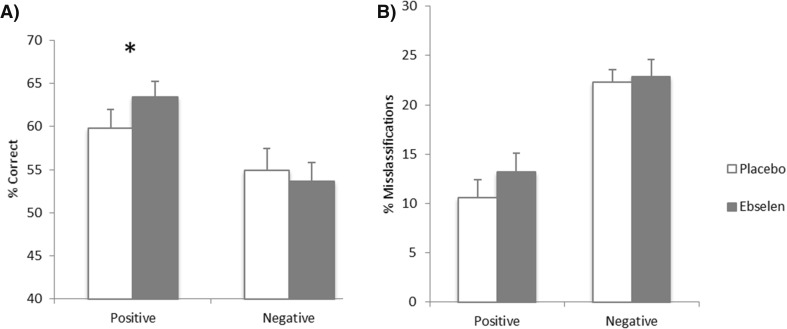
On the CGT, relative to placebo, ebselen reduced delay aversion while on the FERT, it increased the recognition of positive vs negative facial expressions.
The study suggests that at the dosage used, ebselen can decrease impulsivity and produce a positive bias in emotional processing. These findings have implications for the possible use of ebselen in the disorders characterized by impulsive behaviour and dysphoric mood.
锂盐仍然是治疗双相情感障碍最有效的药物,并且对降低自杀行为也有重要作用,这一特性可能与其减少冲动、攻击行为的能力有关。抗氧化药物依布硒啉,基于其在动物体内抑制肌醇单磷酸酶(IMPase)的能力,被认为可能是一种锂盐模拟物,它与锂盐有相同的这一作用。
本研究的目的是确定依布硒啉治疗是否会改变情绪加工并减少冒险行为指标。
我们研究了20名健康参与者,他们在双盲、随机、交叉设计中接受两次测试,分别服用依布硒啉(24小时内3600毫克)或相同的安慰剂。在最后一剂依布硒啉/安慰剂服用后三小时,参与者完成剑桥赌博任务(CGT)和一项需要识别面部情绪表情的任务(面部情绪识别任务(FERT))。
在CGT上,相对于安慰剂,依布硒啉降低了延迟厌恶;而在FERT上,它增加了对正面与负面面部表情的识别。
该研究表明,在所使用的剂量下,依布硒啉可以降低冲动性,并在情绪加工中产生积极偏向。这些发现对于依布硒啉在以冲动行为和烦躁情绪为特征的疾病中的可能应用具有启示意义。