Rodrigues M A, Probst C E, Beaton-Green L A, Wilkins R C
Amnis - MilliporeSigma, Seattle, WA, 98119.
Environmental and Radiation Health Sciences Directorate, Health Canada, Ottawa, Ontario, Canada.
Cytometry A. 2016 Jul;89(7):653-62. doi: 10.1002/cyto.a.22887. Epub 2016 Jun 6.
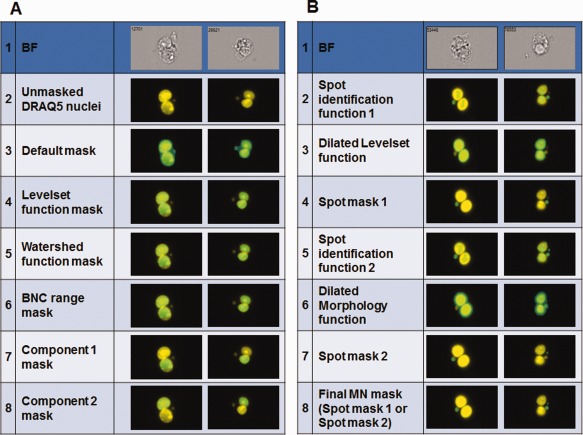
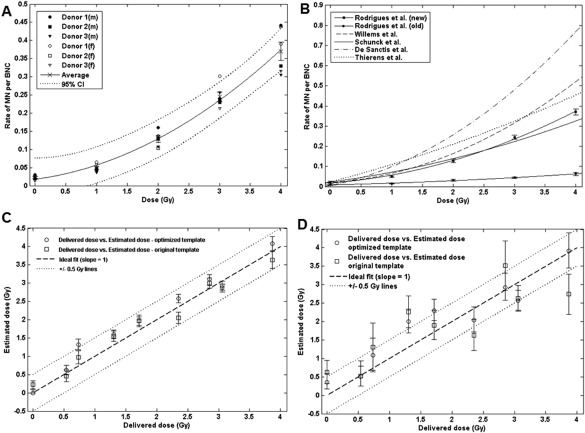
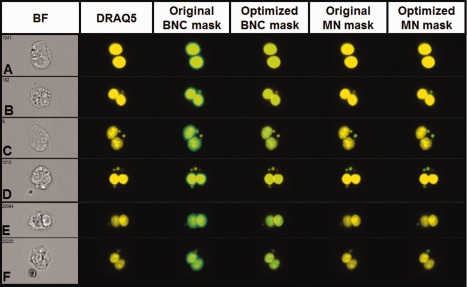
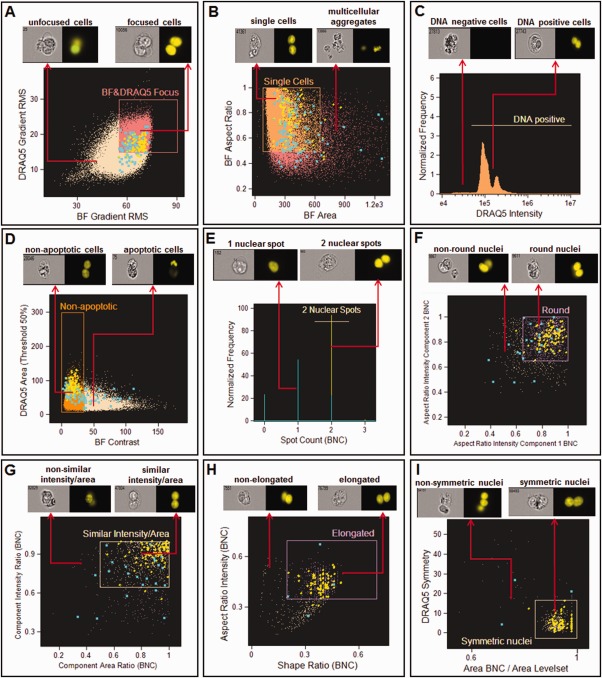
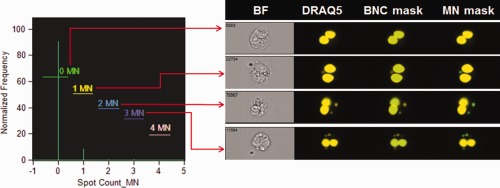
The cytokinesis-block micronucleus (CBMN) assay is a well-established technique that can be employed in triage radiation biodosimetry to estimate whole body doses of radiation to potentially exposed individuals through quantitation of the frequency of micronuclei (MN) in binucleated lymphocyte cells (BNCs). The assay has been partially automated using traditional microscope-based methods and most recently has been modified for application on the ImageStream(X) (IS(X) ) imaging flow cytometer. This modification has allowed for a similar number of BNCs to be automatically scored as compared to traditional microscopy in a much shorter time period. However, the MN frequency measured was much lower than both manual and automated slide-based methods of performing the assay. This work describes the optimized analysis template which implements newly developed functions in the IDEAS(®) data analysis software for the IS(X) that enhances specificity for BNCs and increases the frequency of scored MN. A new dose response calibration curve is presented in which the average rate of MN per BNC is of similar magnitude to those presented in the literature using automated CBMN slide scoring methods. In addition, dose estimates were generated for nine irradiated, blinded samples and were found to be within ±0.5 Gy of the delivered dose. Results demonstrate that the improved identification accuracy for MN and BNCs in the IS(X) -based version of the CBMN assay will translate to increased accuracy when estimating unknown radiation doses received by exposed individuals following large-scale radiological or nuclear emergencies. © 2016 The Authors. Cytometry Part A published by Wiley Periodicals, Inc. on behalf of ISAC.
胞质分裂阻滞微核(CBMN)试验是一种成熟的技术,可用于辐射生物剂量学的分类,通过定量双核淋巴细胞(BNC)中的微核(MN)频率来估计潜在受照个体的全身辐射剂量。该试验已部分采用传统的基于显微镜的方法实现自动化,最近还针对ImageStream(X)(IS(X))成像流式细胞仪进行了改进。这种改进使得与传统显微镜相比,能够在更短的时间内自动对相似数量的BNC进行评分。然而,所测量的MN频率远低于基于载玻片的手动和自动试验方法。这项工作描述了优化的分析模板,该模板在IS(X)的IDEAS(®)数据分析软件中实现了新开发的功能,增强了对BNC的特异性并提高了MN的评分频率。给出了一条新的剂量响应校准曲线,其中每个BNC的MN平均发生率与使用自动CBMN载玻片评分方法的文献报道的发生率相似。此外,还对9个经辐照的盲法样本进行了剂量估计,发现其与所给予的剂量相差在±0.5 Gy以内。结果表明,在基于IS(X)的CBMN试验中对MN和BNC的识别准确性提高,将转化为在估计大规模放射或核紧急情况后受照个体所接受的未知辐射剂量时更高的准确性。© 2016作者。《细胞分析A部分》由Wiley Periodicals, Inc.代表ISAC出版。